


Advertise in Elements
Media Kit and Thematic Preview
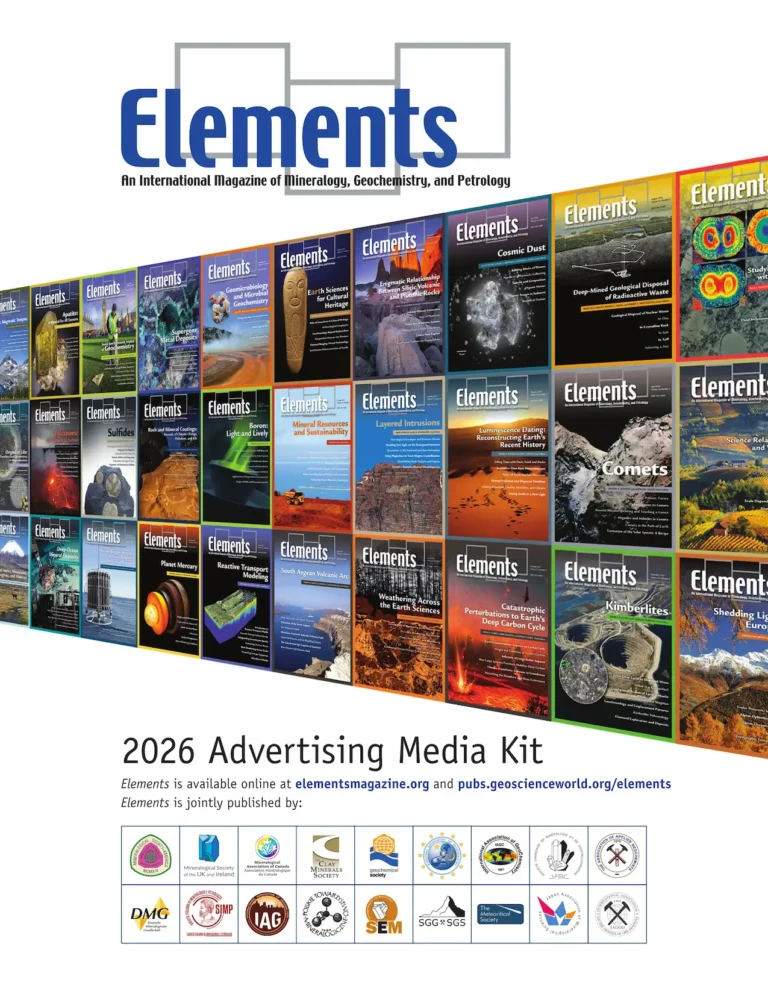
- **NEW** 2026 Media Kit – Advertising Rates and Information for 2026
- Ad Artwork Specifications
Elements Readership
Elements readers work for universities; research institutions; federal, state and local government agencies; corporations; and non-profit organizations.
Our readers interests span the diverse disciplines of mineralogy, petrology, and geochemistry … from the complex molecular interactions at the mineral-water-biology interface … to the formation and dynamics of our Earth from crust to core … to the environmental impact of contaminants on our soils, water, and atmosphere … to the cosmic studies of our Solar System.
Benefits of Advertising in Elements
By advertising in Elements, you profit in so many ways.
- Elements gives you direct access to a high-quality audience: a targeted group of more than 16,000 mineralogists, geochemists, and petrologists.
- Elements provides worldwide exposure to your products. We ship copies in 100+ countries.
- Elements provides a digital presence for your products and company.
- Elements has a long shelf life: people keep their issues for reference and use it in the classroom, so your ad keeps working for you.
- Elements covers the groundbreaking topics in the Earth sciences. These are often linked to advances in technology. Let our readers know what is coming up next and build your brand recognition.
- Ad space in Elements is only 10 to 12% of the total content: your ad is not drowned among others.
- Elements offers ad sizes to fit all budgets.
- You are associated with an exciting venture of the mineralogy, geochemistry and petrology community.
How to Advertise with Elements?
Contact our editorial team if you have any questions or if you wish to discuss potential advertising with us.
Esther Posner
Elements Magazine
Bayreuth, Germany
Phone: +49-151-6859-2868
E-mail: editor@elementsmagazine.org
Distribution demographics (December 2024)
| MEMBERSHIP TYPE | # MEMBERS |
|---|---|
| Print + Online | 14,464 |
| Online Only | 2,156 |
| Combined Membership | 16,620 |
Distribution by region (December 2024)
| REGION | # OF COPIES | # OF COUNTRIES |
|---|---|---|
| Africa & Middle East | 191 | 24 |
| Asia | 2478 | 21 |
| Europe | 6924 | 39 |
| Latin & South America & Caribbean | 225 | 10 |
| North America | 4545 | 5 |
| Oceania | 605 | 3 |
Elements is distributed in 108 countries (35 with more than 25 members).
2026 Advertising Rates (in US$)
| SIZE | PRICE |
|---|---|
| Full page – back cover* | $2,600 |
| Full page – inside covers* | $2,400 |
| Full page* | $2,150 |
| Half page | $1,490 |
| Third page | $1,075 |
| Quarter page | $825 |
| Eighth page | $425 |
***Discounts available with purchase of 3 or more ads in a calendar year.***
*All full page ads include a complementary two-month online ad at elementsmagazine.org
Print Publication Schedule and Advertising Deadlines for 2026
| ISSUE | Theme | Ad Reservation Deadline | ARTWORK DUE |
|---|---|---|---|
| February 2026 (vol. 22, no. 1) | Earth’s Carbon Cycle Thermostat: Beyond the Textbook Model | 15 December 2025 | 1 January 2026 |
| April 2026 (vol. 22, no. 2) | Discovery of Volatiles on the Moon: Renaissance in Lunar Exploration Science & Beyond | 15 February 2026 | 1 March 2026 |
| June 2026 (vol. 22, no. 3) | Mineral Physics Applied to Earth and Planetary Sciences | 15 April 2026 | 1 May 2026 |
| August 2026 (vol. 22, no. 4) | Quartz | 15 June 2026 | 1 July 2026 |
| October 2026 (vol. 22, no. 5) | Stromatolites – Deep Time Geochemical Archives of Microbial Ecosystems of Earth | 15 August 2026 | 1 September 2026 |
| December 2026 (vol. 22, no. 6) | Zeolites | 15 October 2026 | 1 November 2026 |