


v22n4 From The Editor
By Tom Sisson, Carol Frost, Penny King, Matt Kohn, and Esther Posner | August 2026
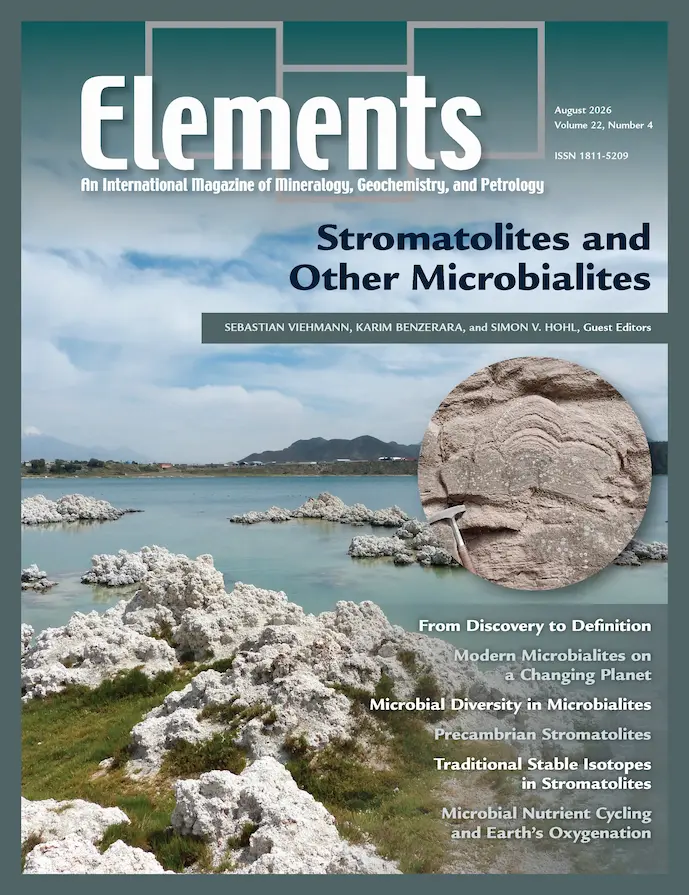
Stromatolites and other microbialites are remarkable bio-mineralising structures that are abundant throughout Earth’s history. Formed in the presence of microbial communities, these bio-sedimentary rocks provide a continuous record of microbial evolution over the last 3.5 billion years. Thus, stromatolites provide unique archives of microbial habitats, revealing their interactions and coevolution with Earth’s continents, atmosphere, and life.
v22n3 From The Editor
By Tom Sisson, Carol Frost, Penny King, and Esther Posner | June 2026
Quartz (trigonal, low-temperature α-quartz) is the most important silica polymorph in nature and occurs as a common constituent of magmatic, metamorphic, and sedimentary rocks. In modern industry, both single crystals and polycrystalline quartz materials are used, for example, as highpurity natural or synthetic quartz crystals, quartz sands, refractory materials, or as an ore for silicon metal crucial for photovoltaics, semiconductor, and steel production, and found in gyroscopes of satellites, special lenses, precision mirror substrates, and other high-tech equipment.
v22n2 From The Editor
By Tom Sisson, Carol Frost, Penny King, and Esther Posner | April 2026
This is a topic that has become a major field of research in mineral sciences, but it is not taught as such in typical undergraduate Earth science curricula. The chapters in this issue attempt to convey some of the exciting developments in the field through the lens of five of the classical branches of physics—mechanics, heat, light, electricity, and magnetism. The hope is that it will attract more scientists to the interface of physics and minerals, point them toward the state of the art, and encourage them to transcend traditional disciplinary boundaries in general.
v22n1 From The Editor
By Sylvie Demouchy | February 2026
The Elements Executive Committee (EC) plays a vital role in the magazine’s governance. Representing all 18 participating societies, the EC ensures that every society has a voice in decision-making related to the operational and financial well-being of Elements. The EC also approves editor appointments and major expenditures, working closely with the Principal Editors and Executive Editor to support the continued success of the magazine.
v22n4 From The Editor
By Tom Sisson, Carol Frost, Penny King, Matt Kohn,
and Esther Posner | August 2026
Stromatolites and other microbialites are remarkable bio-mineralising structures that are abundant throughout Earth’s history. Formed in the presence of microbial communities, these bio-sedimentary rocks provide a continuous record of microbial evolution over the last 3.5 billion years. Thus, stromatolites provide unique archives of microbial habitats, revealing their interactions and coevolution with Earth’s continents, atmosphere, and life.