


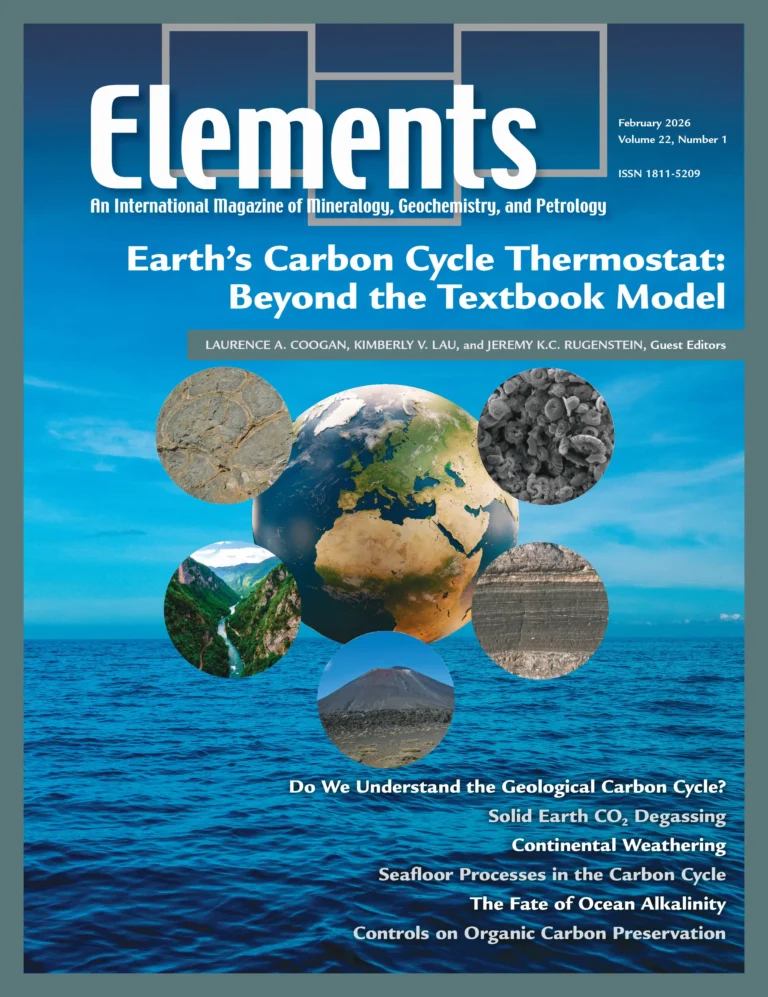
February 2026 – Volume 22 Number 1
GUEST EDITORS
Laurence A. Coogan, Kimberly V. Lau, and Jeremy K.C. Rugenstein
PRINCIPAL EDITOR
Sumit Chakraborty
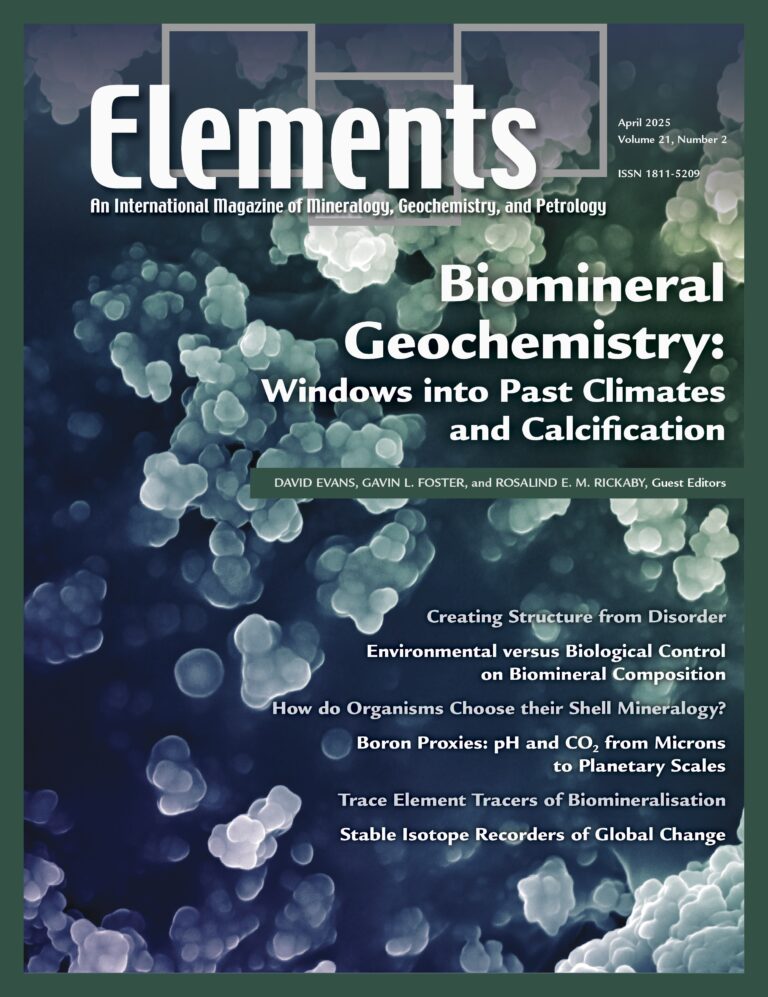
April 2025 – Volume 21 Number 2
GUEST EDITORS
David Evans, Gavin L. Foster, and Rosalind E. M. Rickaby
PRINCIPAL EDITOR
Sumit Chakraborty
Earth’s geological carbon cycle is central to both climate and life. It is generally considered to act as a “thermostat,” regulating climate and preventing global mean temperatures from fluctuating wildly. The textbook model of this regulation involves variations in solid Earth degassing rates, leading to changes in atmospheric CO2 concentrations, surface temperature, and precipitation; in turn, these modulate the rate of alkalinity production via continental silicate weathering, which changes the rate of carbonate mineral formation, thereby rebalancing the carbon cycle. The articles in this issue highlight many alternative or additional mechanisms that may be equally or more important in regulating Earth’s carbon cycle. This issue highlights advances in our understanding of the regulation of the long-term carbon cycle, but also emphasizes the large uncertainties that still remain for both the modern day and in the past: what is the rate of carbon degassing? What are the relative roles of continental and seafloor weathering in regulating the carbon cycle? What fraction of the alkalinity added to the ocean plays a role in the carbon cycle? What role does organic carbon play in the carbon cycle? We are still far from having a complete understanding of the fundamental controls of Earth’s life-support system, but we clearly need to move beyond the textbook model.
Marine calcium carbonate biominerals, especially the shells and skeletons produced by molluscs, corals, and the immeasurably numerous calcifying phytoplankton and zooplankton, are of both societal and environmental importance for two key reasons. Firstly, the mineralised remains of these organisms are one of the largest longterm sinks of carbon on Earth’s surface. Secondly, and perhaps more practically, the (trace) element and isotopic composition of these biominerals probably represents the most widely applied tool for quantitatively reconstructing past environmental conditions on timescales from days to millions of years. It has been known for some time that the processes of biomineralisation imprint on these ‘proxy’ systems, shifting their behaviour away from thermodynamic equilibrium, such that they typically require empirical calibration to an environmental variable of interest. The generally poor understanding of the physics and chemistry of these biomineralisation processes therefore introduces uncertainty both into our palaeo reconstructions and provides significant limits to our ability to accurately predict the future response of the marine carbon cycle to anthropogenic ocean acidification. However, it has recently become apparent that this biological imprint also offers a unique opportunity—skeletal and shell geochemical information can be leveraged to constrain various aspects of physiology including the biomineralisation process to noninvasively understand the organisms themselves. In this issue of Elements, a series of articles showcase how lowtemperature proxy systems can offer insights into both paleoenvironmental change, as well as the mechanistic processes involved in biomineral formation. Ultimately, our aim is to highlight how the two fields could be more closely connected via research into the controls on biomineral chemistry.
The Variscan orogen formed between 380 and 300 million years ago through several accretionary and collisional cycles, culminating with the construction of the Pangea supercontinent. This process occurred via sequential opening and closure of oceanic basins, synchronous detachment of Gondwana derived continental ribbons, and their outboard amalgamation onto the Laurussia margin. The Variscan orogen is rather unique compared with other orogenic belts on Earth: its overthickened and dominantly magmatic crust in the central belt, surprisingly minor mantle involvement in the magmatic and geodynamic processes, coherent and pulsed magmatism along the collision suture, and its complex accretionary history. Because its final product, Pangea, is the youngest and best-understood supercontinent on Earth, the Variscan orogeny offers clues for understanding the mechanisms of supercontinent formation.