

Parting Shots
QUARTZ VAR. COTTERITE: A PERSONAL ODYSSEY; A UNIQUE MYSTERY
By Patrick Roycroft | June 2026
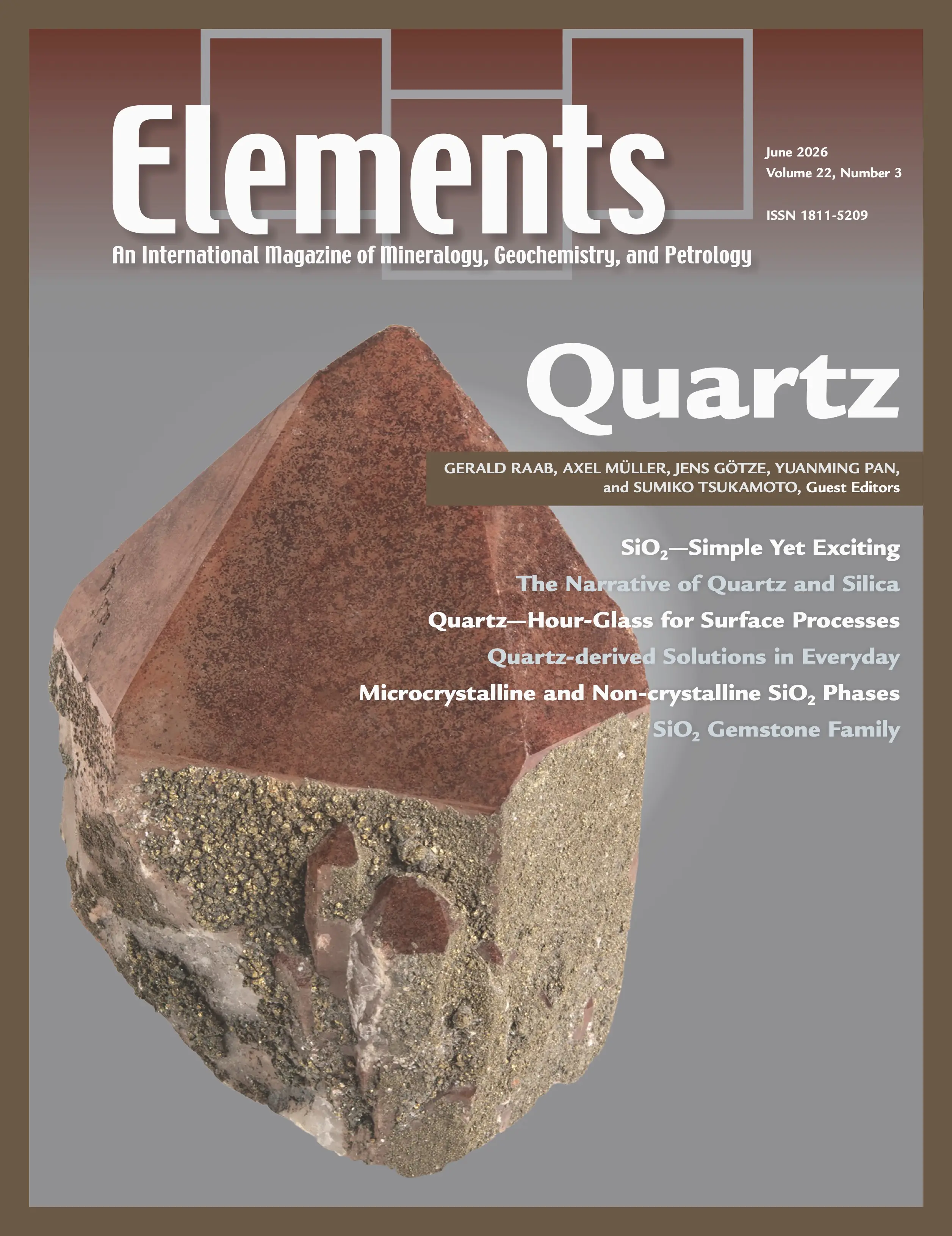
Cotterite was discovered around 1875 by a ‘Miss Cotter’ in the rural Irish townland of Rockforest East in County Cork. Only two, short, 19th century papers were written on the subject: one in 1877 by Richard Moss of the Royal Dublin Society, and the other in 1878 by Robert Harkness, a geology professor at Queen’s College Cork, who named it ‘cotterite’ in honour of its discoverer, Miss Cotter. Who Miss Cotter was, however, was never stated.
REVISING THE TEXTBOOK ON THE GEOLOGIC CARBON CYCLE AND CLIMATE REGULATION
By Lee R. Kump | February 2026
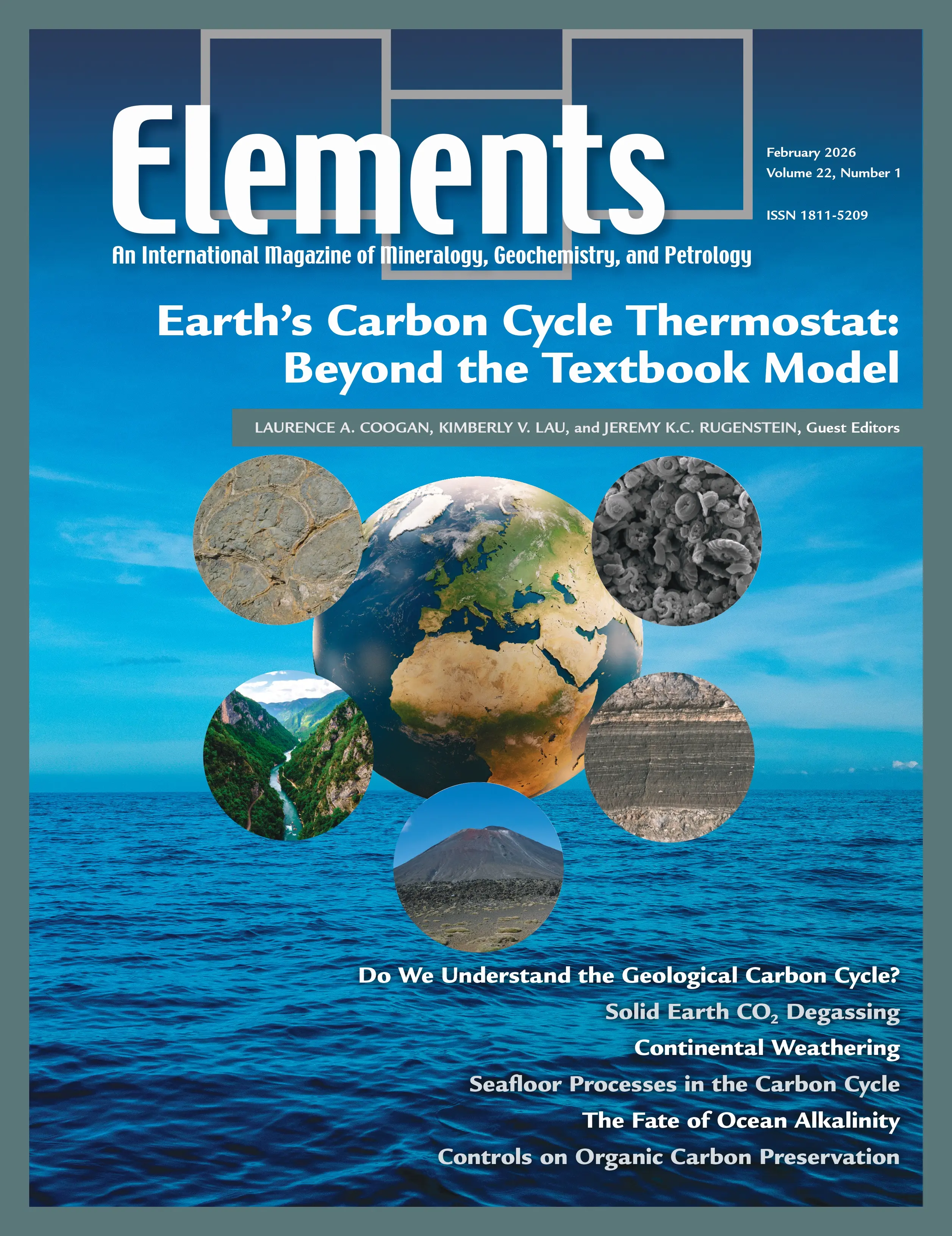
Signs that one’s science is “mature” include when it is referenced as “textbook,” and, perhaps, when one is asked to write a Parting Shots for Elements! In the immortal words of Monty Python’s Terry Gilliam, although “I’m not dead,” at least my science is not quite; I’ve just been a dean for eight years. Seriously, it is wise to challenge “textbook science,” and this issue demonstrates that wisdom.
CALL TO ACTION
By Kerstin Lehnert | June, 2021
We all rely on geochemical data produced by our colleagues, making digital geochemical data systems essential for accessing, preserving, and reusing shared datasets. These systems not only safeguard data for the long term but also provide critical curatorial tasks—ensuring that data can be easily found online, reused efficiently with confidence, and that proper credit is given to the original authors. Although these services benefit the entire community and are fundamental for innovative research in our field, their continuity is under serious threat due to uncertain funding.
Remembrance of Carbonatites Past
By Alan R. Woolley | October, 2021
The Oxford English Dictionary defines ‘vector’ as a quantity having direction as well as magnitude, and ‘scalar’ as a quantity having only magnitude, not direction. Much geological research starts with fieldwork, manifestly a vector activity. In Figure 1A, the geologists are exploring the intersection of a complex, 3-D body, the layered Klokken syenite, a 4 × 3 km igneous intrusion in the Gardar alkaline province of SW Greenland, with a mountainous 3-D land-surface. I described the unusual layering in Elements v10n1 (Parsons 2014). The igneous rocks were emplaced 1,166.3 ± 1.2 million years ago, and the 650 m of 3-D topography, which reveals the inner workings of the magma chamber, was carved by the advance and retreat of the mighty Greenland ice sheet in the last few thousand years. Only the age (a U–Pb age from baddelyite, ZrO2) is a scalar quantity.