
v22n1 From The Editor
By Sylvie Demouchy | February 2026
The Elements Executive Committee (EC) plays a vital role in the magazine’s governance. Representing all 18 participating societies, the EC ensures that every society has a voice in decision-making related to the operational and financial well-being of Elements. The EC also approves editor appointments and major expenditures, working closely with the Principal Editors and Executive Editor to support the continued success of the magazine.
v21n6 From The Editor
By Sumit Chakraborty, Tom Sisson, Carol Frost, Penny King, and Esther Posner | December, 2025
As 2025 draws to a close, Elements is grateful to celebrate another successful year of literary rigor and collaboration in the geosciences. This has been a particularly exciting time as 2025 marked Elements’ 20th anniversary—two remarkable decades of connecting our global geoscience community through the shared language of mineralogy, geochemistry, and petrology. Highlights of the year included gallery exhibits, special sessions, and other activities at Goldschmidt 2025 in Prague (Czech Republic) and IAGC-3 in Cagliari (Italy), where so many of you joined to reflect on Elements’ journey—from its bold inception in 2005 to its continued evolution as a leading society publication in the natural sciences.
v21n5 From The Editor
By Sumit Chakraborty, Tom Sisson, Carol Frost, Penny King, and Esther Posner | October, 2025
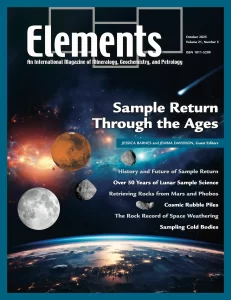
The 20th anniversary celebration for Elements at Goldschmidt 2025 in Prague, Czech Republic was a resounding success, including a large gallery exhibit; an envelope-pushing Special Session, “Elements at 20 Years: Past Successes and Future Directions” and Townhall Discussion; and a jubilant reception featuring delicious Czech catering, a lively Franconian band, and spirited dancing by conference attendees young and old.
v21n4 From The Editor
By Janne Blichert-Toft, Sumit Chakraborty, Tom Sisson, Carol Frost, and Esther Posner | August, 2025
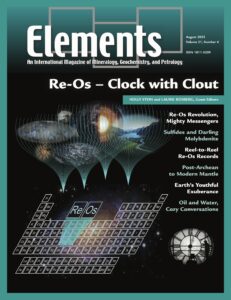
This issue of Elements marks the final theme to be published under the tremendous leadership of Janne Blichert-Toft (CNRS, Ecole Normale Supérieure de Lyon). Janne has served Elements as Principal Editor of Geochemistry since 2022, and will be replaced this year by Carol Frost (University of Wyoming, USA). In addition to this issue of “Re-Os – Clock with Clout” (vol. 21, no. 4), Janne also guided the successful publication of five other popular geo-educational themes in Elements, including “Cement and Concrete: From the Romans to Mars” (October 2022; vol. 18, no. 5), “Alkaline Lakes” (February 2023; vol. 19, no. 1), “Geometallurgy” (December 2023; vol. 19, no. 6), “Cratons to Continents” (June 2024; vol. 20, no. 3), and “Himalayan Leucogranites” (December 2024; vol. 20, no. 6).
v21n3 From The Editor
By Janne Blichert-Toft, Sumit Chakraborty, Tom Sisson, Carol Frost, and Esther Posner | June, 2025
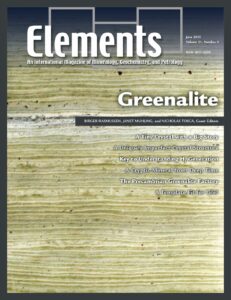
The early Earth, like countless other wet rocky planets, was predestined to make greenalite given the environments and conditions that prevailed in the ancient hydrosphere. The magma-driven circulation of seawater through ancient mafic/ultramafic crust and subsequent venting of hydrothermal fluids into oxygen-free oceans produced ideal conditions for the formation of vast plumes of nanoparticulate greenalite. This process is now seen by some as a key driver in the deposition of banded iron formations, chemical sedimentary rocks ubiquitous on the young Earth and host-rocks of most of the world’s iron deposits. At first glance, greenalite is easily overlooked. Indeed, its minute size and inconspicuous optical properties allowed its true extent to go unnoticed until the use of nanoscale microanalysis in the last decade.
v21n2 From The Editor
By Janne Blichert-Toft, Sumit Chakraborty, Tom Sisson, Carol Frost, and Esther Posner | April, 2025
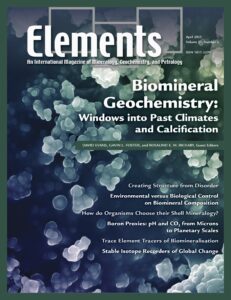
Marine calcium carbonate biominerals, especially the shells and skeletons produced by molluscs, corals, and the immeasurably numerous calcifying phytoplankton and zooplankton, are of both societal and environ mental importance for two key reasons. Firstly, the mineralised remains of these organisms are one of the largest longterm sinks of carbon on Earth’s surface. Secondly, and perhaps more practically, the (trace) element and isotopic composition of these biominerals probably represents the most widely applied tool for quantitatively reconstructing past environmental conditions on timescales from days to millions of years. It has been known for some time that the processes of biomineralisation imprint on these ‘proxy’ systems, shifting their behaviour away from thermodynamic equilibrium, such that they typically require empirical calibration to an environmental variable of interest.
v21n1 From The Editor
By Sumit Chakraborty | February, 2025
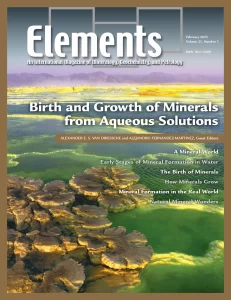
This issue of Elements is dedicated to the fascinating topic of mineral nucleation and growth, in which various authors explore the emerging ideas of non-classical nucleation processes and how they are altering our classical view of mineral formation processes. Contributors emphasize how these processes, including precursor phases, amorphous intermediates, and multi-step pathways, challenge conventional models of mineral formation. Evidence both from experimental studies and theoretical models is presented, showing that nucleation often occurs via disordered or non-equilibrium states, where clusters or aggregates of molecules form before evolving into well-ordered crystalline structures.