


WE’VE COME A LONG WAY
By Tim Drever | December, 2010
The theme of this issue makes me think back on the relationship between geochemistry and soil science and how it has evolved. When I started working on weathering processes and clay mineral formation back in the 1960s, there was remarkably little communication between geochemists and soil scientists. From a geochemist’s perspective, soil scientists (with a few very notable exceptions) were not interested in the same set of questions as us. They were concerned with nutrients and organic matter, whereas geochemists studied silicate mineralogy and major element chemistry. We had little interest in nutrients and paid almost no attention to biology. Geochemistry, in this context, was an inorganic science. Furthermore, to geochemists, the terminology of soil classification, in the United States at least, seemed an impenetrable barrier.
THANKS, DR. GIBBS
By Hap McSween | October, 2010
When I was first exposed to thermodynamics as an undergraduate, I felt like the kid who opened the balloon to see how it works: I wasn’t left with much. It seemed like smoke and mirrors. Why would anyone envision such an intangible and non-intuitive way to understand chemical reactions? And, who came up with this approach in the first place?
SOMETHING IN THE AIR
By David Vaughan | August, 2010
Very few mineralogists, geochemists or petrologists would regard airborne mineral particles (aerosols) as a part of their remit in terms of either research or teaching. Yet, as this issue of Elements magazine demonstrates very clearly, we “ground based” Earth scientists have much to contribute to this field of investigation. In particular, we have approaches, techniques and skills which are not generally available to atmospheric scientists, who, in most cases, come from backgrounds in pure physics or chemistry.
STRATEGIC OR BLUE SKY RESEARCH?
By Susan Stipp | June, 2010
As an academic scientist, I share concerns with colleagues about decreasing support for basic research. Governments are putting increasing pressure on research funding agencies to favour projects that promise to solve specific problems, to produce a product or a process that has economic value. Whether explicitly announced or subtly understated, the concept “from idea to invoice” rings from calls for proposals. From discussions with colleagues and from my own experience, I know this to be true in the US and Japan, at the European Commission, in the British funding bodies, for several Danish agencies, in other Scandinavian countries, in Switzerland, in Germany, and so on. Applications require scientists to put the right words in the box for economic impact.
HELL ON EARTH
By Hap McSween | April, 2010
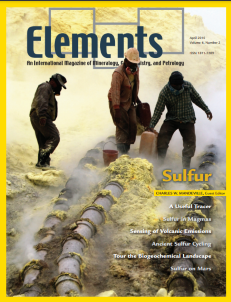
Sulfur was known to the alchemists as brimstone. The etymology of brimstone probably derives from the medieval English words birnen (to burn) and ston (stone). “Fire and brimstone” appears repeatedly in the Bible and Koran, denoting agents of divine wrath—witness the fate of the sinful residents of Sodom and Gemorrah. The Book of Revelations associates brimstone with hell. During the eighteenth century, preachers invoked the sulfurous imagery of hell so effectively that their messages about the final judgment came to be known as fire-and-brimstone sermons. It’s no wonder that sulfur has a bad image.
EVOLUTION AND EXTINCTION
By David J. Vaughan | February, 2010
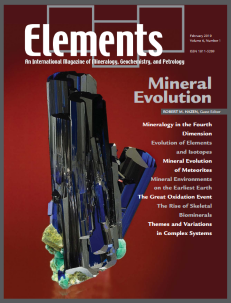
The subject matter of this issue of Elements, like many excellent ideas, will seem obvious to other scientists when put before them. Its elegance makes it appear simple. Mineral evolution provides a sense of progress, or at least of a progression from the simple to the complex, since the explosive beginnings of our universe. The idea of a process of ‘evolution’ that extends back in time for many billions of years before the emergence of any life form on Earth is particularly apt at a time when we have just celebrated the bicentenary of the birth of Charles Darwin, the man who essentially gave us biological evolution.