


1811-5209/25/0021-0264$2.50 DOI: 10.2138/gselements.21.4.264
Keywords: Sediment; oceans; lakes; climate; glaciation; large igneous provinces; bolide impact; crustal evolution; oxygenation; biological evolution; geologic timescale calibration.
INTRODUCTION
Given the unique organophile and chalcophile nature of its parent and daughter isotopes, the Re-Os isotope system holds unmatched value as a sedimentary geochronometer and geological tracer. Both Re and Os are soluble in oxygen- ated waters, but in anoxic environments, both metals are fixed by organic matter and sulfide minerals in organic-rich sediments (ORS). Closure of the Re-Os isotope system in ORS (no gain or loss of Re or Os from the sediment) occurs during or shortly after sediment deposition (Ravizza and Turekian 1989; Cohen et al. 1999). The decay of 187Reto 187Os between the time of deposition and today provides a clock that records the depositional age of ORS rocks (e.g., mudstones, black shales, marly carbonates). Re-Os ages from ORS rocks provide critical information on the timing and duration of geological events and processes, particu- larly for sedimentary sequences lacking biostratigraphy or U-Pb zircon ages from intercalated volcanic ash beds. The 187Os / 188Os187Os / 188Os at the time of deposition can be calculated for ORS (and other sediment types such as Fe-Mn crusts) from a Re-Os isochron diagram or from an individual sample of known age (see Toolkit Fig. 6). The sediments inherit this initial 187Os / 188Os directly from the local water column. Osmium isotopes, therefore, provide tracer information for processes that alter seawater chemistry, such as climate change, tectonic cycles, bolide impacts, and large igneous province volcanism.
The founding principles for Re-Os geochronology of ORS rocks were established by Ravizza and Turekian (1989). Results at this time were, however, severely limited by low-precision analytical methods. A decade later, results using negative thermal ionization mass spectrometry (NTIMS) combined with Carius-tube digestion in inverse aqua regia (normal aqua regia has a 1:3 ratio of nitric acid and hydrochloric acid, respectively; inverse aqua regia has a 2:1 or 3:1 ratio dominated by nitric acid) produced Re-Os depositional ages with precisions of ±3% -8% for Jurassic shales from the UK (Cohen et al. 1999). This study used only hydrocarbon immature shales, assuming hydrocarbon maturation would disturb the Re-Os isotope system, an assumption later shown to be unfounded (Creaser et al. 2002). A major development arose in 2003 with the discovery that sample digestion using CrO3 – H2SO4 selectively liberates hydrogenous Re and Os held within organic matter and sulfide minerals, thereby minimizing release of non-hydrogenous Re and Os from detrital material (Selby and Creaser 2003). Since then, high-precision and demonstrably accurate Re-Os ages from ORS rocks have been produced by multiple laboratories worldwide, with application to problems of global stratigraphic correlation, faunal correlation, geological timescale calibration, paleoenvironmental change, and sedimentary basin evolution. As a result of over 35 years of development, Re-Os ages from ORS rocks, along with U-Pb and Ar-Ar ages from igneous rocks and minerals, are now used as reference ages in the geologic time scale (representation of time based on Earth’s rock record using chronostratigraphy and geochronology).
SEDIMENTARY TIMEKEEPER
Getting the Clock from a Sedimentary Rock: Importance of Sampling Strategies
Precise and accurate geochronology using a Re-Os isochron diagram (see Toolkit Fig. 6) begins with thoughtful sample selection. The goal is to identify ORS rocks that have maintained a closed Re-Os isotope system between the time of deposition and today. Drill core is preferred over outcrop samples to minimize post-depositional loss of Re and Os from oxidative weathering. Still, high-quality Re-Os ages have been obtained from some less-weathered outcrops, road cuts, quarry walls, and mines. Geochemistry (redox- sensitive metals and sulfur abundances) and Rock-Eval pyrolysis indices (laboratory process invented in the 1970s at the French Institute of Petroleum to characterize organic carbon and mineral carbon contents of rocks and soils) are used to determine if outcrop samples are likely to yield Re-Os ages (Georgiev et al. 2012).
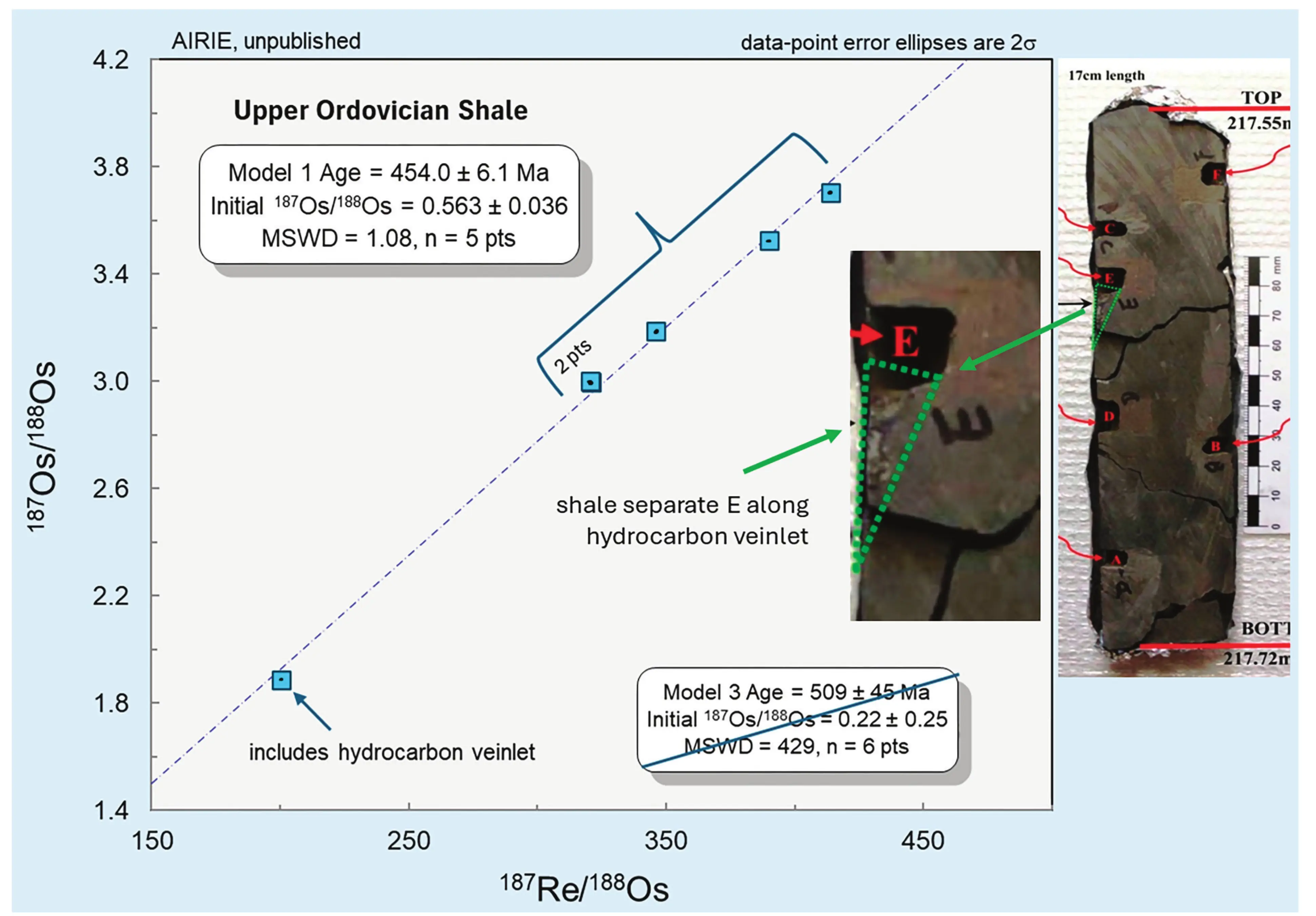
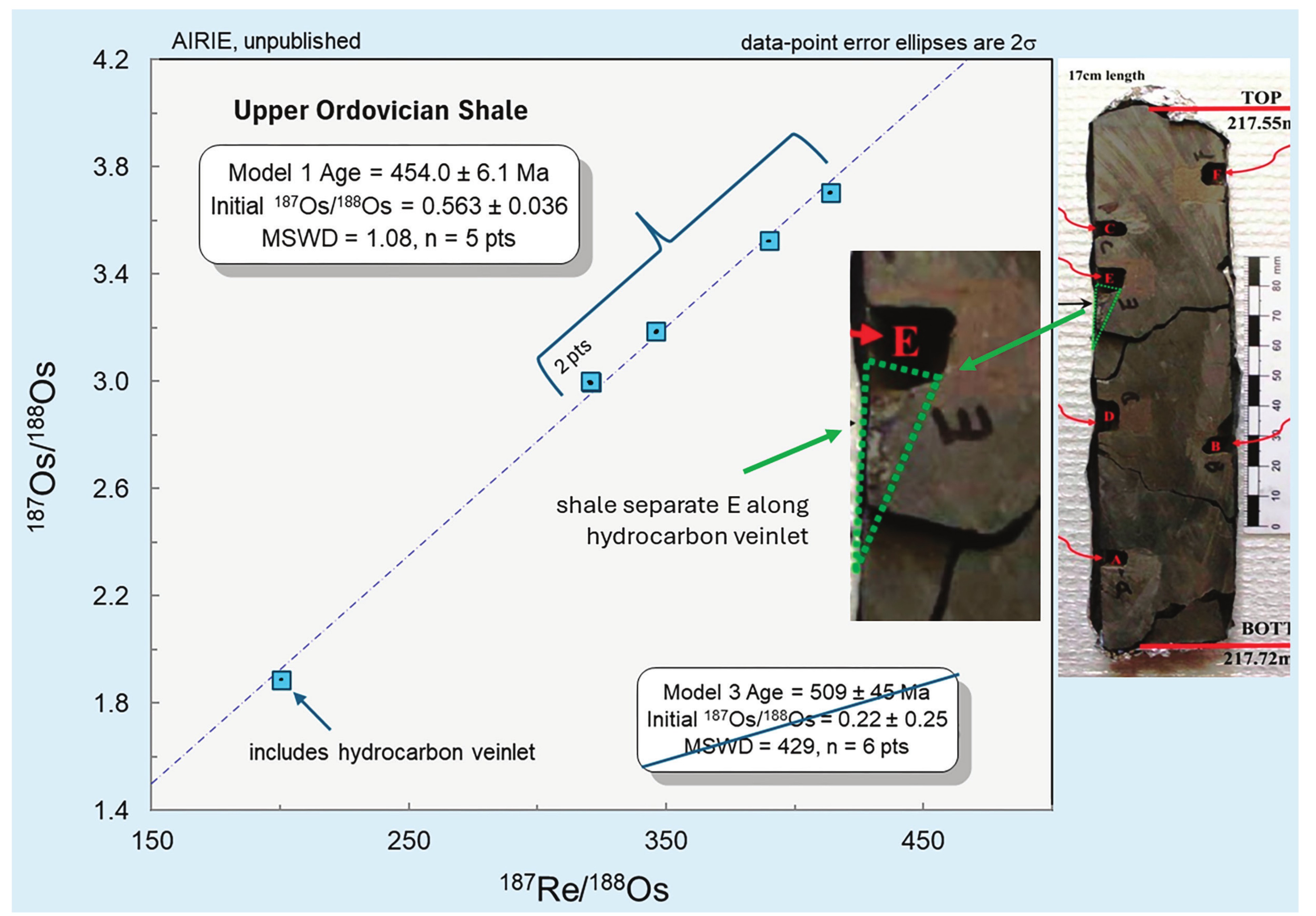
The development of an isochron requires that samples start with identical initial 187Os / 188Os yet variable 187Re / 188Os isotope ratios upon deposition. Because the residence time of Os in seawater is only ~104 years, the sampled strati- graphic interval (ideally 5 to 20 cm) must represent a geologically short time interval; otherwise, any temporal variation in seawater 187Os / 188Os imparts differing initial 187Os / 188Os among samples and, thus, imprecise Re-Os isochron ages. The hydrogenous component in shales (non-detrital component derived directly from the water) typically comprises an array of different organic molecules and sulfides, and these acquire variable 187Re / 188Os upon deposition (DiMarzio et al. 2018).
Download high-resolution image
Thus, most shales from reducing environments contain synsedimentary pyrite and/or organic matter with enough variation in 187Re / 188Os ratios to obtain a precise isochron. Attempts to date terres- trial coal beds confirm spatially variable initial 187Os / 188Os in the complex mixture of organic matter that accumulates in peat mires or fluvial overbank deposits, violating one of the fundamental requirements for an isochron (Goswami et al. 2018). Shales intercalated with coals may result from marine incursions, however, providing datable material for coals (Tripathy et al. 2015).
Post-depositional processes that might give rise to inaccu- rate and/or imprecise Re-Os ages are commonly revealed by petrography; notable examples of features left by such processes include cubic pyrites formed during late diagen- esis and infilled fractures recording fluid flow. Given the redox-sensitive nature of Re and Os, oxidizing fluids are likely to cause open-system behavior. Fractures, veins, and possible temporal hiatuses should be avoided or carefully tested (Fig. 1). In addition to identifying post-deposi- tional disturbance, petrographic inspection can provide clues to the depositional environment; as examples, fine- grained framboidal pyrite indicates precipitation in an anoxic and sulfidic (euxinic) water column, and various pyrite morphologies (e.g., shale laminae draping around a spheroidal pyrite grain) indicate an early diagenetic origin (Hannah et al. 2004).
Some post-depositional processes, however, do not cause open-system Re-Os behavior. Neither hydrocarbon genera- tion and expulsion nor bioturbation during earliest diagen- esis affect the accuracy of Re-Os ages (Creaser et al. 2002; Park et al. 2024). Precise Re-Os depositional ages have been obtained from ORS rocks that experienced contact and/or regional metamorphism (e.g., Kendall et al. 2004; Yang et al. 2009). Although Re-Os ages are now normally obtained from CrO3-H2SO4 digestions (Selby and Creaser 2003), pyrite with indisputably syn-depositional (or early diagenetic) morphologies in ORS rocks also yield accurate and precise Re-Os ages (Hannah et al. 2004).
Setting the Boundaries: Geological Timescale Calibration
Any “new” geochronometer requires cross-calibration with geochronology’s “gold standard,” which is the combined 235U-207Pb and 238U-206Pb systems in zircon or monazite. Using the Exshaw Formation (Alberta, Canada) as an example of a black shale with constrained biostra- tigraphy, known timescale position, and U-Pb monazite geochronology, Selby and Creaser (2005) showed that the Re-Os isotope system in shale could yield a depositional age with < ± 1% (2σ) total uncertainty using Carius-tube CrO3-H2SO4 digestion and NTIMS analysis. The age result of 361.3 ± 2.4 Ma overlaps the U-Pb age of a tuff within the Formation (363.4 ± 0.4 Ma) and the known age of the Devonian-Mississippian boundary hosted within the Exshaw Formation, currently constrained at 358.9 ± 0.4 Ma.
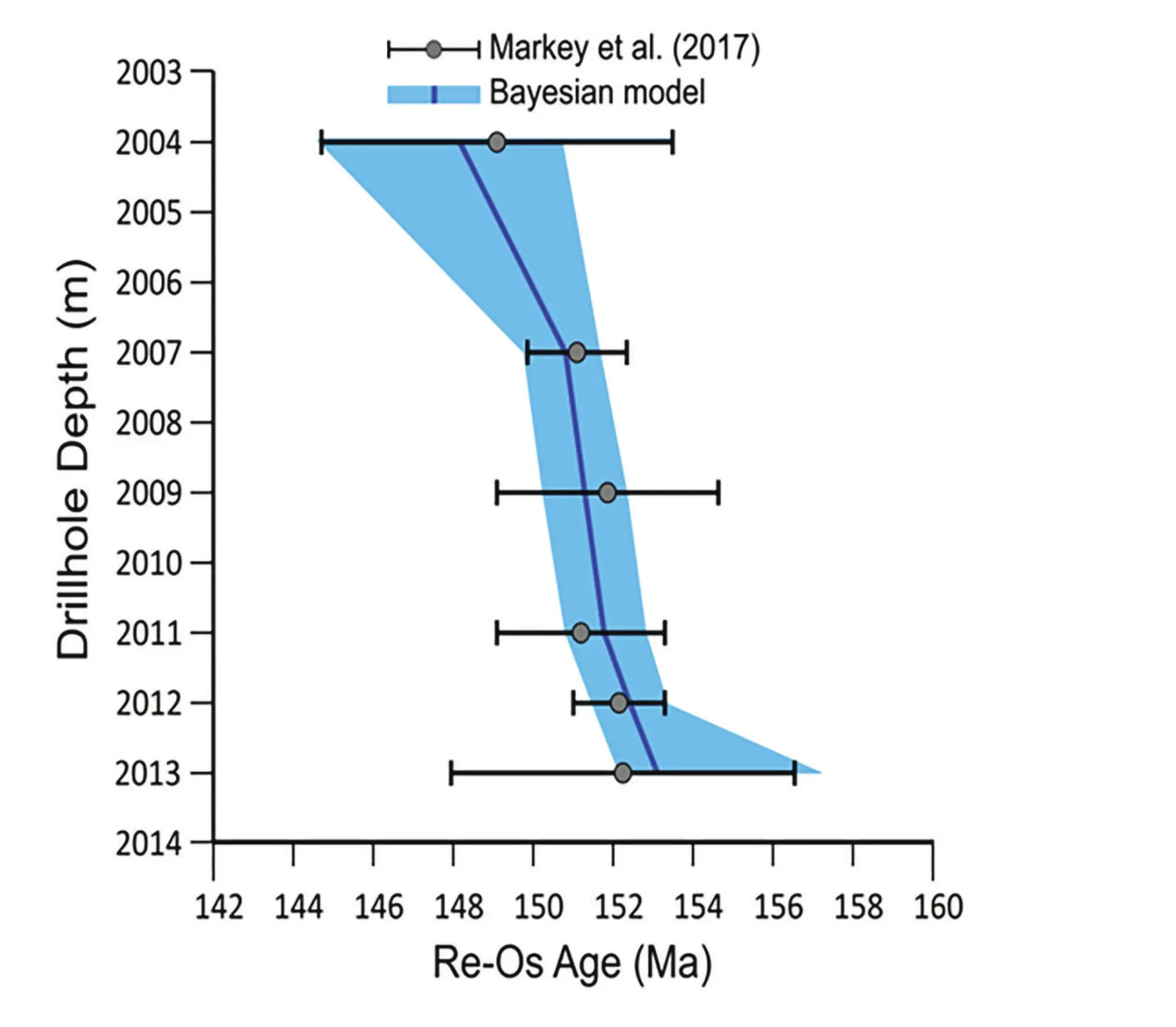
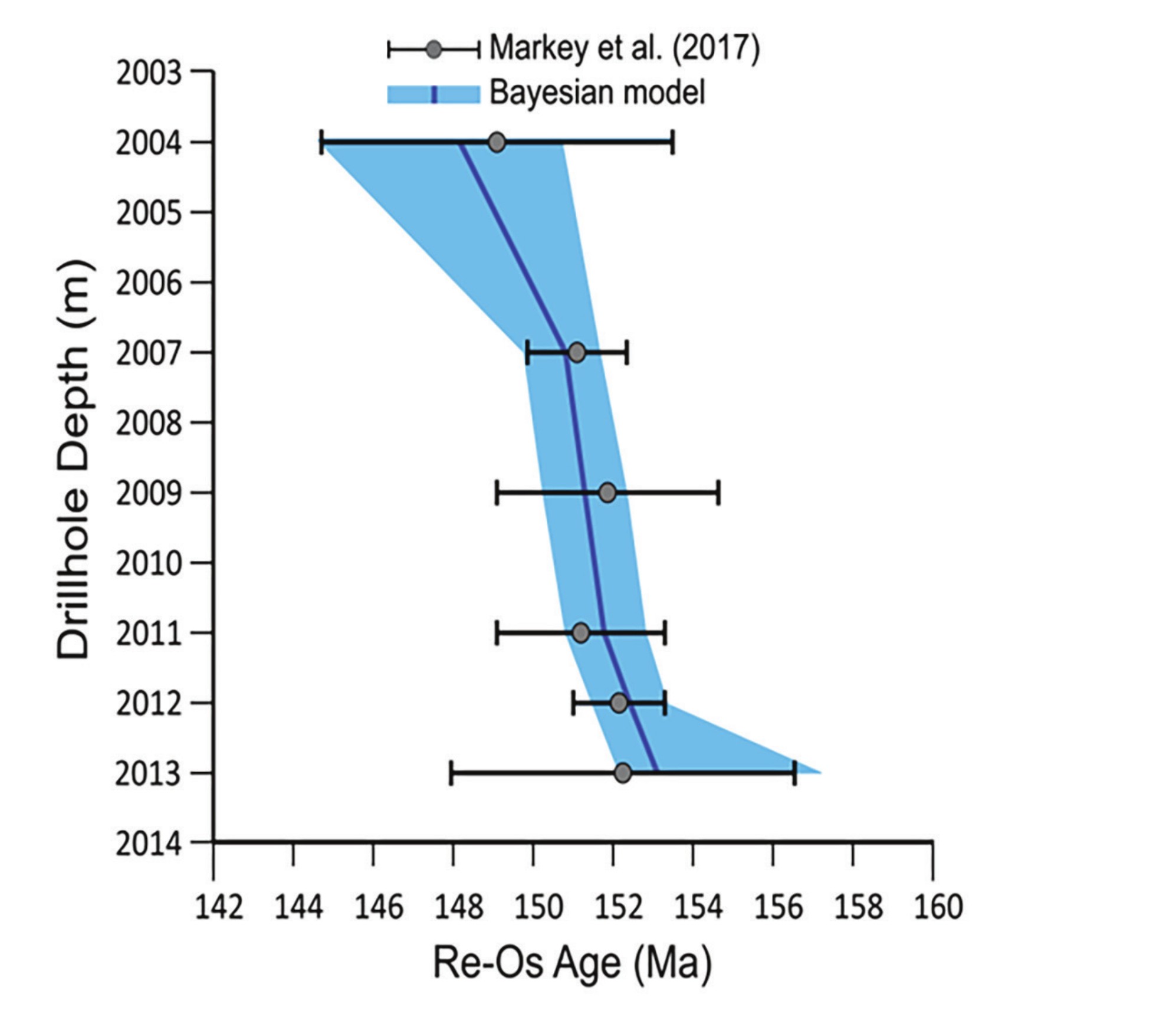
The precision now attainable with the Re-Os geochro- nometer led to the first application of Bayesian-refined Re-Os ages (Xu et al. 2014; Fig. 2). This statistical method is used when the uncertainties of values in a dataset are constrained by independent a priori knowledge. Calculated uncertainties for a set of Re-Os ages of samples collected in stratigraphic order from an intact sedimentary section may be refined in this way. The uncertainty of a Re-Os age cannot exceed the ages of samples stratigraphically above or below, as this would violate the known stratigraphy.
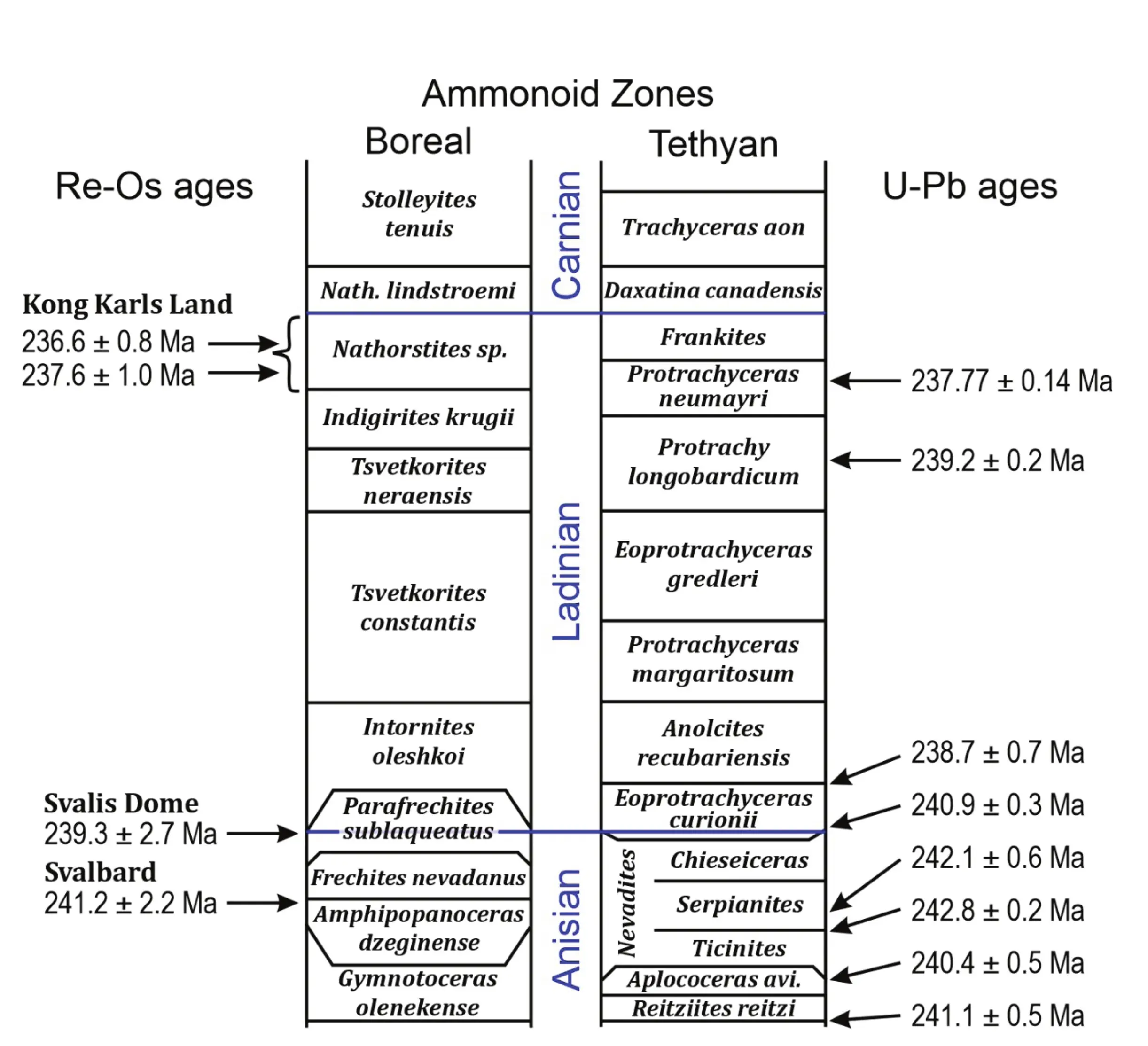
More than a decade ago, both correlation of fossil assem- blages between polar and equatorial realms and age pins in the Triassic time scale were highly contentious.
Download high-resolution image
Download high-resolution image
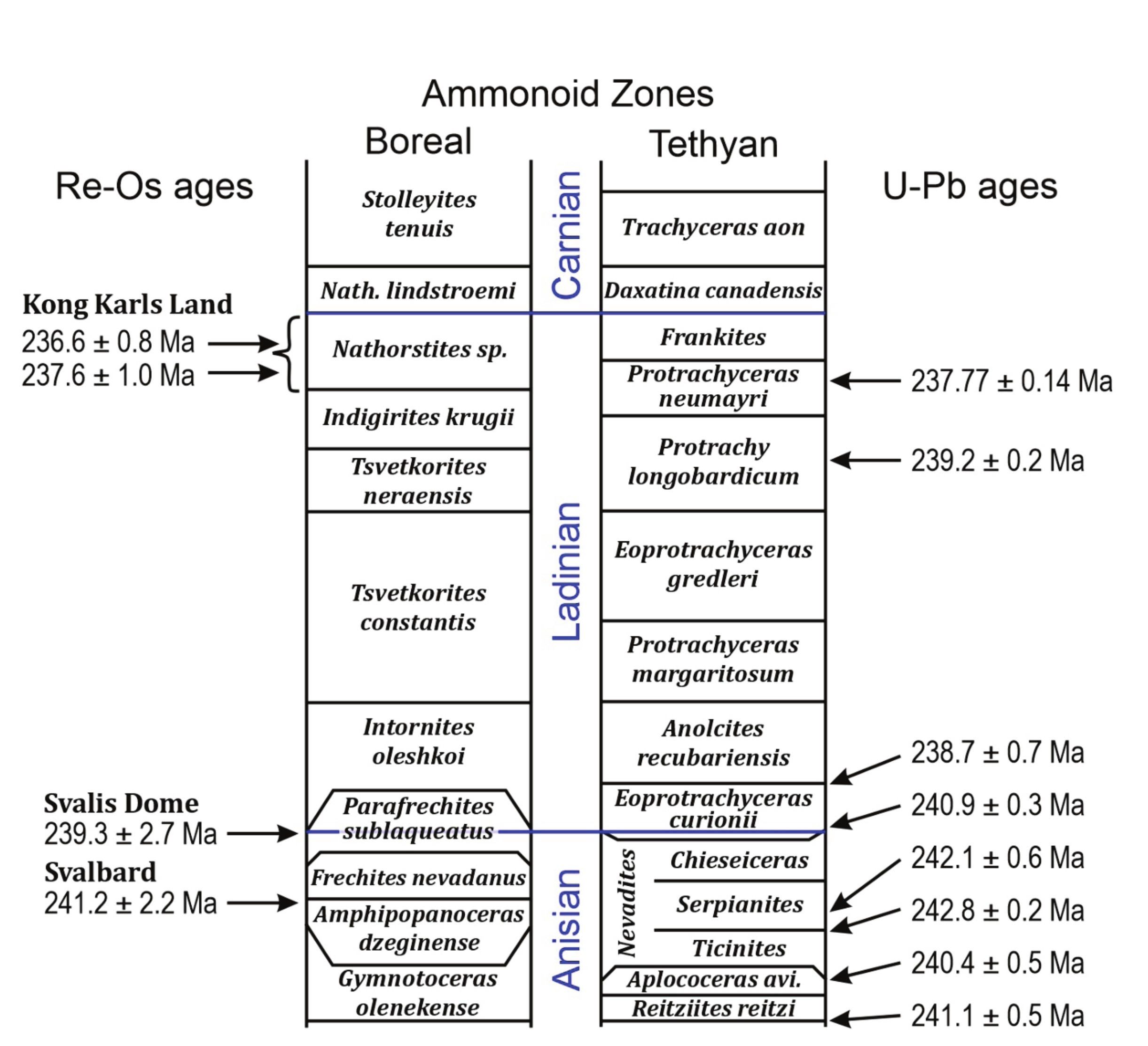
Xu et al.(2014) helped break the logjam with seven new Re-Os isochrons through a continuous ORS section that also hosts well-studied Triassic ammonite fossil assemblages. These Re-Os ages helped decide between two competing time scales for the Triassic. Further, the ages allow corre- lation between the distant realms (Fig. 3) and help tie a large magmatic province (Wrangellia) to a period of intense global warming (the Carnian Pluvial Event), illustrating the significant impact of accurate Re-Os ages from ORS rocks for understanding ancient climate change (Xu et al. 2014). Similarly, new correlations of Late Jurassic ammonite zones have been proposed based on Bayesian-refined Re-Os shale ages from Svalbard. This provides a critical link between different fossil realms, allowing a solution to the problem of faunal provincialism (Park et al. 2024).
Dating the Rock Stars: Re-Os Ages of Famous Events
The large impact of Re-Os shale ages on global stratigraphic correlations is exemplified by the work in Neoproterozoic strata (Kendall et al. 2004, Rooney et al. 2020a). Global events relating to glaciation and deglaciation of multiple “Snowball Earth” events have been refined and correlated worldwide by combining Re-Os geochronology of ORS rocks with U-Pb zircon geochronology. In particular, Re-Os ages helped show that the older Sturtian glaciation lasted an astounding ~56 My (717–661 Ma), highlighting that early eukaryotic multicellular life defied the odds in spectacular fashion to survive this unprecedented climatic catastrophe. The onset of the younger Marinoan glaciation still lacks precise age control, but a Re-Os age has helped constrain deglaciation to ~635 Ma, in agreement with multiple U-Pb ages. Hence, Re-Os shale geochronology has been pivotal in establishing the absolute timing and duration of these global glaciations, which were key events immediately prior to emergence of complex metazoan life and faunal radiations in the Ediacaran and Cambrian, because many of these stratigraphic sections lack volcanic ash beds for U-Pb geochronology.
Sedimentary Re-Os geochronology has provided key age constraints on biological innovations ranging from oxygenic photosynthesis to animal evolution. A Re-Os age of 2316 ± 7 Ma from early diagenetic pyrite from black shales lacking independent geochemical evidence of an anoxic atmosphere provided an important age constraint for the Great Oxidation Event (Hannah et al. 2004). Subsequently, a Re-Os black shale age dated a transient accumulation of photosynthetic O2 in the atmosphere and shallow oceans at ~2.5 Ga, shortly before the Great Oxidation Event (Kendall et al. 2015). Fossil records for which the Re-Os clock has provided age information include eukaryotic microfossils between ~1590 and ~1440 Ma (Rainbird et al. 2020) and the first Ediacaran animal macrofossils on multiple paleocon- tinents between ~580 and ~574 Ma (Rooney et al. 2020b).
Re-Os geochronology has shed new light on major Phanerozoic mass extinction events, including the Permo– Triassic extinction that decimated more species than the other “Big Five” extinctions (Georgiev et al. 2011). Before Georgiev et al. (2011) was published, tight age constraints were limited to U-Pb ages for the famous Meishan exposure in China. The extinction horizon is also exposed in East Greenland with correlative sections on the mid-Norwegian shelf. Using drill core, Re-Os geochronology for two Boreal shale sections immediately below the extinction horizon yielded four highly precise ages overlapping multiple U-Pb zircon ages from an ash bed at the Meishan extinction horizon on the opposite side of the globe, confirming the timing and global extent of this greatest extinction event (Georgiev et al. 2011). The initial 187Os / 188Os ratio of ~0.6 for all four isochrons rules out massive basaltic volcanism or a bolide impact (expected initial 187Os / 188Os of ~0.13) as the cause of the extinction, while high concentrations of toxic metals in late Permian shales implicate noxious seawater.
Unusual perturbations to biogeochemical cycles, often recorded as carbon isotope excursions, have also received significant attention from the Re-Os community. In addition to dating carbon isotope excursions associated with Phanerozoic deoxygenation events, Re-Os geochro- nology has constrained the timing of large positive and negative excursions recorded in Neoproterozoic sedimen- tary rocks worldwide.
Download high-resolution image
For example, Re-Os ages from multiple paleocontinents were used to suggest that the most severe negative carbon isotope excursion in Earth’s history, the Shuram Excursion, was a globally synchronous event between 574.0 ± 4.7 and 567.3 ± 3.0 Ma (Rooney et al. 2020b).
Another noteworthy application of Re-Os geochronology is determining the duration of a supercontinent cycle. A Re-Os black shale age of 1067.3 ± 13.5 Ma dated the base of the 4-km-thick Shaler Supergroup in northern Canada, whereas U-Pb zircon and baddeleyite ages for the Franklin large igneous province dated the top of the supergroup. Together, these ages yielded a duration of ~350 My between the assembly and breakup of the Rodinia supercontinent (Rainbird et al. 2020).
REEL-TO-REEL TRACER: OSMIUM ISOTOPES
Water column 187Os / 188Os, captured by ORS and other sediment types (e.g., Fe-Mn crusts), is set by the relative contributions of different Os sources and, thus, provides information about Earth system processes. A sediment’s 187Os / 188Os at the time of deposition can be deter- mined from the initial 187Os / 188Os ratio (y-intercept) of a Re-Os isochron (see Toolkit Fig. 6) or calculated from the sediment’s present-day 187Re / 188Os and 187Os / 188Os if the sediment age can be interpolated from other dated sedimentary horizons or volcanic ash beds, and if it can be shown that the sediment’s Re-Os systematics have been undisturbed since the time of deposition.
Tape Recorder of Tectonic, Climatic, and Sea Level Changes
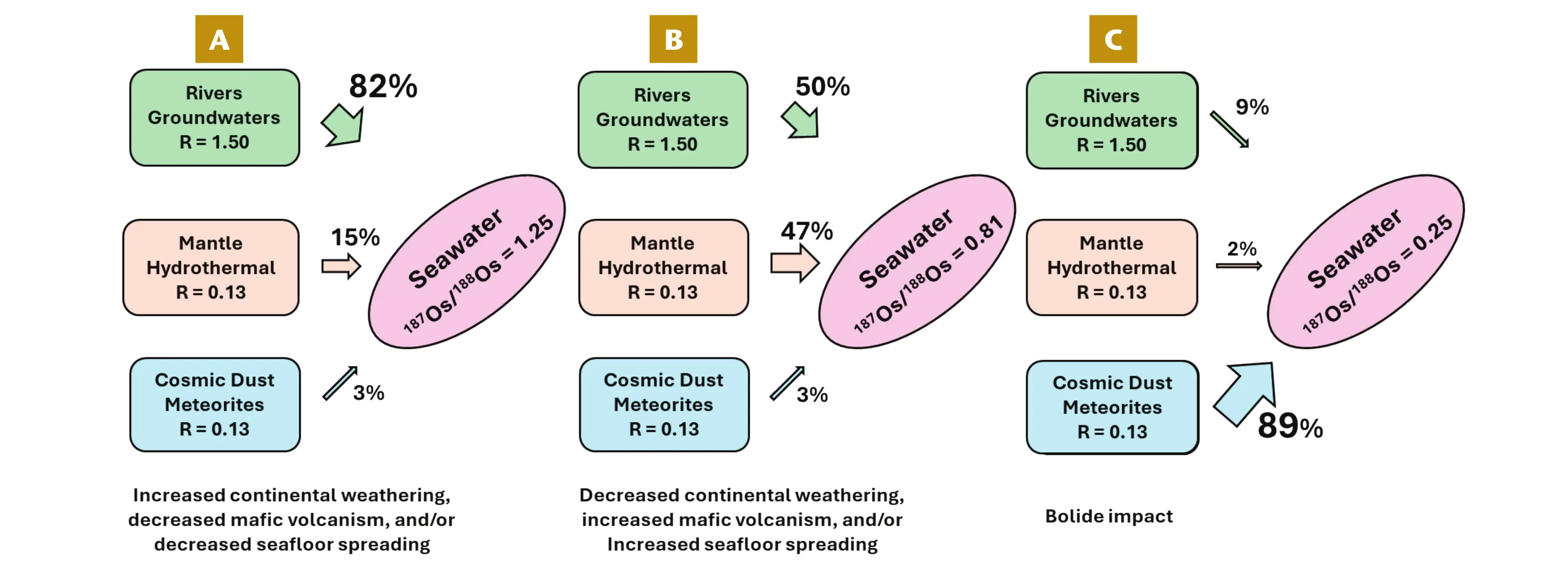
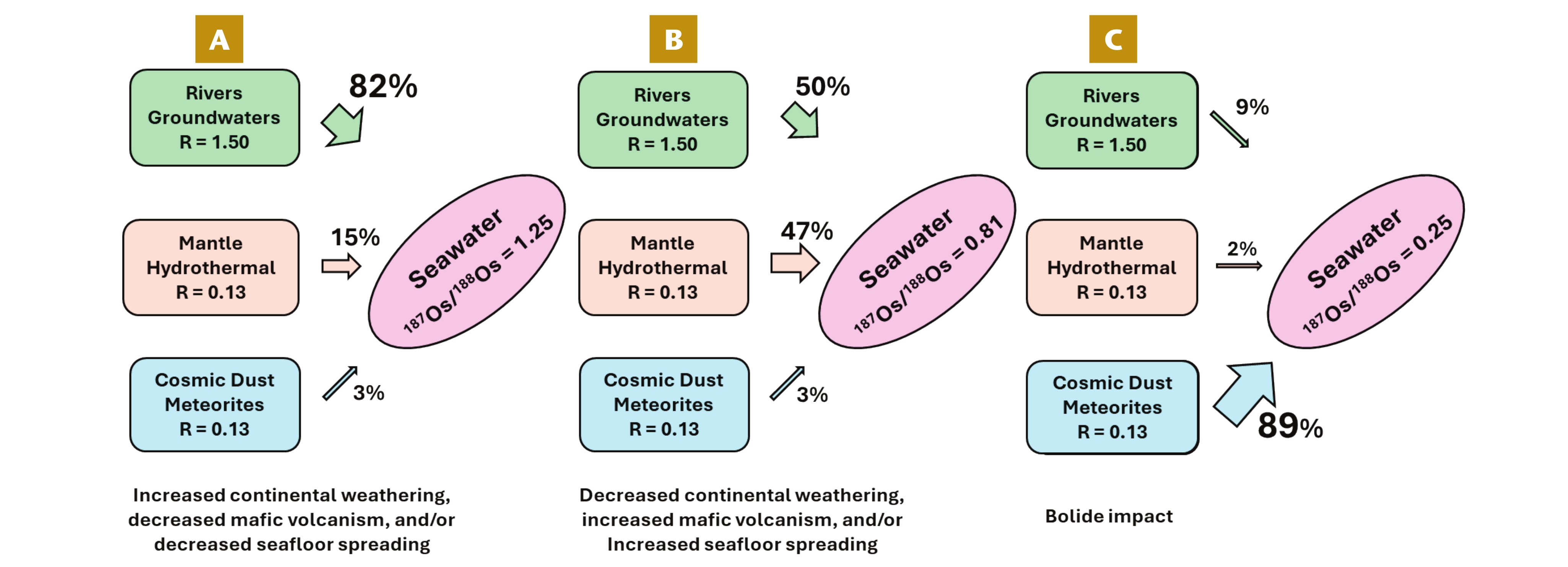
Seawater 187Os / 188Os ratios are commonly used to assess the sensitivity of continental weathering to climatic and tectonic changes (Fig. 4). This ratio is nearly homogenous (~1.05) in modern deep oceans and reflects a dominant Os contribution from continental weathering. The average 187Os / 188Os ratio of the upper continental crust (~1.4) is an order of magnitude higher than that of mantle and extraterrestrial materials (~0.13), the other major sources of Os input to seawater. Relative changes in continental weathering intensity in the past can, therefore, be tracked effectively using seawater 187Os / 188Os ratios (Fig. 4; see Toolkit Fig. 13).
Past variations in seawater 187Os / 188Os have been recon- structed by analyzing hydrogenous Os phases from several archives (e.g., ORS rocks, Fe-Mncrusts and nodules, foramin- ifera). The Fe-Mn crusts and nodules largely accumulate Os directly from seawater and their diagenetic alteration can have minimal effect on 187Os / 188Os (e.g., Burton et al. 1999). The measured 187Os / 188Os ratios of surface Fe-Mn deposits match well with the modern seawater value, confirming proxy reliability. The 187Os / 188Os ratios of these slow- growing (a few mm/My) deposits archive large variations in seawater 187Os / 188Os on million-year timescales.
Notably, 187Os / 188Os ratios show a steady rise from 0.4 to 1.05 during the Cenozoic Era, with the highest value being observed for the modern ocean (see Toolkit Fig. 12 and Toolkit references). This trend is broadly consistent with the corresponding first-order rise in seawater 87Sr/86Sr during the Cenozoic and reflects high weathering influxes from young orogenic belts (e.g., Himalayan-Tibetan plateau river basins). This observation underscores the impact of mountain building processes on continental weathering rates, which in turn regulate the global climate. At finer temporal resolution, significant differences are observed between the Cenozoic seawater Os and Sr isotope curves (see Toolkit Fig. 12). These differences reflect the much longer seawater residence time for Sr (~106 y)) than Os (~104 y)) and temporal changes in oxidation of sulfide minerals, which supply more chalcophile Os than lithophile Sr to seawater (Torres et 2014). Sulfide oxidation in river basins produces sulfuric acid, which reacts with carbonates, thus releasing CO2 to the atmosphere that counterbalances CO2 consumed by H2CO3-mediated silicate weathering. The mismatch between 87Sr/86Sr and 187Os / 188Os seawater trends during the Cenozoic, therefore, has provided deeper insight into fluctuations in the rates of these two weath- ering processes due to tectonic activity and their net effect on atmospheric CO2 levels (Torres et al. 2014).
Glacial–interglacial variations in seawater 187Os / 188Os depict a strong relationship between weathering and climate. Seawater 187Os / 188Os ratios inferred from marine sediments are systematically lower during glacial events because of slower weathering rates. By contrast, seawater 187Os / 188Os increased during deglaciation because exposed post-glacial soils and fresh bedrock are readily weathered in a warmer climate and transported by increased run-off. Climate-driven variations in seawater 187Os / 188Os ratios and sedimentary Os enrichments at kilo-year timescales and their offset between sites have also provided clues about changes in regional-scale weathering patterns and oceanic redox states due to sea-level fluctuations (Paquay and Ravizza 2012). Seawater 187Os / 188Os further has been used to trace changes in climate and ocean circulation in the wake of the Neoproterozoic Snowball Earth glaciations. These studies reveal that the onset of deglaciation is initially accompanied by high seawater 187Os / 188Os in continental margin environments, reflecting intense continental weathering of a glacially scoured terrestrial landscape in a high-CO2 greenhouse climate. Subsequently, continental margin seawater 187Os / 188Os decreased upon mixing with deeper-ocean waters, which had developed low 187Os / 188Os during the Snowball Earth with hydrothermal Os inputs into ice-covered oceans (Rooney et al. 2020a).
At the Heart of a Continent: Regional Processes Recorded in Paleolakes
Organic-rich lake sediments provide high-resolution records of changes in paleoclimate, tectonic and landscape evolution, and terrestrial paleoecology within a conti- nent. Unlike oceans, the volume of water in lakes is small relative to their drainage basins. Thus, lacustrine systems are highly sensitive to small fluctuations in both volume and composition of water and sediment influx. Lacustrine records, however, are often marred by limited chronolog- ical constraints.
Attempts to date lake sediments using Re-Os geochronology are typically hampered by a narrow range of 187Re / 188Os ratios and variability in initial 187Os / 188Os ratios. Still, useful depositional ages have been obtained if sample suites are carefully selected from distal sections farther from shore where lake water 187Os / 188Os is more likely to be stable. For example, Re-Os dating of shale from the Eocene Green River Formation (Douglas Creek Member), Uinta Basin, Utah, USA yielded a depositional age of 49.2 ± 1.0 Ma, consistent with ⁴⁰Ar/ ³⁹Ar ages of intercalated tuff horizons (Cumming et al. 2012).
In lacustrine environments, the short Os residence time allows lake sediments to record stratigraphic variations in depositional 187Os / 188Os at ~102 to 103 year timescales, thus providing high-resolution records for the overall 187Os / 188Os of lake inputs. Such changes in input can be orders of magnitude faster than changes in seawater 187Os / 188Os. These rapid variations may be useful for tracking shifts in drainage geology triggered by regional climate change or tectonic variations that change the relative contribution of Os from different bedrock sources. Variability in initial 187Os / 188Os (1.37–1.57; from individual samples) was observed for Green River sediments (Douglas Creek Member; ~49 Ma), suggesting (i) variations in conti- nental runoff and (ii) measurable changes to overall lake water chemistry (Cumming et al. 2012).
Osmium isotope records from ORS rocks have the poten- tial to discriminate between terrestrial and marine deposi- tional settings, and changes in marine basin connectivity to the open ocean. Significant deviations of depositional 187Os / 188Os from the established concurrent seawater 187Os / 188Os record may indicate non-marine sediment deposition. For example, a change from a marine to a lacustrine setting would be revealed by a change in deposi- tional 187Os / 188Os toward relatively higher values compared with independent estimates of coeval marine 187Os / 188Os (e.g., Poirier and Hillaire-Marcel, 2011). Highly restricted marine basins, with limited exchange of water with the open ocean, may generate ambiguous 187Os / 188Os records with similarly high values and large short-term variability.
Knockout Punches: Bolide Impacts and Large Igneous Provinces
Unlike conventional isotopic tracers like Sr, the large difference in 187Os / 188Os between mantle/extraterrestrial Os (~0.13) and continental Os (~1.4) enables the Re-Os isotope system to identify periods of time in which the mass balance of Os in the oceans was dominated by mantle or extraterrestrial input, such as large bolide impacts or short- term eruption of large igneous provinces (LIPs), which are enormous volumes of mafic magma erupted over geologi- cally short periods of time, typically ~105–106 years. The Cretaceous/Paleogene (K-Pg) boundary at ~66 Ma is one such interval widely attributed to a large bolide impact (see Toolkit Fig. 12C). An inferred seawater 187Os / 188Os approaching meteoric values measured at globally widespread exposures of the K-Pg boundary supports this hypothesis (Fig. 4; Koeberl and Shirey 1997; see also refer- ences in Toolkit).
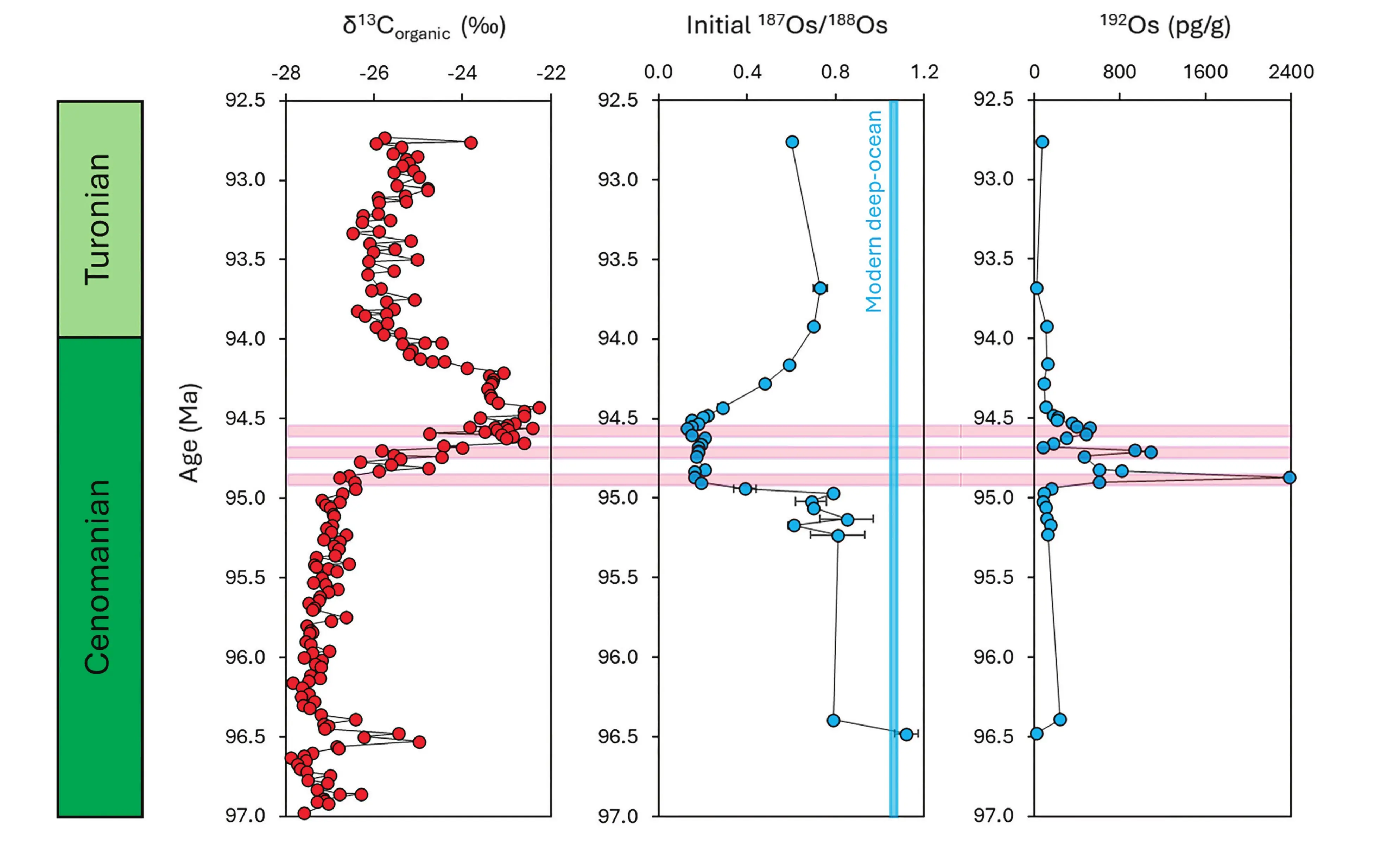
Mesozoic Oceanic Anoxic Events (OAEs) are characterized by periods of low seawater O2, climatic warming, carbon burial, and major changes in oceanic fauna. A triggering mechanism for OAEs is commonly proposed to be the eruption of LIPs. Osmium isotopes played a pivotal role in linking LIPs to OAEs, with the discovery that very low, mantle-like 187Os / 188Os ratios coupled with large Os enrichments characterize oceanic sediments deposited during OAE2 at ~93 Ma (Cenomanian–Turonian boundary; Turgeon and Creaser 2008).
Download high-resolution image
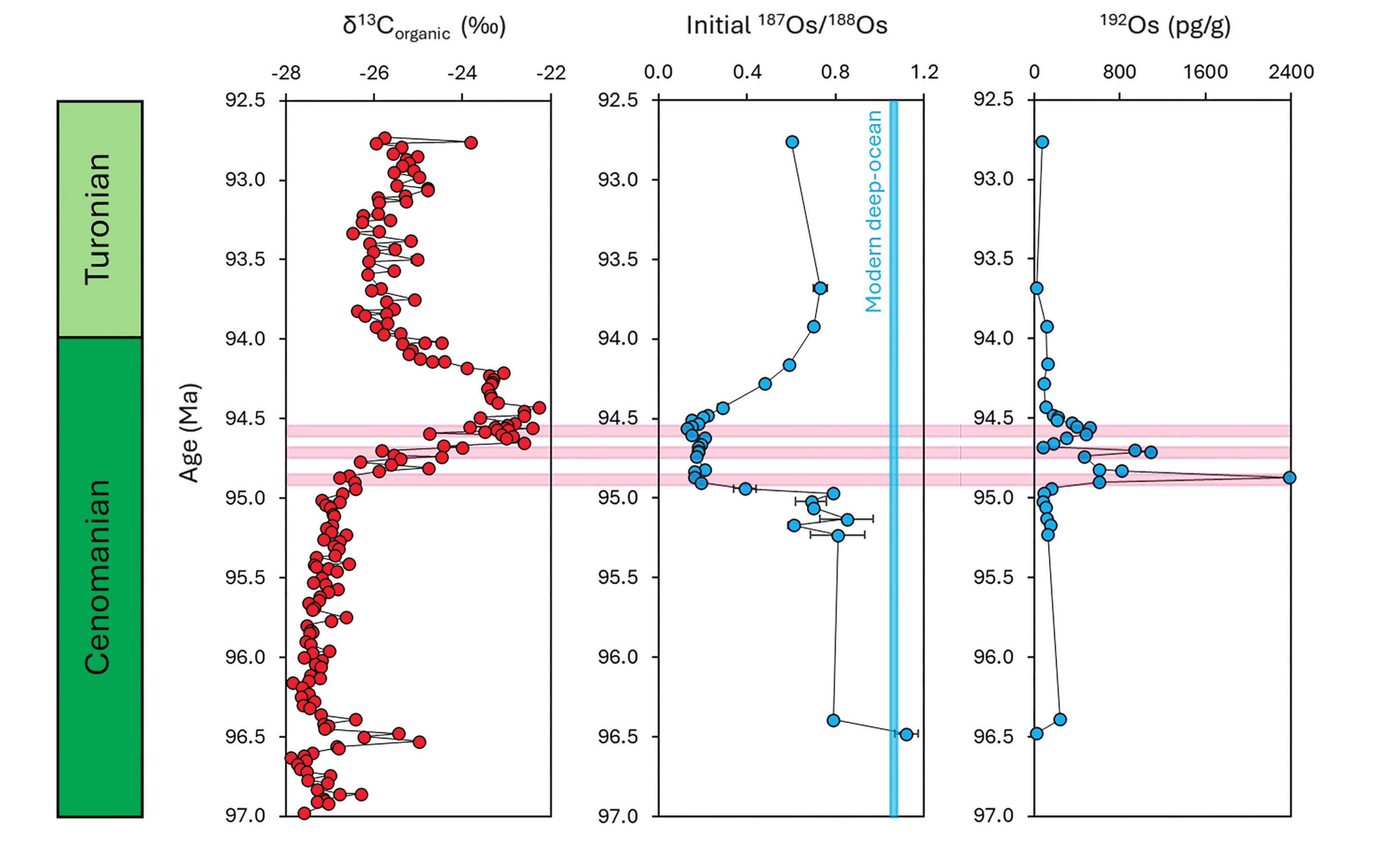
Further work verified this extended the effect globally (Du Vivier et al. 2015), and identified three distinct pulses of unradio- genic LIP-derived Os into the oceans during the ~450 Ka duration of OAE2 (Fig. 5; Sullivan et al. 2020). However, distinguishing between bolide impact and LIP-derived Os is not possible using Os isotopes alone as both have ratios of ~0.13 (Fig. 4; see Toolkit Fig. 5) and, thus, require other data such as highly siderophile element abundances (Sullivan et al. 2020). After the discovery of low 187Os / 188Os ratios across OAE2, other Cretaceous OAEs also yielded evidence of LIP-derived Os. In contrast, the Toarcian OAE (T-OAE) is characterized by elevated 187Os / 188Os during OAE sediment deposition, which likely records intense continental weathering in a volcanogenic-induced green- house climate, without significant direct input of Os from LIPs (Them et al. 2017).
Evolution of our Blue Planet Through Time: The Seawater 187Os / 188Os Perspective
Seawater 187Os / 188Os ratios inferred from Precambrian ORS rocks have provided insight into a fundamental transi- tion in Earth’s history: the onset of atmospheric oxygen- ation and oxidative continental weathering (Hannah et al. 2004; Kendall et al. 2015). An atmospheric O2 level of perhaps >0.1% PAL (present atmospheric level) is needed to weather the Earth’s upper crust, allowing oxidation of Os with elevated 187Os / 188Os to be transported to the oceans. Hence, seawater 187Os / 188Os that is higher than mantle and extraterrestrial 187Os / 188Os is evidence for photosynthetic O2 accumulation and oxidative weathering.
The oldest known instance of oxidative weathering and transport of crustal Os may be the 2.5 Ga Mt. McRae Shale, although the initial 187Os / 188Os (0.34 ± 0.19) derived from these black shales is only marginally higher than the mantle value of ~0.11 at 2.5 Ga (Kendall et al. 2015). Other ORS rocks from the late Archean and early Paleoproterozoic, including during the Great Oxidation Event (Hannah et al. 2004; Yang et al. 2009), yield seawater 187Os / 188Os equivalent to mantle values. One possible interpretation is that oxidative weathering of the late Archean and early Paleoproterozoic crust provided a much smaller flux of Os to the oceans than mantle Os inputs at seafloor spreading centers. It must also be recognized that the 187Os / 188Os of the upper continental crust was lower at this time because less 187Rehad decayed to 187Os. Most Archean ORS rocks have low authigenic Re enrichments because low atmospheric O2 (<10⁻⁴ % PAL) limited chemical weathering and river transport of Re to the oceans, and widespread ocean anoxia caused the small amounts of oceanic Re to be removed over a wide seafloor area. Consequently, Archean ORS rocks typically did not develop high 187Os / 188Os because decay of 187Reto 187Oswas limited. Hence, continental weathering may have continued to provide Os with low 187Os / 188Os to early Proterozoic oceans, even during and shortly after the Great Oxidation Event (Hannah et al. 2004).
The observation that seawater 187Os / 188Os is clearly higher than the mantle is first observed in the mid-Proterozoic and becomes common in the Neoproterozoic and Phanerozoic (see Toolkit Fig. 12). Three main factors likely contrib- uted to these temporal changes. First, the continental crust evolved towards higher 187Os / 188Os through time via 187Redecay to 187Os. Second, secular mantle cooling likely decreased the seafloor hydrothermal flux of Os to the oceans, making the continental contribution more impor- tant. Third, increasing subaerial exposure and weathering of younger Proterozoic ORS rocks with greater authigenic Re enrichments produced increasingly elevated Re/Os and 187Os / 188Os ratios in river waters delivered to the oceans. Co-evolution of the atmosphere, hydrosphere, crust, and mantle, therefore, have modulated first-order temporal changes in seawater 187Os / 188Os through time.
FUTURE DIRECTIONS
Many novel insights into Earth system processes have been made with the Re-Os isotope system, but there remain ample opportunities for current and future generations of geoscientists to make important contributions. Gaps in the seawater 187Os / 188Os curve need to be filled, especially for the Precambrian, but even the Phanerozoic curve still has low temporal resolution compared with the seawater Os residence time. Sedimentary deposits from rivers may contain information about ancient river 187Os / 188Os and provide new insights into paleoenvironments and variations in seawater and lacustrine 187Os / 188Os. Mass-dependent variations of Re and Os isotopes in nature are only just starting to be explored as tracers of environ- mental processes such as oxidative weathering. There are many geological processes/events and biological innova- tions/catastrophes throughout Earth’s history whose timing and duration could benefit from Re-Os depositional ages. More precise Re-Os ages for ORS rocks are possible if the spread of 187Re / 188Os ratios on isochron diagrams can be maximized by targeting individual organic matter and sulfide phases. Standardized (community-wide) analytical and data reduction procedures for Re-Os geochronology and isotopic tracing will improve overall data quality and the precision and accuracy of depositional ages, as well as encourage and support entry of the next generation of Re-Os isotope geochemists.
ACKNOWLEDGMENTS
The authors thank Urs Schaltegger and Swapan Sahoo for constructive reviews, and editors Holly Stein, Laurie Riesberg, and Janne Blichert-Toft for their helpful advice and suggestions.
REFERENCES
Burton KW, Bourdon B, Birck JL, Allègre CJ, Hein JR (1999) Osmium isotope variations in the oceans recorded by Fe–Mn crusts. Earth and Planetary Science Letters 171: 185-197, doi: 10.1016/ S0012-821X(99)00139-9
Cohen AS, Coe AL, Bartlett JM, Hawkesworth CJ (1999) Precise Re–Os ages of organicrich mudrocks and the Os isotope composition of Jurassic seawater. Earth and Planetary Science Letters 167: 159-173, doi: 10.1016/S0012-821X(99)00026-6
Creaser RA, Sannigrahi P, Chacko T, Selby D (2002) Further evaluation of the Re-Os geochronometer in organic-rich sedimentary rocks: a test of hydrocarbon maturation effects in the Exshaw Formation, Western Canada Sedimentary Basin. Geochimica et Cosmochimica Acta 66: 3441-3452, doi: 10.1016/ S0016-7037(02)00939-0
Cumming VM, Selby D, Lillis PG (2012) Re–Os geochronology of the lacustrine Green River Formation: insights into direct depositional dating of lacustrine successions, Re–Os systematics and paleocontinental weathering. Earth and Planetary Science Letters 359-360: 194-205, doi: 10.1016/j.epsl.2012.10.012
DiMarzio JM, Georgiev SV, Stein HJ, Hannah JL (2018) Residency of rhenium and osmium in a heavy crude oil. Geochimica et Cosmochimica Acta 220: 180-200, doi: 10.1016/j.gca.2017.09.038
Du Vivier ADC, Selby D, Condon DJ, Takashima R, Nishi H (2015) Pacific 187Os / 188Os isotope chemistry and U–Pb geochronology: synchroneity of global Os isotope change across OAE 2. Earth and Planetary Science Letters 428: 204-216, doi: 10.1016/j.epsl.2015.07.020
Georgiev S and 5 coauthors (2011) Hot acidic Late Permian seas stifle life in record time. Earth and Planetary Science Letters 310: 389-400, doi: 10.1016/j.epsl.2011.08.010
Georgiev S and 10 coauthors (2012) Chemical signals for oxidative weathering predict Re–Os isochroneity in black shales, East Greenland. Chemical Geology 324-325: 108-121, doi: 10.1016/j. chemgeo.2012.01.003
Goswami V, Hannah JL, Stein HJ (2018) Why terrestrial coals cannot be dated using the Re-Os geochronometer: evidence from the Finnmark Platform, southern Barents Sea, and the Fire Clay coal horizon, Central Appalachian Basin. International Journal of Coal Geology 188: 121-135, doi: 10.1016/j.coal.2018.02.005
Hannah JL, Bekker A, Stein HJ, Markey RJ, Holland HD (2004) Primitive Os and 2316 Ma age for marine shale: implications for Paleoproterozoic glacial events and the rise of atmospheric oxygen. Earth and Planetary Science Letters 225: 43-52, doi: 10.1016/j.epsl.2004.06.013
Kendall BS, Creaser RA, Ross GM, Selby D (2004) Constraints on the timing of Marinoan “Snowball Earth” glaciation by 187Re–187Osdating of a Neoproterozoic, post-glacial black shale in Western Canada. Earth and Planetary Science Letters 222: 729-740, doi: 10.1016/j.epsl.2004.04.004
Kendall B, Creaser RA, Reinhard CT, Lyons TW, Anbar AD (2015) Transient episodes of mild environmental oxygenation and oxidative continental weathering during the late Archean. Science Advances 1: e1500777, doi: 10.1126/sciadv.1500777
Koeberl C, Shirey SB (1997) Re–Os isotope systematics as a diagnostic tool for the study of impact craters and distal ejecta. Palaeogeography, Palaeoclimatology, Palaeoecology 132: 25-46, doi: 10.1016/ S0031-0182(97)00045-X
Markey R and 5 coauthors (2017) Re-Os identification of glide faulting and precise ages for correlation from the Upper Jurassic Hekkingen Formation, southwestern Barents Sea. Palaeogeography, Palaeoclimatology, Palaeoecology 466: 209-220, doi: 10.1016/j.palaeo.2016.11.032
Paquay FS, Ravizza G (2012) Heterogeneous seawater 187Os / 188Os during the Late Pleistocene glaciations. Earth and Planetary Science Letters 349-350: 126-138, doi: 10.1016/j.epsl.2012.06.051
Park J and 5 coauthors (2024) Re-Os geochronology of the Middle to Upper Jurassic marine black shales in the Agardhfjellet Formation, Central Spitsbergen, Svalbard: a cornerstone for global faunal correlation and Os isotopic change. Palaeogeography, Palaeoclimatology, Palaeoecology 633: 111878, doi: 10.1016/j.palaeo.2023.111878
Poirier A, Hillaire-Marcel C (2011) Improved Os-isotope stratigraphy of the Arctic Ocean. Geophysical Research Letters 38: L14607, doi: 10.1029/2011GL047953
Rainbird RH, Rooney AD, Creaser RA, Skulski T (2020) Shale and pyrite Re-Os ages from the Hornby Bay and Amundsen basins provide new chronological markers for Mesoproterozoic stratigraphic successions of northern Canada. Earth and Planetary Science Letters 548: 116492, doi: 10.1016/j. epsl.2020.116492
Ravizza G, Turekian KK (1989) Application of the 187Re-187Ossystem to black shale geochronometry. Geochimica et Cosmochimica Acta 53: 3257-3262, doi: 10.1016/0016-7037(89)90105-1
Rooney AD, Yang C, Condon DJ, Zhu M, Macdonald FA (2020a) U-Pb and Re-Os geochronology tracks stratigraphic condensation in the Sturtian snowball Earth aftermath. Geology 48: 625-629, doi: 10.1130/G47246.1
Rooney AD and 8 coauthors (2020b) Calibrating the coevolution of Ediacaran life and environment. Proceedings of the National Academy of Sciences 117: 16824- 16830, doi: 10.1073/pnas.2002918117
Selby D, Creaser RA (2003) Re–Os geochronology of organic rich sediments: an evaluation of organic matter analysis methods. Chemical Geology 200: 225-240, doi: 10.1016/S0009-2541(03)00199-2
Selby D, Creaser RA (2005) Direct radiometric dating of the Devonian- Mississippian time-scale boundary using the Re-Os black shale geochronometer. Geology 33: 545-548, doi: 10.1130/ G21324.1
Sullivan DL and 5 coauthors (2020) High resolution osmium data record three distinct pulses of magmatic activity during Cretaceous Oceanic Anoxic Event 2 (OAE-2). Geochimica et Cosmochimica Acta 285: 257-273, doi: 10.1016/j. gca.2020.04.002
Them TR and 5 coauthors (2017) Evidence for rapid weathering response to climatic warming during the Toarcian Oceanic Anoxic Event. Scientific Reports 7: 5003, doi: 10.1038/s41598-017-05307-y
Torres MA, West AJ, Li G (2014) Sulfide oxidation and carbonate dissolution as a source of CO2 over geological timescales. Nature 507: 346-349, doi: 10.1038/nature13030
Tripathy GR, Hannah JL, Stein HJ, Geboy NJ, Ruppert LF (2015) Radiometric dating of marine-influenced coal using Re-Os geochronology. Earth and Planetary Science Letters 432: 13-23, doi: 10.1016/j. epsl.2015.09.030
Turgeon SC, Creaser RA (2008) Cretaceous oceanic anoxic event 2 triggered by a massive magmatic episode. Nature 454: 323-326, doi: 10.1038/nature07076
Yang G, Hannah JL, Zimmerman A, Stein HJ, Bekker A (2009) Re–Os depositional age for Archean carbonaceous slates from the southwestern Superior Province: challenges and insights. Earth and Planetary Science Letters 280: 83-92, doi: 10.1016/j.epsl.2009.01.019
Xu G and 7 coauthors (2014) Cause of Upper Triassic climate crisis revealed by Re–Os geochemistry of Boreal black shales. Palaeogeography, Palaeoclimatology, Palaeoecology 395: 222-232, doi: 10.1016/j. palaeo.2013.12.027