


EARTH—THE WATER PLANET, THE QUARTZ PLANET
Tom Sisson | June 2026
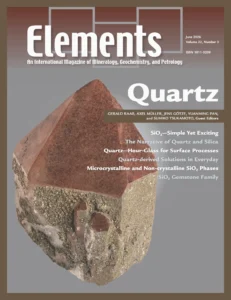
Earth’s vivid blue decorated with wispy white clouds and polar ice caps stands out against the blackness of space, broadcasting its abundant surface water. In contrast, the other terrestrial planets, our moon and theirs, and the asteroids are effectively deserts. Early Mars held surface water and may once have resembled Earth, but Mars lost its water long ago, save for remnants frozen in its polar ice caps and possibly as subsurface brines and permafrost. In the outer Solar System, the icy crusts of Enceladus, Europa, Ganymede, and Triton, and possibly Titan and Callisto, are thought to float on concealed aqueous oceans prevented from freezing by inner radiogenic heat and their host planets’ tidal forcings, but those distant moons are too cold for surface water, so Earth is distinctly and appropriately thought of as the water planet.
MINERALS, PHYSICS, AND CHEMISTRY—A DIFFUSE BOUNDARY
Sumit Chakraborty | April 2026
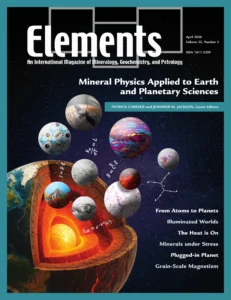
The highest academic degree that most readers of this issue would be familiar with is a PhD—Doctor of Philosophy. Independent of whether the field of research of the person earning the degree lies in the sciences, humanities, social sciences, engineering, or any other branch of intellectual inquiry, the degree is the same. This reflects the commonality of scholarly depth, critical analysis, and new perspectives that underlie the degree in any field that has a place in a university, which itself is governed by the principles of Universitas (a Latin word meaning the whole). Boundaries between disciplines came into place much later, largely for organizational reasons.
BANE OF THE BINARY
Sumit Chakraborty | February 2026
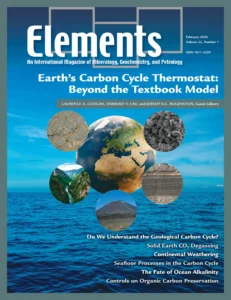
We live in a digital age where the binary number system of zeroes and ones manages to deal with a mind-boggling array of topics and concepts. A search engine, with the help of those two digits, will provide an answer to just about any topic under the Sun and beyond. In many situations in life, we manage to cozily settle into the narrative provided by the binary: thumbs up, thumbs down. The binary world channelizes the thought process to “if it is not this, then it must be that” (sound like a computer code?)—there is no other, nothing in between. Black or white—not much grey, let alone color.