Author name: Anton R. Chakhmouradian

Rare Earth Mineralization in Igneous Rocks: Sources and Processes

Deposits of rare earth elements (REEs) in igneous rocks have played an instrumental role in meeting the growing industrial demand for these elements since the 1960s. Among the many different igneous rocks containing appreciable concentrations of REEs, carbonatites and peralkaline silicate rocks are the most important sources of these elements, both historically and for meeting the anticipated growth in REE demand. The contrasting geochemical and mineralogical characteristics of REE mineralization in carbonatites, peralkaline feldspathoid rocks, and peralkaline granites reflect different sources and evolutionary pathways of their parental magmas, as well as differences in the extent of postmagmatic reworking of primary REE minerals by hydrothermal fluids.

This content is for Registered members only. To subscribe, please
join one of our participating societies or contact the Editorial Team.

Login
Already a member? Log in here

Rare Earth Mineralization in Igneous Rocks: Sources and Processes Read More »
Laetoli: The Oldest Known Hominin Footprints in Volcanic Ash

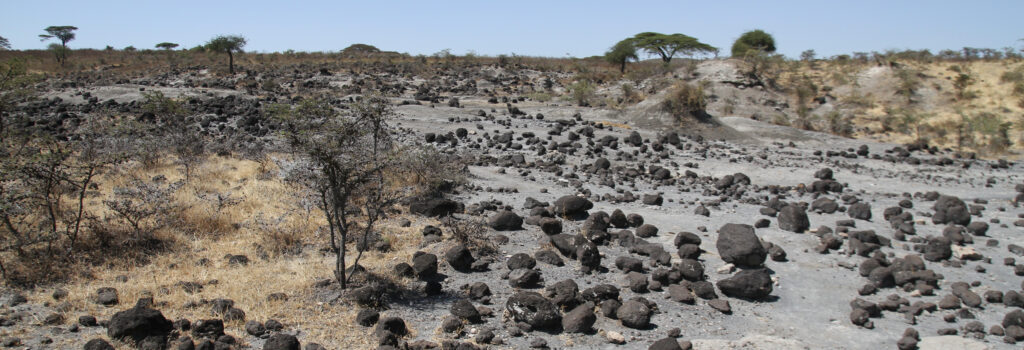
Hominin footprints are rare in eastern Africa and known from the Laetoli (Tanzania), Ileret (Kenya), and Melka Kunture (Ethiopia) areas. The prints were made by Australopithecus afarensis, Homo erectus,
and Homo heidelbergensis. Their study is an important source of information regarding hominin body size, anatomy, positional behavior, and locomotion biomechanics. The most-known and best-studied examples are the 3.66-Ma Australopithecus afarensis footprint trackways at Laetoli, which represent the oldest known record of hominin bipedalism in Africa. The footprints occur in a volcanic tuff sequence, which was originally deposited as melilite nephelinite ash. Recent excavations show that this valuable paleoanthropological site is slowly disappearing as a result of surface diagenetic processes. Preservation of the footprints is essential and urgently needed.

This content is for Registered members only. To subscribe, please
join one of our participating societies or contact the Editorial Team.

Login
Already a member? Log in here

Laetoli: The Oldest Known Hominin Footprints in Volcanic Ash Read More »

Carbonatites: Contrasting, Complex, and Controversial

Carbonatites are unique, enigmatic, and controversial rocks directly sourced from, or evolved from, mantle melts. Mineral proportions and chemical compositions of carbonatites are highly variable and depend on a wide range of processes: melt generation, liquid immiscibility, fractional crystallization, and post-magmatic alteration. Observations of plutonic carbonatites and their surrounding metasomatic rocks (fenites) suggest that carbonatite intrusions and volcanic rocks do not fully represent the true compositions of the parental carbonatite melts and fluids. Carbonatites are enriched in rare elements, such as niobium and rare earths, and may host deposits of these elements. Carbonatites are also important for understanding the carbon cycle and mantle evolution.

This content is for Registered members only. To subscribe, please
join one of our participating societies or contact the Editorial Team.

Login
Already a member? Log in here

Carbonatites: Contrasting, Complex, and Controversial Read More »

Scroll to Top

December 2025 --The Variscan Orogeny in Europe – Understanding Supercontinent Formation

The Variscan orogen formed between 380 and 300 million years ago through several accretionary and collisional cycles, culminating with the construction of the Pangea supercontinent. This process occurred via sequential opening and closure of oceanic basins, synchronous detachment of Gondwana derived continental ribbons, and their outboard amalgamation onto the Laurussia margin. The Variscan orogen is rather unique compared with other orogenic belts on Earth: its overthickened and dominantly magmatic crust in the central belt, surprisingly minor mantle involvement in the magmatic and geodynamic processes, coherent and pulsed magmatism along the collision suture, and its complex accretionary history. Because its final product, Pangea, is the youngest and best-understood supercontinent on Earth, the Variscan orogeny offers clues for understanding the mechanisms of supercontinent formation.