


Author name: Bernard J. Wood

Garnet in the Earth’s Mantle

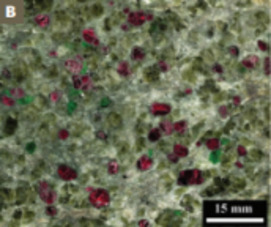
Aluminous garnet, (Mg,Fe2+,Ca)3(Al,Cr)2Si3O12, is an important constituent of mantle peridotite (~10%) and of the other abundant upper mantle rock, eclogite (~50%). Its unusual crystal chemistry means that it strongly prefers some trace elements and confers a “garnet signature” on mantle melts. As depth increases from 250 to 600 km, garnet increases in abundance in mantle rocks, dissolving large fractions of the other silicates and becoming Si rich (majoritic). These compositional changes are observed in some garnets found as inclusions in diamond. Garnet disappears from mantle assemblages at about 700 km depth, where it is replaced by an even denser silicate, perovskite.

This content is for Registered members only. To subscribe, please
join one of our participating societies or contact the Editorial Team.

Login
Already a member? Log in here

Garnet in the Earth’s Mantle Read More »
The Role of Reducing Conditions in Building Mercury

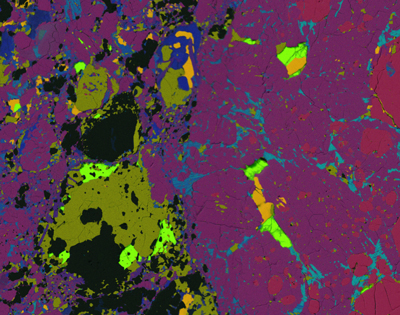
Extremely reducing conditions, such as those that prevailed during the accretion and differentiation of Mercury, change the “normal” pattern of behaviour of many chemical elements. Lithophile elements can become chalcophile, siderophile elements can become lithophile, and volatile elements can become refractory. In this context, unexpected elements, such as Si, are extracted to the core, while others (S, C) concentrate in the silicate portion of the planet, eventually leading to an exotic surface mineralogy. In this article, experimental, theoretical and cosmochemical arguments are applied to the understanding of how reducing conditions influenced Mercury, from the nature of its building blocks to the dynamics of its volcanism.

This content is for Registered members only. To subscribe, please
join one of our participating societies or contact the Editorial Team.

Login
Already a member? Log in here

The Role of Reducing Conditions in Building Mercury Read More »

Scroll to Top

December 2025 --The Variscan Orogeny in Europe – Understanding Supercontinent Formation

The Variscan orogen formed between 380 and 300 million years ago through several accretionary and collisional cycles, culminating with the construction of the Pangea supercontinent. This process occurred via sequential opening and closure of oceanic basins, synchronous detachment of Gondwana derived continental ribbons, and their outboard amalgamation onto the Laurussia margin. The Variscan orogen is rather unique compared with other orogenic belts on Earth: its overthickened and dominantly magmatic crust in the central belt, surprisingly minor mantle involvement in the magmatic and geodynamic processes, coherent and pulsed magmatism along the collision suture, and its complex accretionary history. Because its final product, Pangea, is the youngest and best-understood supercontinent on Earth, the Variscan orogeny offers clues for understanding the mechanisms of supercontinent formation.