
Author name: Craig E. Manning

Subduction-Zone Fluids

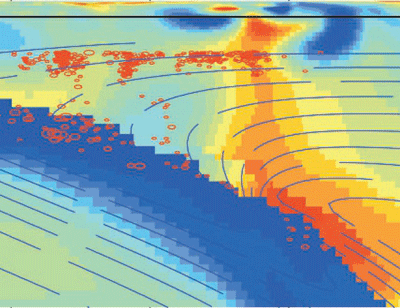
Fluids are essential to the physical and chemical processes in subduction zones. Two types of subduction-zone fluids can be distinguished. First, shallow fluids, which are relatively dilute and water rich and that have properties that vary between subduction zones depending on the local thermal regime. Second, deep fluids, which possess higher proportions of dissolved silicate, salts and non-polar gases relative to water content, and have properties that are broadly similar in most subduction systems, regardless of the local thermal structure. We review key physical and chemical properties of fluids in two key subduction-zone contexts—along the slab top and beneath the volcanic front—to illustrate the distinct properties of shallow and deep subduction-zone fluids.

This content is for Registered members only. To subscribe, please
join one of our participating societies or contact the Editorial Team.

Login
Already a member? Log in here

Subduction-Zone Fluids Read More »

Hydrothermal Properties of Geologic Fluids

Aqueous fluids are critical agents in the geochemical evolution of Earth’s interior. Fluid circulation and fluid–rock reactions in the Earth take place at temperatures ranging from ambient to magmatic, at pressures from ambient to extreme, and involve fluids that range from nearly pure H2O through to complex, multicomponent solutions. Consequently, the physical and chemical properties of hydrothermal fluids vary widely as functions of geologic setting; this variation strongly impacts fluid-driven processes. This issue will focus on the nature of geologic fluids at hydrothermal conditions and how such fluids affect geologic processes in some major settings.

This content is for Registered members only. To subscribe, please
join one of our participating societies or contact the Editorial Team.

Login
Already a member? Log in here

Hydrothermal Properties of Geologic Fluids Read More »

Scroll to Top

December 2025 --The Variscan Orogeny in Europe – Understanding Supercontinent Formation

The Variscan orogen formed between 380 and 300 million years ago through several accretionary and collisional cycles, culminating with the construction of the Pangea supercontinent. This process occurred via sequential opening and closure of oceanic basins, synchronous detachment of Gondwana derived continental ribbons, and their outboard amalgamation onto the Laurussia margin. The Variscan orogen is rather unique compared with other orogenic belts on Earth: its overthickened and dominantly magmatic crust in the central belt, surprisingly minor mantle involvement in the magmatic and geodynamic processes, coherent and pulsed magmatism along the collision suture, and its complex accretionary history. Because its final product, Pangea, is the youngest and best-understood supercontinent on Earth, the Variscan orogeny offers clues for understanding the mechanisms of supercontinent formation.