Author name: Larry M. Heaman

Dating Kimberlites: Methods and Emplacement Patterns Through Time

Key to deciphering the origin and tectonic setting of kimberlite magmatism is an accurate understanding of when they formed. Although determining absolute emplacement ages for kimberlites is challenging, recent methodological advances have contributed to a current database of >1,000 precisely dated kimberlite occurrences. Several profound findings emerge from kimberlite geochronology: kimberlites were absent in the first half of Earth history; most kimberlites were emplaced during the Mesozoic; kimberlite magma formation may be triggered by a variety of Earth processes (deep mantle plumes, subduction of oceanic lithosphere, continental rifting); and enhanced periods of kimberlite magmatism coincide with supercontinent breakup.

This content is for Registered members only. To subscribe, please
join one of our participating societies or contact the Editorial Team.

Login
Already a member? Log in here

Dating Kimberlites: Methods and Emplacement Patterns Through Time Read More »

Kimberlites as Geochemical Probes of Earth’s Mantle

Kimberlites are ultrabasic, Si-undersaturated, low Al, low Na rocks rich in CO2 and H2O. The distinctive geochemical character of kimberlite is strongly influenced by the nature of the local underlying lithospheric mantle. Despite this, incompatible trace element ratios and radiogenic isotope characteristics of kimberlites, filtered for the effects of crustal contamination and alteration, closely resemble rocks derived from the deeper, more primitive, convecting mantle. This suggests that the ultimate magma source is sub-lithospheric. Although the composition of primitive kimberlite melt remains unresolved, kimberlites are likely derived from the convecting mantle, with possible source regions ranging from just below the lithosphere, through the transition zone, to the core–mantle boundary.

This content is for Registered members only. To subscribe, please
join one of our participating societies or contact the Editorial Team.

Login
Already a member? Log in here

Kimberlites as Geochemical Probes of Earth’s Mantle Read More »

Kimberlites: From Deep Earth to Diamond Mines

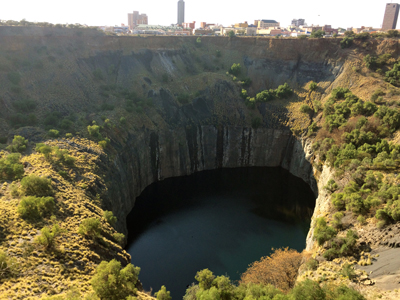
Kimberlites are rare, enigmatic, low-volume igneous rocks. They are highly enriched in magnesium, volatiles (CO2 and H2O) and incompatible trace elements and are thought to be the most deeply derived (>150 km) magmatic rocks on Earth. Kimberlites occur in ancient and thick continental lithosphere, forming intrusive sheets and composite pipes, commonly in clusters. Despite their rarity, kimberlites have attracted considerable attention because they entrain not only abundant mantle fragments but also diamonds, which can provide a uniquely rich picture of the deep Earth. This issue summarises current thinking on kimberlite petrology, geochemistry, and volcanology and outlines the outstanding questions on the genesis of kimberlites and associated diamond mines.

This content is for Registered members only. To subscribe, please
join one of our participating societies or contact the Editorial Team.

Login
Already a member? Log in here

Kimberlites: From Deep Earth to Diamond Mines Read More »

Scroll to Top

December 2025 --The Variscan Orogeny in Europe – Understanding Supercontinent Formation

The Variscan orogen formed between 380 and 300 million years ago through several accretionary and collisional cycles, culminating with the construction of the Pangea supercontinent. This process occurred via sequential opening and closure of oceanic basins, synchronous detachment of Gondwana derived continental ribbons, and their outboard amalgamation onto the Laurussia margin. The Variscan orogen is rather unique compared with other orogenic belts on Earth: its overthickened and dominantly magmatic crust in the central belt, surprisingly minor mantle involvement in the magmatic and geodynamic processes, coherent and pulsed magmatism along the collision suture, and its complex accretionary history. Because its final product, Pangea, is the youngest and best-understood supercontinent on Earth, the Variscan orogeny offers clues for understanding the mechanisms of supercontinent formation.