Author name: Harry Y. McSween Jr.

Unique, Antique Vesta

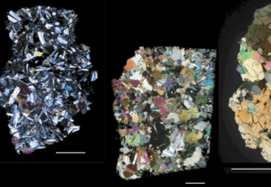
Most asteroids are collisional rubble from eons past, and few of them have survived intact. Vesta, the second most massive asteroid, is the only differentiated, rocky body in this category. This asteroid provides a unique view of the kinds of planetesimals that accreted to form the terrestrial planets. We know more about this asteroid than any other, thanks to its recently completed exploration by the orbiting Dawn spacecraft and studies of the ~1000 meteorites derived from it. The synergy provided by in situ analyses and samples has allowed an unparalleled understanding of Vesta’s mineralogy, petrology, geochemistry, and geochronology.

This content is for Registered members only. To subscribe, please
join one of our participating societies or contact the Editorial Team.

Login
Already a member? Log in here

Unique, Antique Vesta Read More »

The Orbital Search for Altered Materials on Mars

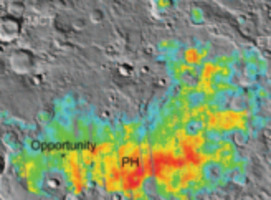
The Martian surface is dominated by primary igneous minerals common in basaltic rocks. Limited chemical alteration exists in fine-grained dust, and is likely in sands and rocks at high latitudes and in the northern lowland plains where materials have interacted with ice and snow. Evidence for extensive production of secondary phases is revealed at higher spatial resolutions, where alteration effects of unique, and perhaps time-limited, aqueous environments are observed. The distribution of ice on Mars thus appears to have a global influence on the production of alteration materials, whereas the effects of water are discovered in unique and locally diverse geological settings.

This content is for Registered members only. To subscribe, please
join one of our participating societies or contact the Editorial Team.

Login
Already a member? Log in here

The Orbital Search for Altered Materials on Mars Read More »

Water on Mars

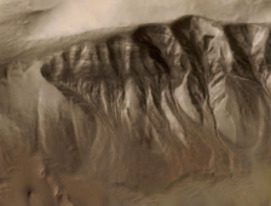
Water on Mars exists at the poles and in the subsurface. It has interacted with crustal rocks, providing geomorphological, geochemical, and mineralogical insights into Mars’ geological history and inferences about its biological potential. The roles of water are revealed through studies of altered materials using orbiting-spacecraft imagery and spectroscopy, instruments mounted on rovers, and laboratory measurements on Martian meteorites.

This content is for Registered members only. To subscribe, please
join one of our participating societies or contact the Editorial Team.

Login
Already a member? Log in here

Water on Mars Read More »

Scroll to Top

December 2025 --The Variscan Orogeny in Europe – Understanding Supercontinent Formation

The Variscan orogen formed between 380 and 300 million years ago through several accretionary and collisional cycles, culminating with the construction of the Pangea supercontinent. This process occurred via sequential opening and closure of oceanic basins, synchronous detachment of Gondwana derived continental ribbons, and their outboard amalgamation onto the Laurussia margin. The Variscan orogen is rather unique compared with other orogenic belts on Earth: its overthickened and dominantly magmatic crust in the central belt, surprisingly minor mantle involvement in the magmatic and geodynamic processes, coherent and pulsed magmatism along the collision suture, and its complex accretionary history. Because its final product, Pangea, is the youngest and best-understood supercontinent on Earth, the Variscan orogeny offers clues for understanding the mechanisms of supercontinent formation.