


Author name: Jay D. Bass

Elastic Properties of Minerals: A Key for Understanding the Composition and Temperature of Earth’s Interior

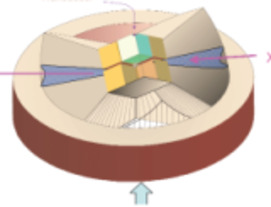
Seismological studies give us a high-definition 3-D picture of the Earth’s interior in terms of seismic velocity and density. Near the surface, observations of these properties can be compared with rock samples. As we go deeper into the Earth, interpretation of seismic data is more difficult. Laboratory measurements of velocities and other elastic properties of minerals are the key to understanding this seismic information, allowing us to translate it into quantities such as chemical composition, mineralogy, temperature, and preferred orientation of minerals. Here we present a description of modern techniques for measuring elastic properties at high pressures and temperatures, emphasizing those most relevant to understanding the interior of the Earth and other planets.
This content is for Registered members only. To subscribe, please
join one of our participating societies or contact the Editorial Team.

Login
Already a member? Log in here

Elastic Properties of Minerals: A Key for Understanding the Composition and Temperature of Earth’s Interior Read More »

Deep Earth and Recent Developments in Mineral Physics

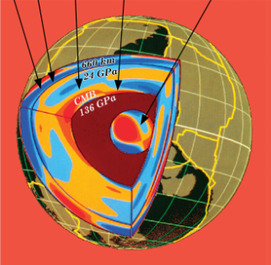
Very few rocks on the Earth’s surface come from below the crust. In fact, most of Earth’s interior is unsampled, at least in the sense that we do not have rock samples from it. So how do we know what is down there? Part of the answer comes from laboratory and computer experiments that try to recreate the enormous pressure–temperature conditions in the deep Earth and to measure the properties of minerals under these conditions. This is the realm of high-pressure mineral physics and chemistry. By comparing mineral properties at high pressures and temperatures with geophysical observations of seismic velocities and density at depth, we get insight into the mineralogy, composition, temperature, and deformation within Earth’s interior, from the top of the mantle to the center of the planet.

This content is for Registered members only. To subscribe, please
join one of our participating societies or contact the Editorial Team.

Login
Already a member? Log in here

Deep Earth and Recent Developments in Mineral Physics Read More »

Scroll to Top

December 2025 --The Variscan Orogeny in Europe – Understanding Supercontinent Formation

The Variscan orogen formed between 380 and 300 million years ago through several accretionary and collisional cycles, culminating with the construction of the Pangea supercontinent. This process occurred via sequential opening and closure of oceanic basins, synchronous detachment of Gondwana derived continental ribbons, and their outboard amalgamation onto the Laurussia margin. The Variscan orogen is rather unique compared with other orogenic belts on Earth: its overthickened and dominantly magmatic crust in the central belt, surprisingly minor mantle involvement in the magmatic and geodynamic processes, coherent and pulsed magmatism along the collision suture, and its complex accretionary history. Because its final product, Pangea, is the youngest and best-understood supercontinent on Earth, the Variscan orogeny offers clues for understanding the mechanisms of supercontinent formation.