
Author name: Stearns A. Morse

Plagioclase Zonation: An Archive of Trapped Liquid and Crustal Contamination

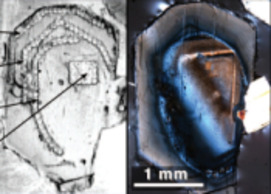
Many cumulates in layered intrusions contain plagioclase crystals that are compositionally zoned in terms of their major elements, and, less commonly, in their 87Sr/86Sr isotopic ratios. Major-element zoning in plagioclase is best explained by trapped liquid in the pore spaces between cumulus crystals, which is a result of the complex interplay between the rate of crystal growth and the cooling rate. Isotopic zoning in feldspars likely reflects crystal growth in a magma that is becoming, or has become, isotopically contaminated through wall rock partial melting and assimilation processes. Mineral-scale isotopic zoning, such as detected in plagioclase, can be used to infer the cooling rates of layered intrusions.

This content is for Registered members only. To subscribe, please
join one of our participating societies or contact the Editorial Team.

Login
Already a member? Log in here

Plagioclase Zonation: An Archive of Trapped Liquid and Crustal Contamination Read More »
Isotopic Microsampling of Magmatic Rocks

Radiogenic isotope ratios can be used as a kind of petrogenetic “DNA” to identify the source components of magmas. Technical advances allowing us to measure isotopic compositions at the sub-crystal scale have led to the realisation that many magmatic rocks are isotopically heterogeneous. Crystals traditionally regarded as phenocrysts grown from the host magma have now been shown to be wholly or partly out of isotopic equilibrium with the glass or groundmass in which they are contained. Many of these crystals are likely to be recycled from earlier cumulates. Combining these fingerprinting techniques with the other approaches described in this issue offers an unprecedented opportunity to understand the processes and timescales through which magmas are assembled, differentiated and delivered to sites of eruption or emplacement.

This content is for Registered members only. To subscribe, please
join one of our participating societies or contact the Editorial Team.

Login
Already a member? Log in here

Isotopic Microsampling of Magmatic Rocks Read More »

Frontiers in Textural and Microgeochemical Analysis

Igneous rocks display a large and varied range of textures and compositions, reflecting complex magma pathways, differentiation processes and cooling histories. Integrating geochemical analyses with petrographic and textural information allows us to gain valuable insights into the details of the magma system: the rock’s texture serves as a window into the crystallization history of the magma, while the compositions of the components (crystals and glass) document the conditions and pathways of evolution. In this issue of Elements we take a look at the frontiers in igneous petrology, focussing on the state of the art in textural and microgeochemical analysis and on how we can use some of the latest approaches to unravel the complexities of the magmatic system.

This content is for Registered members only. To subscribe, please
join one of our participating societies or contact the Editorial Team.

Login
Already a member? Log in here

Frontiers in Textural and Microgeochemical Analysis Read More »

Scroll to Top

December 2025 --The Variscan Orogeny in Europe – Understanding Supercontinent Formation

The Variscan orogen formed between 380 and 300 million years ago through several accretionary and collisional cycles, culminating with the construction of the Pangea supercontinent. This process occurred via sequential opening and closure of oceanic basins, synchronous detachment of Gondwana derived continental ribbons, and their outboard amalgamation onto the Laurussia margin. The Variscan orogen is rather unique compared with other orogenic belts on Earth: its overthickened and dominantly magmatic crust in the central belt, surprisingly minor mantle involvement in the magmatic and geodynamic processes, coherent and pulsed magmatism along the collision suture, and its complex accretionary history. Because its final product, Pangea, is the youngest and best-understood supercontinent on Earth, the Variscan orogeny offers clues for understanding the mechanisms of supercontinent formation.