

Author name: Mark D. Schmitz

High-Precision Geochronology

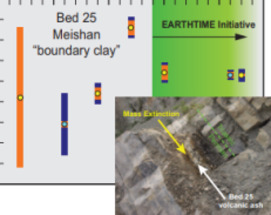
High-precision geochronology is integral to testing hypotheses regarding the correlation, causes, and rates of events and processes in Earth history. Recent studies have sought to reconcile very precise, but apparently conflicting, ages for the same geological samples and events using different chronometers. Both systematic (decay constants, ages of standard materials) and geological (daughter-nuclide loss, inheritance) complexities contribute to the challenges of rock-clock calibration. Community-wide efforts to improve radioisotope geochronology have successfully mitigated many of these factors, and have brought high-precision geochronology to a threshold of unprecedented integration with stratigraphic and geochemical proxies of Earth systems dynamics.

This content is for Registered members only. To subscribe, please
join one of our participating societies or contact the Editorial Team.

Login
Already a member? Log in here

High-Precision Geochronology Read More »
One Hundred Years of Isotope Geochronology, and Counting

In 1913, Frederick Soddy’s research on the fundamentals of radioactivity led to the discovery of “isotopes.” Later that same year, Arthur Holmes published his now famous book The Age of the Earth, in which he applied this new science of radioactivity to the quantification of geologic time. Combined, these two landmark events did much to establish the field of “isotope geochronology” – the science that underpins our knowledge of the absolute age of most Earth (and extraterrestrial) materials. In celebrating the centenary, this issue brings together modern perspectives on the continually evolving fi eld of isotope geochronology – a discipline that reflects and responds to the demands of studies ranging from the early evolution of the Solar System to our understanding of Quaternary climate change, and the 4.5 billion years in between.

This content is for Registered members only. To subscribe, please
join one of our participating societies or contact the Editorial Team.

Login
Already a member? Log in here

One Hundred Years of Isotope Geochronology, and Counting Read More »

Scroll to Top

December 2025 --The Variscan Orogeny in Europe – Understanding Supercontinent Formation

The Variscan orogen formed between 380 and 300 million years ago through several accretionary and collisional cycles, culminating with the construction of the Pangea supercontinent. This process occurred via sequential opening and closure of oceanic basins, synchronous detachment of Gondwana derived continental ribbons, and their outboard amalgamation onto the Laurussia margin. The Variscan orogen is rather unique compared with other orogenic belts on Earth: its overthickened and dominantly magmatic crust in the central belt, surprisingly minor mantle involvement in the magmatic and geodynamic processes, coherent and pulsed magmatism along the collision suture, and its complex accretionary history. Because its final product, Pangea, is the youngest and best-understood supercontinent on Earth, the Variscan orogeny offers clues for understanding the mechanisms of supercontinent formation.