


Author name: Davide Novella

Deep Hydrogen Reservoirs and Longevity

The oceans are voluminous H2O reservoirs that regulate climate and life on Earth. Yet much larger H2O reservoirs, potentially accounting for several oceans, may exist in the Earth’s mantle and core in the form of H atoms trapped into the structure of nominally anhydrous minerals (NAMs). H atoms trapped into the structure of nominally anhydrous minerals (NAMs) and metallic alloys. Determining the size of these ‘hidden oceans’ is key to understanding planetary evolution and surface dynamics and can be done by combining data from rare natural samples with experimental and theoretical models. The longevity of these deep H reservoirs is controlled by H transport rates over geological times, which are dominated by percolation rates, once H partitions into melts, or by plate mobility, if H remains locked in NAMs.

This content is for Registered members only. To subscribe, please
join one of our participating societies or contact the Editorial Team.

Login
Already a member? Log in here

Deep Hydrogen Reservoirs and Longevity Read More »

Deforming the Upper Mantle—Olivine Mechanical Properties and Anisotropy

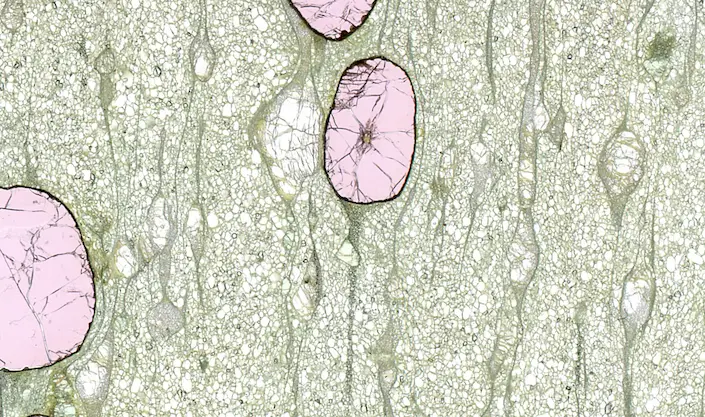
The interior of the Earth remains our last terra incognita, inaccessible to direct observations. Our understanding of the deformation of the mantle, which shapes our planet through convection and plate tectonics, is based on analysis of: (1) rare mantle rocks carried to the Earth’s surface by volcanic or tectonic processes, (2) the consequences of this deformation on the planet’s surface, and (3) geophysical data. These observables combined with laboratory experiments and numerical modeling imply that olivine deforms via the motion of defects within its crystalline structure and along grain boundaries. Ductile deformation by these crystal-scale processes results in anisotropic propagation of seismic waves, which allows us to probe upper-mantle deformation at scales of tens to hundreds of kilometers.

This content is for Registered members only. To subscribe, please
join one of our participating societies or contact the Editorial Team.

Login
Already a member? Log in here

Deforming the Upper Mantle—Olivine Mechanical Properties and Anisotropy Read More »

Scroll to Top

December 2025 --The Variscan Orogeny in Europe – Understanding Supercontinent Formation

The Variscan orogen formed between 380 and 300 million years ago through several accretionary and collisional cycles, culminating with the construction of the Pangea supercontinent. This process occurred via sequential opening and closure of oceanic basins, synchronous detachment of Gondwana derived continental ribbons, and their outboard amalgamation onto the Laurussia margin. The Variscan orogen is rather unique compared with other orogenic belts on Earth: its overthickened and dominantly magmatic crust in the central belt, surprisingly minor mantle involvement in the magmatic and geodynamic processes, coherent and pulsed magmatism along the collision suture, and its complex accretionary history. Because its final product, Pangea, is the youngest and best-understood supercontinent on Earth, the Variscan orogeny offers clues for understanding the mechanisms of supercontinent formation.