


Author name: Jeroen Ritsema

The 2011 Tohoku Earthquake

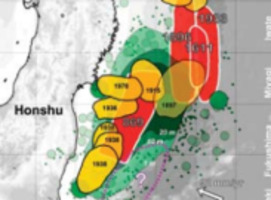
Rapid seismological analyses, carried out within minutes of the March 11, 2011, Tohoku earthquake, were crucial in providing an earthquake ground shaking and tsunami early warning and in hastening the evacuation of the population along Japan’s northeastern coast. By 20 to 30 minutes after fault rupture began, these analyses had established that the event had a moment magnitude of Mw = 9 and involved shallow thrust faulting on the plate boundary megathrust. Preparation for future large earthquakes on megathrusts in Japan and elsewhere should include onshore and offshore geodetic monitoring of strain accumulation, implementation of rapid earthquake and tsunami warning systems, and public training and education for shaking and tsunami response.

This content is for Registered members only. To subscribe, please
join one of our participating societies or contact the Editorial Team.

Login
Already a member? Log in here

The 2011 Tohoku Earthquake Read More »
Discovery of Post-Perovskite and New Views on the Core–Mantle Boundary Region

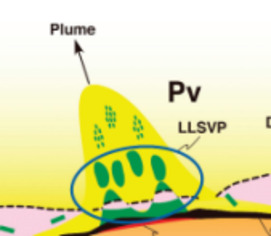
Aphase transition of MgSiO3 perovskite, the most abundant component of the lower mantle, to a higher-pressure form called post-perovskite was recently discovered for pressure and temperature conditions in the vicinity of the Earth’s core–mantle boundary. This discovery has profound implications for the chemical, thermal, and dynamical structure of the lowermost mantle called the D” region. Several major seismological characteristics of the D” region can now be explained by the presence of post-perovskite, and the specific properties of the phase transition provide the first direct constraints on absolute temperature and temperature gradients in the lowermost mantle. Here we discuss the current understanding of the core–mantle boundary region.

This content is for Registered members only. To subscribe, please
join one of our participating societies or contact the Editorial Team.

Login
Already a member? Log in here

Discovery of Post-Perovskite and New Views on the Core–Mantle Boundary Region Read More »

Scroll to Top

December 2025 --The Variscan Orogeny in Europe – Understanding Supercontinent Formation

The Variscan orogen formed between 380 and 300 million years ago through several accretionary and collisional cycles, culminating with the construction of the Pangea supercontinent. This process occurred via sequential opening and closure of oceanic basins, synchronous detachment of Gondwana derived continental ribbons, and their outboard amalgamation onto the Laurussia margin. The Variscan orogen is rather unique compared with other orogenic belts on Earth: its overthickened and dominantly magmatic crust in the central belt, surprisingly minor mantle involvement in the magmatic and geodynamic processes, coherent and pulsed magmatism along the collision suture, and its complex accretionary history. Because its final product, Pangea, is the youngest and best-understood supercontinent on Earth, the Variscan orogeny offers clues for understanding the mechanisms of supercontinent formation.