


Author name: Jing-Sui Yang

Diamonds in Ophiolites

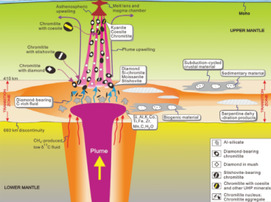
Ophiolites are a newly documented host of diamonds on Earth. Abundant diamonds have indeed been separated from peridotites and chromitites of ophiolites in China, Myanmar, and Russia. In addition, diamond grains have recently been discovered in chromite from the Cretaceous Luobusa ophiolite (Tibet) and the early Paleozoic Ray-Iz ophiolite (polar Urals, Russia). These diamonds are accompanied by a wide range of highly reduced minerals, such as Ni–Mn–Co alloys, Fe–Si and Fe–C phases, and moissanite (SiC); these have been found as either mineral separates or inclusions in diamonds and indicate growth under superreducing conditions. The diamond-bearing chromite grains likely formed near the mantle transition zone and were then brought to shallow levels in the upper mantle to form podiform chromitites in oceanic lithosphere. Because these diamond grains occur widely in peridotites and chromitites of many ophiolites, we refer to them as ophiolite-hosted diamonds. It is possible that such diamonds may be common in the upper oceanic mantle.

This content is for Registered members only. To subscribe, please
join one of our participating societies or contact the Editorial Team.

Login
Already a member? Log in here

Diamonds in Ophiolites Read More »

Ophiolites and Their Origins

Ophiolites are suites of temporally and spatially associated ultramafic, mafic, and felsic rocks that are interpreted to be remnants of ancient oceanic crust and upper mantle. Ophiolites show significant variations in their internal structure, geochemical fingerprints, and emplacement mechanisms. These differences are controlled by (1) the proximity, when formed at the magmatic stage, to a plume or trench; (2) the rate, geometry, and nature of ocean-ridge spreading; (3) mantle composition, temperature, and fertility; and (4) the availability of fluids. The oceanic crust preserved in ophiolites may form in any tectonic setting during the evolution of ocean basins, from the rift–drift and seafloor spreading stages to subduction initiation and terminal closure. An ophiolite is emplaced either from downgoing oceanic lithosphere via subduction-accretion or from the upper plate in a subduction zone through trench–continent collision. Subduction zone tectonics is thus the most important factor in the igneous evolution of ophiolites and their emplacement into continental margins.

This content is for Registered members only. To subscribe, please
join one of our participating societies or contact the Editorial Team.

Login
Already a member? Log in here

Ophiolites and Their Origins Read More »

Scroll to Top

December 2025 --The Variscan Orogeny in Europe – Understanding Supercontinent Formation

The Variscan orogen formed between 380 and 300 million years ago through several accretionary and collisional cycles, culminating with the construction of the Pangea supercontinent. This process occurred via sequential opening and closure of oceanic basins, synchronous detachment of Gondwana derived continental ribbons, and their outboard amalgamation onto the Laurussia margin. The Variscan orogen is rather unique compared with other orogenic belts on Earth: its overthickened and dominantly magmatic crust in the central belt, surprisingly minor mantle involvement in the magmatic and geodynamic processes, coherent and pulsed magmatism along the collision suture, and its complex accretionary history. Because its final product, Pangea, is the youngest and best-understood supercontinent on Earth, the Variscan orogeny offers clues for understanding the mechanisms of supercontinent formation.