Thematic Articles

The Geomicrobiology of Supergene Metal Deposits

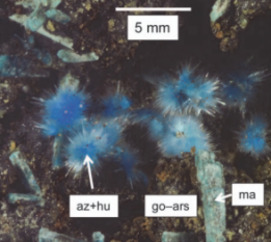
Microbe-catalyzed redistribution of metals in the Earth’s crust can produce remarkable, and often economic, metal enrichments. These catalytic processes rely on redox transformations to produce secondary-mineral assemblages. Classic supergene systems relate to copper, where weathering is driven by microbial activity. Roll-front uranium deposits represent a similar, albeit lateral, evolution from aerobic weathering to anaerobic enrichment. Gold is generally resistant to oxidation but a remarkable biogeochemical cycle can produce secondary gold. Finally, banded iron formations, which are microbially catalysed sedimentary deposits, can be further weathered to form high-grade ore. Metals are as important to enzyme catalysts as these catalysts are to metal enrichment.

This content is for Registered members only. To subscribe, please
join one of our participating societies or contact the Editorial Team.

Login
Already a member? Log in here

The Geomicrobiology of Supergene Metal Deposits Read More »
Predicting Geologic Corrosion with Electrodes

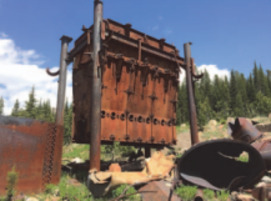
Ever since humans discovered how to separate metal from its ore mineral, preserving its metallic luster has been a driving force in the advancement of materials science. In modern times, developing materials that will contain and isolate nuclear waste has pushed corrosion science to new limits. We must now predict corrosion rates over geologic time scales, upwards of a million years. This article reviews the electrochemical basics that underpin metal and mineral corrosion and uses that to understand the case study of copper corrosion in nuclear-waste containers. Electrochemistry can also explain electron-transfer processes on mineral surfaces and so offer insight into weathering and environmentally relevant natural redox processes, such as those forming supergene metal deposits.

This content is for Registered members only. To subscribe, please
join one of our participating societies or contact the Editorial Team.

Login
Already a member? Log in here

Predicting Geologic Corrosion with Electrodes Read More »

Copper Isotopic Perspectives on Supergene Processes: Implications for the Global Cu Cycle

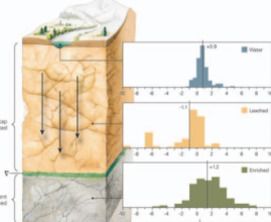
A compilation of copper isotopic compositions (δ65Cu) from supergene systems suggests distinct differences in the mean δ65Cu of Cu in leach cap (δ65Cu = −1.2 ± 3.5‰), enrichment zone (mean δ65Cu = +1.2 ± 4.2‰), and fl uids (mean δ65Cu = +0.9 ± 1.3‰) relative to the high-temperature sulfi des that comprise the primary ore (δ65Cu = +0.1 ± 0.6‰). These isotopic differences can be explained by the oxidative dissolution of primary ore minerals, such as chalcopyrite, and the subsequent precipitation of oxides in the near-surface system and of sulfi des at depth. A dynamic mass balance model predicts the observed Cu isotopic compositions of the Cu reservoirs in nature and constrains the temporal isotopic evolution of supergene systems. From the model, these systems isotopically evolve to substantial extents over 500 ka to 5 Ma time scales. In relatively closed systems, percent-level loss of Cu from the solid (with δ65Cu values >>0‰) is possible, suggesting that supergene systems are important components of the global Cu cycle.

This content is for Registered members only. To subscribe, please
join one of our participating societies or contact the Editorial Team.

Login
Already a member? Log in here

Copper Isotopic Perspectives on Supergene Processes: Implications for the Global Cu Cycle Read More »

The Paleoclimatic Signatures of Supergene Metal Deposits

Supergene metal deposits host a comprehensive record of climate-driven geochemical reactions that may span the entire Cenozoic. Products of these reactions can be dated by a variety of radiogenic isotopic methods, such as 40Ar/39Ar, (U–Th)/He, U–Pb, and U-series. The frequency of mineral precipitation, determined by dating a representative number of samples of a particular mineral collected from distinct parts of the supergene ore body, refl ects times in the geological past when weathering conditions were conducive to water–rock interaction. The frequency of mineral precipitation through time permits identifying periods in the geological past when climatic conditions were most conducive to chemical weathering and supergene ore genesis.

This content is for Registered members only. To subscribe, please
join one of our participating societies or contact the Editorial Team.

Login
Already a member? Log in here

The Paleoclimatic Signatures of Supergene Metal Deposits Read More »
Supergene Alteration of Ore Deposits: From Nature to Humans

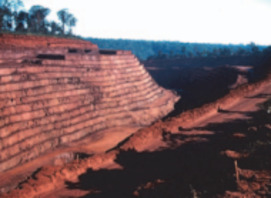
Supergene minerals form under near-ambient conditions on the Earth’s surface. Supergene mineralization is controlled by the parent rock composition, climatic conditions, geomorphological environment, and chemical compounds added during mineral processing. They appear in alteration zones called “orecretes.” Bronze Age miners exploited these easily accessible high-grade soft ores for Fe, Cu, Pb, and Ag. Some supergene minerals can also grow in poorly ventilated mining galleries and shafts, coat metal mining artifacts and smelting residues, and form from disastrous blasts and fi res in ancient mining settlements. Supergene deposits bridge the gap between humans and metal resources at the interface between rock, soil, air, water, and living organisms. These deposits provide essential clues to geological, environmental, and archeological studies

This content is for Registered members only. To subscribe, please
join one of our participating societies or contact the Editorial Team.

Login
Already a member? Log in here

Supergene Alteration of Ore Deposits: From Nature to Humans Read More »

Geological and Economic Significance of Supergene Metal Deposits

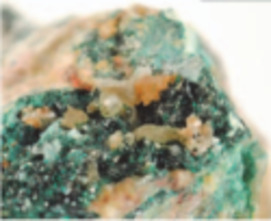
Supergene metal deposits form when common rock types or deeply buried primary ore bodies are exposed at or near the Earth’s surface and undergo oxidation, dissolution and reconcentration of the metals. Supergene metal deposits are economically interesting because of their accessibility for extraction and increased grades. Scientifically they are attractive because of their mineralogical diversity and what they reveal about surficial history. Apart from supplying mankind’s need for metals, supergene metal deposits provide clues about our past climate and offer an unparalleled opportunity to explore the long-term corrosion behavior of natural and man-made materials and their environmental impact.

This content is for Registered members only. To subscribe, please
join one of our participating societies or contact the Editorial Team.

Login
Already a member? Log in here

Geological and Economic Significance of Supergene Metal Deposits Read More »
Revolution and Evolution: 100 Years of U–Pb Geochronology

U–Pb geochronology has its roots in a spectacular decade of discovery. Within about ten years of the discovery of radioactivity in 1896, old ideas about the nature of matter were overthrown and the seeds of geochronology were planted. After giants of physics like Ernest Rutherford moved on to other research, Arthur Holmes nurtured the new field of geochronology, combining physics, chemistry, and geology to produce the earliest quantitative geologic timescale. Over the following decades, geochronology experienced a series of revolutionary and evolutionary advances, and became a vital part of almost all fields of geology.

This content is for Registered members only. To subscribe, please
join one of our participating societies or contact the Editorial Team.

Login
Already a member? Log in here

Revolution and Evolution: 100 Years of U–Pb Geochronology Read More »

Time Constraints and Tie-Points in the Quaternary Period

The Quaternary Period, by virtue of the near-surface preservation and widespread accessibility of its environmental archives, provides fundamental data to test models of climate change, sea level variation, geomagnetic field variation, human and faunal migration, cultural evolution and more. Spatially disparate records of past environmental change with subannual to multimillennial temporal resolution are compared to examine the relative timing of events and consider causal mechanisms, and this analysis puts great demands on the chronological tools available. Highly precise and accurate age estimates are required, in concert with correlative tools or chronostratigraphic markers. We focus on radioisotope chronometers (e.g. U-series, 40Ar/39Ar and 14C) and illustrate their application in three vignettes for which different strategies are required: (1) the dramatic decades of the last deglaciation (~14.7 ka), (2) before and after one of the last geomagnetic excursions (~41 ka) and (3) the glacial–interglacial cycles of the Middle Pleistocene (125–780 ka).

This content is for Registered members only. To subscribe, please
join one of our participating societies or contact the Editorial Team.

Login
Already a member? Log in here

Time Constraints and Tie-Points in the Quaternary Period Read More »

Dating the Oldest Rocks and Minerals in the Solar System

Meteorites originating from asteroids are the oldest-known rocks in the Solar System, and many predate formation of the planets. Refractory inclusions in primitive chondrites are the oldest-known materials, and chondrules are generally a few million years younger. Igneous achondrites and iron meteorites also formed in the first five million years of the protoplanetary disk and escaped accretion into planets. Isotopic dates from these meteorites serve as time markers for the Solar System’s earliest history. Because of the unique environments in the protoplanetary disk, dating the earliest meteorites has its own opportunities and challenges, different from those of terrestrial geochronology.

This content is for Registered members only. To subscribe, please
join one of our participating societies or contact the Editorial Team.

Login
Already a member? Log in here

Dating the Oldest Rocks and Minerals in the Solar System Read More »

High-Spatial-Resolution Geochronology

High-spatial-resolution isotope analyses have revolutionised U–(Th–)Pb geochronology. These analyses can be done at scales of a few tens of microns or less using secondary ion mass spectrometry or laser ablation inductively coupled plasma mass spectrometry. They allow determination of the internal age variation of uranium- and thorium-bearing minerals and as a consequence much greater understanding of Earth system processes. The determination of variation on the micron scale necessitates the sampling of small volumes, which restricts the achievable precision but allows discrimination of discrete change, linkage to textural information, and determination of multiple isotopic and elemental data sets on effectively the same material. High-spatial-resolution analysis is being used in an increasing number of applications. Some of these applications have become fundamental to their scientific fields, while others have opened new opportunities for research.

This content is for Registered members only. To subscribe, please
join one of our participating societies or contact the Editorial Team.

Login
Already a member? Log in here

High-Spatial-Resolution Geochronology Read More »

Scroll to Top

December 2025 --The Variscan Orogeny in Europe – Understanding Supercontinent Formation

The Variscan orogen formed between 380 and 300 million years ago through several accretionary and collisional cycles, culminating with the construction of the Pangea supercontinent. This process occurred via sequential opening and closure of oceanic basins, synchronous detachment of Gondwana derived continental ribbons, and their outboard amalgamation onto the Laurussia margin. The Variscan orogen is rather unique compared with other orogenic belts on Earth: its overthickened and dominantly magmatic crust in the central belt, surprisingly minor mantle involvement in the magmatic and geodynamic processes, coherent and pulsed magmatism along the collision suture, and its complex accretionary history. Because its final product, Pangea, is the youngest and best-understood supercontinent on Earth, the Variscan orogeny offers clues for understanding the mechanisms of supercontinent formation.