
Thematic Articles

Greenhouse Gas Emissions at the Urban Scale

Cities are responsible for more than 70% of global anthropogenic greenhouse gas emissions from buildings, transport, energy, industry, and waste-related sources. Improved urban-scale emission estimates are essential for understanding local trends and providing guidance for mitigation strategies. Current research in cities around the world is focused on establishing more robust methods for quantifying and modeling urban-scale emissions of the most abundant anthropogenic greenhouse gases: carbon dioxide (CO2), methane (CH4), and nitrous oxide (N2O).

This content is for Registered members only. To subscribe, please
join one of our participating societies or contact the Editorial Team.

Login
Already a member? Log in here

Greenhouse Gas Emissions at the Urban Scale Read More »
Urban Geochemistry and Human Health

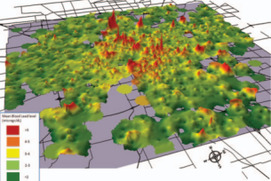
Cities are typically evaluated by metrics involving transportation, energy, and economics, but increasingly, environmental quality and human health are becoming important indicators of safe and habitable cities. Population density and industrialization history have resulted in urban contaminant legacies that can impact the health of urban populations. Integrating environmental assessment with human exposure and health studies is in its infancy, but combined geospatial and geotemporal studies have the capacity to explain and predict the health of urban environments. Studies integrating metal geochemistry with human health impacts reveal the complicated layering of environment, exposure, uptake, and human health in cities, and they call for more effort towards the integration of Earth and health science data.

This content is for Registered members only. To subscribe, please
join one of our participating societies or contact the Editorial Team.

Login
Already a member? Log in here

Urban Geochemistry and Human Health Read More »

Hotbeds of Biogeochemical Diversity: Insights from Urban Long-Term Ecological Research Sites

Over the last two decades, long-term ecological research in the United States has expanded to urban sites. Cities, despite the dominance of built structures, utilize unexpected amounts of human-generated nutrients. Additionally, cities can both intensify and weaken local impacts of processes such as climate. Challenges remain at these sites, as property-scale biogeochemical forcings from individuals and institutions must be accounted for throughout this research. Meeting the challenge is crucial as prediction of biogeochemical processes is fundamental to the development of sustainable strategies for managing human inputs to cities and surrounding areas.

This content is for Registered members only. To subscribe, please
join one of our participating societies or contact the Editorial Team.

Login
Already a member? Log in here

Hotbeds of Biogeochemical Diversity: Insights from Urban Long-Term Ecological Research Sites Read More »

Impact of Urban Development on Physical and Chemical Hydrogeology

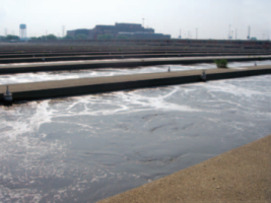
Urban environments significantly alter physical and chemical hydrogeologic settings. The physical alteration of the landscape can change recharge, groundwater flow dynamics, and local water balances. Microbial contamination of water sources due to wastewater is an everpresent threat, but contamination by metals and industrial compounds is a long-term concern in cities with industrial economies. The hydrogeologic setting and the age and wealth of a city are important factors influencing the magnitude of the impact on and the recovery of a hydrogeologic system from urban activities. Urban environments can have unique influences on water geochemistry, making delineation of site-specific urban geochemical markers necessary to quantify the extent of urban effects on water quality.

This content is for Registered members only. To subscribe, please
join one of our participating societies or contact the Editorial Team.

Login
Already a member? Log in here

Impact of Urban Development on Physical and Chemical Hydrogeology Read More »

Legacy Problems in Urban Geochemistry

Modern cities are affected by multiple sources of contamination and pollution, the effects of which overlap in space and time. Toxic metal contamination, organic pollution, smog, acid rain, and greenhouse gas accumulation are the most widespread legacies of an often uncontrolled growth that has deeply changed the geochemical character of the urban environment over the last four millennia. Even though progress has changed human habits and positively influenced the quality of city life, the past is frequently a hidden source of environmental problems with the potential to affect the health of current and future urban residents.

This content is for Registered members only. To subscribe, please
join one of our participating societies or contact the Editorial Team.

Login
Already a member? Log in here

Legacy Problems in Urban Geochemistry Read More »

WHY URBAN GEOCHEMISTRY?

In a very short period of time, the majority of the human population has become urban, and by 2050 two out of every three people in the world will live in cities. Urban areas are extremely important socially, economically, and culturally, but they also have a profound impact on the environment. In that context, this issue of Elements considers the geochemical significance of 21st-century cities and some of the unprecedented challenges they face.

This content is for Registered members only. To subscribe, please
join one of our participating societies or contact the Editorial Team.

Login
Already a member? Log in here

WHY URBAN GEOCHEMISTRY? Read More »

Rare Earth Mining and Exploration in North America

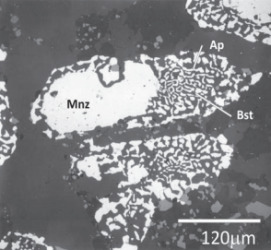
The occurrences of rare earth elements (REEs) in North America are abundant and diverse in mineralogy and geology. The Mountain Pass carbonatite in California historically has been a major world source for the light REEs. Monazite sands have also been mined on a moderate level in the southeastern United States. Fluids released from the mining of uraninite at Elliot Lake, Ontario, were intermittently a source for yttrium. Peralkaline igneous rocks in several areas of North America are currently under exploration for the entire REE spectrum, with emphasis on the heavy REEs. Although many REE occurrences contain a substantial tonnage of REEs, amenability to mineral processing and extraction of the REEs must be definitively established in each case.

This content is for Registered members only. To subscribe, please
join one of our participating societies or contact the Editorial Team.

Login
Already a member? Log in here

Rare Earth Mining and Exploration in North America Read More »

Diversity of Rare Earth Deposits: The Key Example of China

As a source of strategic commodities for high technologies, the deposits of rare earth elements (REEs) in China are a world-class phenomenon. The combination of the world’s largest accumulation of REEs in the Bayan Obo deposit and the low cost of mining the extremely valuable heavy REEs from residual deposits makes China almost a monopoly producer. Research on a range of Chinese deposits shows that not only hypogene but also secondary processes create economic REE deposits. These deposits have characteristic REE distribution patterns, which range from primary light REE enrichment in carbonatites from the Himalayan Mianning–Dechang orogenic belt and in metamorphosed carbonatite and polyphase mineralization at Bayan Obo, through unusual flat REE patterns in carbonatites from the Qinling orogenic belt, to strong secondary heavy REE enrichment in residual clays from southern China.

This content is for Registered members only. To subscribe, please
join one of our participating societies or contact the Editorial Team.

Login
Already a member? Log in here

Diversity of Rare Earth Deposits: The Key Example of China Read More »

Hydrothermal Mobilisation of the Rare Earth Elements – a Tale of “Ceria” and “Yttria”

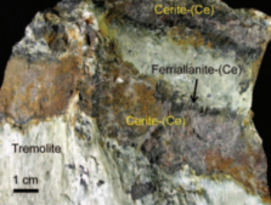
Although the rare earth elements have been thought by many to be immobile in hydrothermal fluids, we have known since the first attempts to separate them in the early nineteenth century that they are soluble in aqueous solutions. Driven by a need to isolate individual REEs for industrial applications, and more recently to explore for them, we have started to develop an understanding of their solubility and speciation in hydrothermal fluids. This knowledge is allowing us to understand the processes that promote their transport in the Earth’s crust, their concentration, and their fractionation.

This content is for Registered members only. To subscribe, please
join one of our participating societies or contact the Editorial Team.

Login
Already a member? Log in here

Hydrothermal Mobilisation of the Rare Earth Elements – a Tale of “Ceria” and “Yttria” Read More »

Rare Earth Mineralization in Igneous Rocks: Sources and Processes

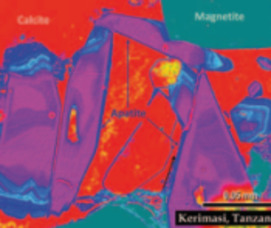
Deposits of rare earth elements (REEs) in igneous rocks have played an instrumental role in meeting the growing industrial demand for these elements since the 1960s. Among the many different igneous rocks containing appreciable concentrations of REEs, carbonatites and peralkaline silicate rocks are the most important sources of these elements, both historically and for meeting the anticipated growth in REE demand. The contrasting geochemical and mineralogical characteristics of REE mineralization in carbonatites, peralkaline feldspathoid rocks, and peralkaline granites reflect different sources and evolutionary pathways of their parental magmas, as well as differences in the extent of postmagmatic reworking of primary REE minerals by hydrothermal fluids.

This content is for Registered members only. To subscribe, please
join one of our participating societies or contact the Editorial Team.

Login
Already a member? Log in here

Rare Earth Mineralization in Igneous Rocks: Sources and Processes Read More »

Scroll to Top

December 2025 --The Variscan Orogeny in Europe – Understanding Supercontinent Formation

The Variscan orogen formed between 380 and 300 million years ago through several accretionary and collisional cycles, culminating with the construction of the Pangea supercontinent. This process occurred via sequential opening and closure of oceanic basins, synchronous detachment of Gondwana derived continental ribbons, and their outboard amalgamation onto the Laurussia margin. The Variscan orogen is rather unique compared with other orogenic belts on Earth: its overthickened and dominantly magmatic crust in the central belt, surprisingly minor mantle involvement in the magmatic and geodynamic processes, coherent and pulsed magmatism along the collision suture, and its complex accretionary history. Because its final product, Pangea, is the youngest and best-understood supercontinent on Earth, the Variscan orogeny offers clues for understanding the mechanisms of supercontinent formation.