

Thematic Articles

Presolar History Recorded in Extraterrestrial Materials

Extraterrestrial samples include a rich variety of materials with different histories. Among the array of Solar System materials are tiny grains with extremely anomalous isotopic compositions—records of nucleosynthetic processes that occurred deep within their now extinct parent stars. The isotopic and mineralogical characterization of these presolar grains in the laboratory provides unprecedented insight into stellar and galactic evolution, nucleosynthesis, and dust formation and processing. The discovery of presolar grains has opened up a pivotal new dimension in the field of astrophysics. Coupled with astronomical observations and astrophysical studies, stardust analyses bring nanometer-scale detail to the history of our immense Galaxy.

This content is for Registered members only. To subscribe, please
join one of our participating societies or contact the Editorial Team.

Login
Already a member? Log in here

Presolar History Recorded in Extraterrestrial Materials Read More »
A Cosmochemical View of the Solar System

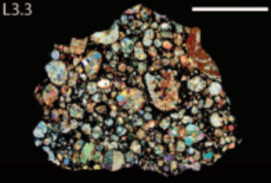
Cosmochemistry is the study of extraterrestrial materials aimed at understanding the nature of Solar System bodies, including the planets, their natural satellites, and small bodies. An important goal is to increase our understanding of the chemical origin of the Solar System and the processes by which its planets and small bodies have evolved to their present states. Research in cosmochemistry covers an enormous range of disciplines and techniques, including mineralogy, petrology, major and trace element chemistry, isotope compositions, radiometric ages, magnetism, and radiationexposure effects. These studies provide a wealth of data about the processes of stellar evolution, planetary-system formation, alteration in asteroidal and cometary interiors, and the accretion history of the Earth, including the origin of Earth’s volatile and organic materials.

This content is for Registered members only. To subscribe, please
join one of our participating societies or contact the Editorial Team.

Login
Already a member? Log in here

A Cosmochemical View of the Solar System Read More »

Nanoparticles for Remediation: Solving Big Problems with Little Particles

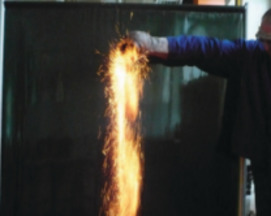
Remediation with engineered nanomaterials (ENMs) promises more effective and cheaper approaches than conventional methods due to the increased reactivity of nanoparticles and the possibility of in situ treatment. Three examples of the use of ENMs in soil remediation are nanoscale zero-valent iron for the degradation of halogenated organic compounds, nanoscale calcium peroxide for the destruction of organics (e.g. gasoline) and nanoscale metal oxides for the adsorption of metals. However, these methods are very new, and more research is needed on the mobility of ENMs in the soil and their impact on the environment.

This content is for Registered members only. To subscribe, please
join one of our participating societies or contact the Editorial Team.

Login
Already a member? Log in here

Nanoparticles for Remediation: Solving Big Problems with Little Particles Read More »

Bioremediation: Working with Bacteria

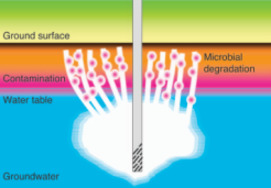
Soil bioremediation is a complex and costly process that aims to restore contaminated sites to environmentally sustainable conditions using microorganisms. The process relies upon the ability of microorganisms to degrade organic molecules, but it also depends on the microorganisms coming into contact with the contaminants, and the environment in the contaminated soil being conducive to the survival of the bacteria. A wide variety of techniques have been developed to ensure that these latter two constraints are overcome and to enhance contaminant biodegradation. Future developments in bioremediation are likely to lead to a reduction in both the energy used and the resulting pollutant and greenhouse gas emissions.

This content is for Registered members only. To subscribe, please
join one of our participating societies or contact the Editorial Team.

Login
Already a member? Log in here

Bioremediation: Working with Bacteria Read More »

Assisted Phytoextraction: Helping Plants to Help Us

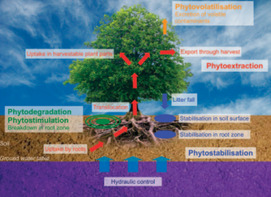
Phytoextraction is a process in which plants are used to remove trace metal contaminants from soils. This approach for cleaning soils appears very attractive, but essentially it is still at the development stage. Assisted phytoextraction, also called enhanced phytoextraction, seeks to improve metal extraction rates by manipulating the growing conditions of the plants. However, major technical challenges remain to be resolved.

This content is for Registered members only. To subscribe, please
join one of our participating societies or contact the Editorial Team.

Login
Already a member? Log in here

Assisted Phytoextraction: Helping Plants to Help Us Read More »

Mineral-Based Amendments for Remediation

Amending soils with mineral-based materials to immobilize contaminants is both old and new. Although mineral amendments have been used for decades in agriculture, new applications with a variety of natural and reprocessed materials are emerging. By sequestering contaminants in or on solid phases and reducing their ability to partition into water or air, amendments can reduce the risk of exposure to humans or biota. A variety of mineral types are commonly used to amend contaminated soils, with different modes of molecular-scale sequestration. Regulatory, social, and economic factors also influence decisions to employ mineral amendments as a treatment technology.

This content is for Registered members only. To subscribe, please
join one of our participating societies or contact the Editorial Team.

Login
Already a member? Log in here

Mineral-Based Amendments for Remediation Read More »

Organic Amendments for Remediation: Putting Waste to Good Use

The incorporation of common organic wastes (e.g. compost, biosolids, recycled paper waste) into soil promotes contaminant removal and stabilization, and diverts waste from landfill or incineration. However, implementation is constrained by public perception, timescale, cost and the pollutant burden of the organic waste itself. In addition, the high nutrient content of most organic wastes can lead to low biodiversity value at restoration sites. These potential negative aspects are now being countered by the mixing of waste streams, thus providing a multifunctional solution to land remediation where pollutant removal is not the only long-term goal.

This content is for Registered members only. To subscribe, please
join one of our participating societies or contact the Editorial Team.

Login
Already a member? Log in here

Organic Amendments for Remediation: Putting Waste to Good Use Read More »

The Need for Sustainable Soil Remediation

Humanity requires healthy soil in order to flourish. Soil is central to food production, the regulation of greenhouse gases, recreational areas such as parks and sports fields and the creation of an environment pleasing to the eye. But soil is fragile and easily damaged by uninformed management or accidents. One type of damage is contamination by chemicals that provide the lifestyles to which the developed world has become accustomed. Traditional soil “clean-up” has entailed either simple disposal or isolation of contaminated soil. Clearly this is not sustainable. Modern remedial techniques apply mineralogical and geochemical knowledge to clean up contaminated soil and make it good for reuse, rather than simply discarding this precious and finite resource.

This content is for Registered members only. To subscribe, please
join one of our participating societies or contact the Editorial Team.

Login
Already a member? Log in here

The Need for Sustainable Soil Remediation Read More »

Thermodynamic Modeling of the Earth’s Interior

The validity and usefulness of thermodynamic models commonly used to model the physical and chemical properties of Earth’s interior at high to ultrahigh pressures and their associated geophysical databases are discussed. All calorimetric data used in these models must have the quality of fitting to experimental phase diagrams derived from work not only at high temperatures and pressures but also under ambient conditions. The density and temperature profiles calculated for Earth’s mantle and core and the phase diagram of iron calculated under core conditions illustrate how thermodynamic modeling helps us understand the physics of Earth’s deep interior.

This content is for Registered members only. To subscribe, please
join one of our participating societies or contact the Editorial Team.

Login
Already a member? Log in here

Thermodynamic Modeling of the Earth’s Interior Read More »

Thermodynamics of Phase Equilibria in Magma

Throughout geological history, partial melting of mantle rocks and magma ascent and crystallization have played key roles in shaping the Earth. The importance of magmas stems from their liquid nature, that is, from their high atomic mobility and lack of long-range order. Compared to crystals, magmas thus have peculiar thermodynamic properties. A few examples illustrate how solid–liquid and liquid–volatile equilibria can be predicted. Given the almost infinite diversity of conditions of chemical composition, temperature and pressure in nature, thermodynamic modelling has become a necessary tool for understanding magmatic processes.

This content is for Registered members only. To subscribe, please
join one of our participating societies or contact the Editorial Team.

Login
Already a member? Log in here

Thermodynamics of Phase Equilibria in Magma Read More »

Scroll to Top

December 2025 --The Variscan Orogeny in Europe – Understanding Supercontinent Formation

The Variscan orogen formed between 380 and 300 million years ago through several accretionary and collisional cycles, culminating with the construction of the Pangea supercontinent. This process occurred via sequential opening and closure of oceanic basins, synchronous detachment of Gondwana derived continental ribbons, and their outboard amalgamation onto the Laurussia margin. The Variscan orogen is rather unique compared with other orogenic belts on Earth: its overthickened and dominantly magmatic crust in the central belt, surprisingly minor mantle involvement in the magmatic and geodynamic processes, coherent and pulsed magmatism along the collision suture, and its complex accretionary history. Because its final product, Pangea, is the youngest and best-understood supercontinent on Earth, the Variscan orogeny offers clues for understanding the mechanisms of supercontinent formation.