Thematic Articles

Monitoring a Supervolcano in Repose: Heat and Volatile Flux at the Yellowstone Caldera

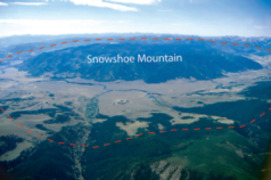
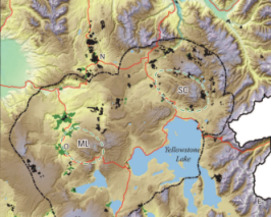
Although giant calderas (“supervolcanoes”) may slumber for tens of thousands of years between eruptions, their abundant earthquakes and crustal deformation reveal the potential for future upheaval. Any eventual supereruption could devastate global human populations, so these systems must be carefully scrutinized. Insight into dormant but restless calderas can be gained by monitoring their output of heat and gas. At Yellowstone, the large thermal and CO2 fluxes require massive input of basaltic magma, which continues to invade the lower to mid-crust, sustains the overlying high-silica magma reservoir, and may result in volcanic hazard for millennia to come. The high flux of CO2 may contribute to the measured deformation of the caldera floor and can also modify the pressure, thermal, and chemical signals emitted from the magma. In order to recognize precursors to eruption, we must scrutinize the varied signals emerging from restless calderas with the goal of discriminating magmatic, hydrothermal, and hybrid phenomena.

This content is for Registered members only. To subscribe, please
join one of our participating societies or contact the Editorial Team.

Login
Already a member? Log in here

Monitoring a Supervolcano in Repose: Heat and Volatile Flux at the Yellowstone Caldera Read More »
Supereruptions and Supervolcanoes: Processes and Products

Pyroclastic deposits and lava flows generated by supereruptions are similar to, but tens of times larger than, those observed in historic eruptions. Physical processes control eruption styles, which then dictate what products are available for sampling and how well the eruption sequence can be determined. These erupted products and their ordering in time permit reconstruction of the parental magma chamber. Supervolcanoes also have smaller eruptions that provide snapshots of magma chamber development in the lead-in to and aftermath of supereruptions. Many aspects of supereruption dynamics, although on a vast scale, can be understood from observations or inferences from smaller historic and prehistoric events. However, the great diversity in the timings of supereruptions and in the eruptive behaviour of supervolcanoes present continuing challenges for research.

This content is for Registered members only. To subscribe, please
join one of our participating societies or contact the Editorial Team.

Login
Already a member? Log in here

Supereruptions and Supervolcanoes: Processes and Products Read More »

How Long Does It Take to Supersize an Eruption?

Along-recognized correlation between the volume of major eruptions and the time interval between them suggests that magma may accumulate for about a million years before a supereruption. However, radiometric ages and time-dependent phenomena like crystal growth and compositional homogenization show that the duration of supervolcano magma accumulation could be significantly shorter than this. Crystals in supervolcano magmas may have protracted growth histories and may grow from chemically different hosts as crystallization progresses. Semisolid crystal mushes rather than liquid-rich magma chambers may be the prevalent state of supervolcano feeder systems and should be the focus of geophysical studies aimed at predicting future supereruptions.

This content is for Registered members only. To subscribe, please
join one of our participating societies or contact the Editorial Team.

Login
Already a member? Log in here

How Long Does It Take to Supersize an Eruption? Read More »

The Magma Reservoirs That Feed Supereruptions

The vigor and size of volcanic eruptions depend on what happens in magma reservoirs in the Earth’s crust. When magmatic activity occurs within continental areas, large reservoirs of viscous, gas-rich magma can be generated and cataclysmically discharged into the atmosphere during explosive supereruptions. As currently understood, large pools of explosive magma are produced by extracting interstitial liquid from long-lived “crystal mushes” (magmatic sponges containing >50 vol% of crystals) and collecting it in unstable liquid-dominated lenses.

This content is for Registered members only. To subscribe, please
join one of our participating societies or contact the Editorial Team.

Login
Already a member? Log in here

The Magma Reservoirs That Feed Supereruptions Read More »

Supervolcanoes and Their Explosive Supereruptions

Earth’s largest volcanic eruptions were an order of magnitude larger than any witnessed by humans since the advent of civilization. These “supereruptions” have played an important role in our species’ past and they pose a serious future threat. In this issue of Elements, we consider key issues that reflect both the scientific and social importance of these aweinspiring phenomena: the products and processes of the eruptions themselves, the nature and evolution of the shallow magma chambers that feed them, the monitoring of active supervolcano systems, and the potential consequences to humans of future supereruptions.

This content is for Registered members only. To subscribe, please
join one of our participating societies or contact the Editorial Team.

Login
Already a member? Log in here

Supervolcanoes and Their Explosive Supereruptions Read More »

Arsenic in Drinking Water: Impact on Human Health

In terms of its impact on human health, arsenic is unique in that most of the evidence linking it to diseases comes from epidemiological work; animal studies have not provided good models. It is also unique in causing a large number of different damaging effects and, as more studies are conducted, more such effects are found. To date, we know that arsenic from drinking water can cause severe skin diseases including skin cancer; lung, bladder, and kidney cancers, and perhaps other internal tumors; peripheral vascular disease; hypertension; and diabetes. It also seems to have a negative impact on repro- ductive processes (infant mortality and weight of newborn babies). The toxi- cology of arsenic involves mechanisms that are still not completely understood, but it is clear that a number of factors can affect both individual and popula- tion-level susceptibility to the toxic effects of arsenic-contaminated drinking water. Current research is addressing some of these, including genetic suscep- tibility and lifestyle factors that may increase arsenic’s toxic effects, such as smoking, diet, and concurrent exposure to other substances. The reversibility of some effects upon cessation of exposure is also being investigated.

This content is for Registered members only. To subscribe, please
join one of our participating societies or contact the Editorial Team.

Login
Already a member? Log in here

Arsenic in Drinking Water: Impact on Human Health Read More »

Arsenic in Soils, Mine Tailings, and Former Industrial Sites

Much progress has recently been made on the relation between the crystal chemistry of arsenic and its speciation and distribution at the Earth’s surface. The investigation of As-impacted soils and acid mine drainages, using synchrotron-based techniques, shows the importance of As adsorption on, or coprecipitation with, hydrous ferric oxides in delaying the long-term impact of As on the biosphere. Arsenic mobility often depends on bacterial activity, with accompanying major seasonal modifications of As speciation, even at extreme As concentrations. Remediation technologies use geochemical affinities between arsenic and specific low-temperature phases to reduce the bioavailability of arsenic.

This content is for Registered members only. To subscribe, please
join one of our participating societies or contact the Editorial Team.

Login
Already a member? Log in here

Arsenic in Soils, Mine Tailings, and Former Industrial Sites Read More »

Arsenic in Shallow, Reducing Groundwaters in Southern Asia: An Environmental Health Disaster

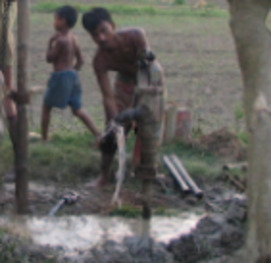
Arsenic concentrations in shallow, reducing groundwaters in Bengal, Southeast Asia, and elsewhere constitute a major hazard to the health of people using these waters for drinking, cooking, or irrigation. A comparison of occurrences in the Ganges–Brahmaputra, Mekong, and Red River basins shows that common geological characteristics include (1) river drainage from the rapidly weathering Himalayas, (2) rapidly buried organic- bearing and relatively young (ca. Holocene) sediments, and (3) very low, basin-wide hydraulic gradients. Anaerobic microbial respiration, utilizing either sedimentary or surface-derived organic carbon, is one important process contributing to the mobilization of arsenic from host minerals, notably hydrous iron oxides. In spite of the paucity of data from before the extensive develop- ment of groundwater pumping in these areas, there is sufficient evidence to make a prima facie case that human activity might exacerbate arsenic release into these groundwaters. The difficulties in implementing comprehensive groundwater remediation suggest serious attention should be given to developing treatment technologies for alternative surface-water supplies.

This content is for Registered members only. To subscribe, please
join one of our participating societies or contact the Editorial Team.

Login
Already a member? Log in here

Arsenic in Shallow, Reducing Groundwaters in Southern Asia: An Environmental Health Disaster Read More »

Microbial Transformations of Arsenic in the Environment: From Soda Lakes to Aquifers

Arsenic is a highly toxic element that supports a surprising range of biogeochemical transformations. The biochemical basis of these microbial interactions is described, with an emphasis on energy- yielding redox biotransformations that cycle between the As5+ and As3+ oxidation states. The subsequent impact of As3+-oxidising and As5+-reducing prokaryotes on the chemistry of selected environments is also described, focusing on soda lakes with naturally high concentrations of the metalloid and on Southeast Asian aquifer sediments, where the microbial reduction of sorbed As5+ and subsequent mobilisation of As3+ into water abstracted for drinking and irrigation threaten the lives of millions.

This content is for Registered members only. To subscribe, please
join one of our participating societies or contact the Editorial Team.

Login
Already a member? Log in here

Microbial Transformations of Arsenic in the Environment: From Soda Lakes to Aquifers Read More »

Chemistry and Mineralogy of Arsenic

Arsenic has diverse chemical behavior in the natural environment. It has the ability to readily change oxidation state and bonding configura- tion, which creates rich inorganic and organic chemistry. This behav- ior is a consequence of the electronic configuration of its valence orbitals, with partially filled states capable of both electron donation and overlap in covalent bonds. In natural compounds, arsenic bonds primarily to oxygen and sulfur, generating a variety of aqueous species and minerals. The affinity of arsenic for these two elements, along with its stable bonding to methyl groups, constitutes the structural basis for most organic and biosynthetic compounds. The agile chemistry of arsenic helps to explain its contradictory action as both a toxin and a curative, and its sometimes-elusive behavior in the environment.

This content is for Registered members only. To subscribe, please
join one of our participating societies or contact the Editorial Team.

Login
Already a member? Log in here

Chemistry and Mineralogy of Arsenic Read More »

Scroll to Top

December 2025 --The Variscan Orogeny in Europe – Understanding Supercontinent Formation

The Variscan orogen formed between 380 and 300 million years ago through several accretionary and collisional cycles, culminating with the construction of the Pangea supercontinent. This process occurred via sequential opening and closure of oceanic basins, synchronous detachment of Gondwana derived continental ribbons, and their outboard amalgamation onto the Laurussia margin. The Variscan orogen is rather unique compared with other orogenic belts on Earth: its overthickened and dominantly magmatic crust in the central belt, surprisingly minor mantle involvement in the magmatic and geodynamic processes, coherent and pulsed magmatism along the collision suture, and its complex accretionary history. Because its final product, Pangea, is the youngest and best-understood supercontinent on Earth, the Variscan orogeny offers clues for understanding the mechanisms of supercontinent formation.