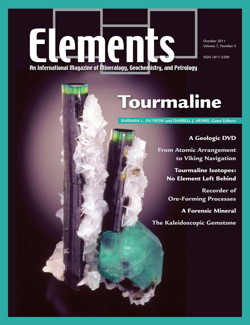
From the Vikings’ sunstone to a modern piezometric pressure sensor, tourmaline is an intriguing mineral with a new degree of significance. Tourmaline was considered by 18th century physicists as the key to a grand unification theory relating heat, electricity, and magnetism, but new studies define its role as an indicator of Earth’s processes. With its plethora of chemical constituents and its wide stability range, from near-surface conditions to the pressures and temperatures of the mantle, tourmaline has become a valuable mineral for understanding crustal evolution. Tourmaline encapsulates a single-mineral thermometer, a provenance indicator, a fluid-composition recorder, and a geochronometer. Although also prized as a gemstone, tourmaline is clearly more than meets the eye.
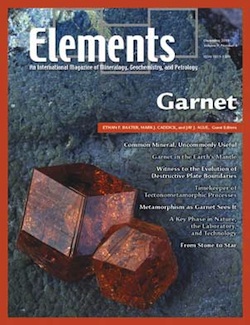
December 2013 - Garnet: Common Mineral, Uncommonly Useful
Garnet is among the most studied—and most beloved—minerals, owing to its commonality in diverse geologic contexts, its often large euhedral crystals, its sometimes dazzling colors, and its propensity for preserving information about its growth history. Chemically zoned garnet represents a remarkable tool for deciphering metamorphic conditions and the evolving tectonic processes that drive garnet growth over many millions of years. In the deep Earth, garnet is a key rock-forming mineral, influencing the physical properties of the mantle and the composition of mantle-derived magmas. Garnet has been sought for ages as a semiprecious gemstone (the birthstone of January) and has been mined or synthesized (including nonsilicate garnet) for industrial purposes, including laser, magnetic, and ion-conductor technology. This issue of Elements will emphasize the most recent innovations in thermodynamic, geochemical, geochronologic, and industrial applications of garnet, while providing perspective on decades of garnet-related research.
December 2025 --The Variscan Orogeny in Europe – Understanding Supercontinent Formation
The Variscan orogen formed between 380 and 300 million years ago through several accretionary and collisional cycles, culminating with the construction of the Pangea supercontinent. This process occurred via sequential opening and closure of oceanic basins, synchronous detachment of Gondwana derived continental ribbons, and their outboard amalgamation onto the Laurussia margin. The Variscan orogen is rather unique compared with other orogenic belts on Earth: its overthickened and dominantly magmatic crust in the central belt, surprisingly minor mantle involvement in the magmatic and geodynamic processes, coherent and pulsed magmatism along the collision suture, and its complex accretionary history. Because its final product, Pangea, is the youngest and best-understood supercontinent on Earth, the Variscan orogeny offers clues for understanding the mechanisms of supercontinent formation.