


1811-5209/25/0021-0346$2.50 DOI: 10.2138/gselements.21.5.346
Keywords: Space weathering; returned samples; solar wind; micrometeoroids
INTRODUCTION
Space weathering is one of the most common processes operating to modify the layer of unconsolidated rocky material, known as regolith, on planetary bodies across our Solar System (Hapke 2001; Pieters and Noble 2016). It is driven by two primary processes: (1) the interaction of surface regolith with energetic ions streaming from the Sun as solar wind, combined with solar flare ions, and galactic cosmic rays, which penetrate <100 nm, a few centimeters, and a few meters into the regolith, respectively; and (2) the bombardment of planetary surfaces with high-velocity micrometeoroid impacts. Space weathering changes the morphology, mineralogy, microstructure, isotopic, and chemical composition of grains on airless surfaces. These microstructural and chemical changes accumulate in regolith grains through time and, in doing so, modify the spectral characteristics of the surfaces of airless bodies (like asteroids or moons) that we observe either telescopically or using remote sensing spacecraft. Building an under- standing of how space weathering processes work to change the chemistry and structure of grains on airless surfaces at the nanoscale is ultimately critical for interpretations of planetary composition and mineralogy at the global scale (Hapke 2001; Pieters and Noble 2016).
THE MOON AS A SPACE WEATHERING LABORATORY
The framework for space weathering was built from a lunar perspective. Images from remote observations of the Moon first identified bright rays emanating from young craters. These were shown to represent regolith material that was freshly excavated by recent impacts, as opposed to regolith that was previously exposed at the lunar surface over geologic timescales (Gold 1955). These observations were confirmed with the return of lunar samples by the Apollo and Luna missions. The visible-near-infrared (VNIR) spectral reflectance characteristics of lunar materials could be measured in the laboratory for the first time, revealing striking differences between regolith collected at the lunar surface and powders prepared by crushing lunar rocks. Even for samples with similar bulk mineralogy, composition, and grain size, lunar regolith exhibited VNIR spectra that were darker (decreased reflectance), had a redder spectral slope (increasing reflectance with increasing wavelength), and showed attenuated absorption bands compared with the regolith powders prepared in terrestrial laboratories from lunar rocks (Hapke 2001). The thermal infrared (IR) features are also affected, with spectra exhibiting a shift of the silicate emissivity maximum, known as the Christiansen feature, to longer wavelengths and a reduction in band strength of the fundamental Si-O vibrational bands, known as the Reststrahlen bands, and transparency features (e.g., Glotch et al. 2015). These results pointed towards a process that caused microstructural and chemical changes in regolith exposed to the harsh environment of interplanetary space at the lunar surface. In contrast, the interiors of lunar rocks were protected from this alteration process, resulting in more traditional VNIR signatures. With the identification of these spectral differences in surface-exposed lunar regolith, the search began for the nano- and micro-scale structural and chemical drivers of these changes. As a result, myriad products were identified, characterized, and ultimately attributed to a constituent set of processes called space weathering (Fig. 1).
Interplanetary dust particles are continually bombarding the lunar surface, melting and sometimes vaporizing target materials in the regolith. Sample return missions have worked to provide constraints on the composition, mineralogy, and physical properties of this dust, including the Long Duration Exposure Facility (LDEF), which characterized the population of natural and manmade particulates

Download high-resolution image
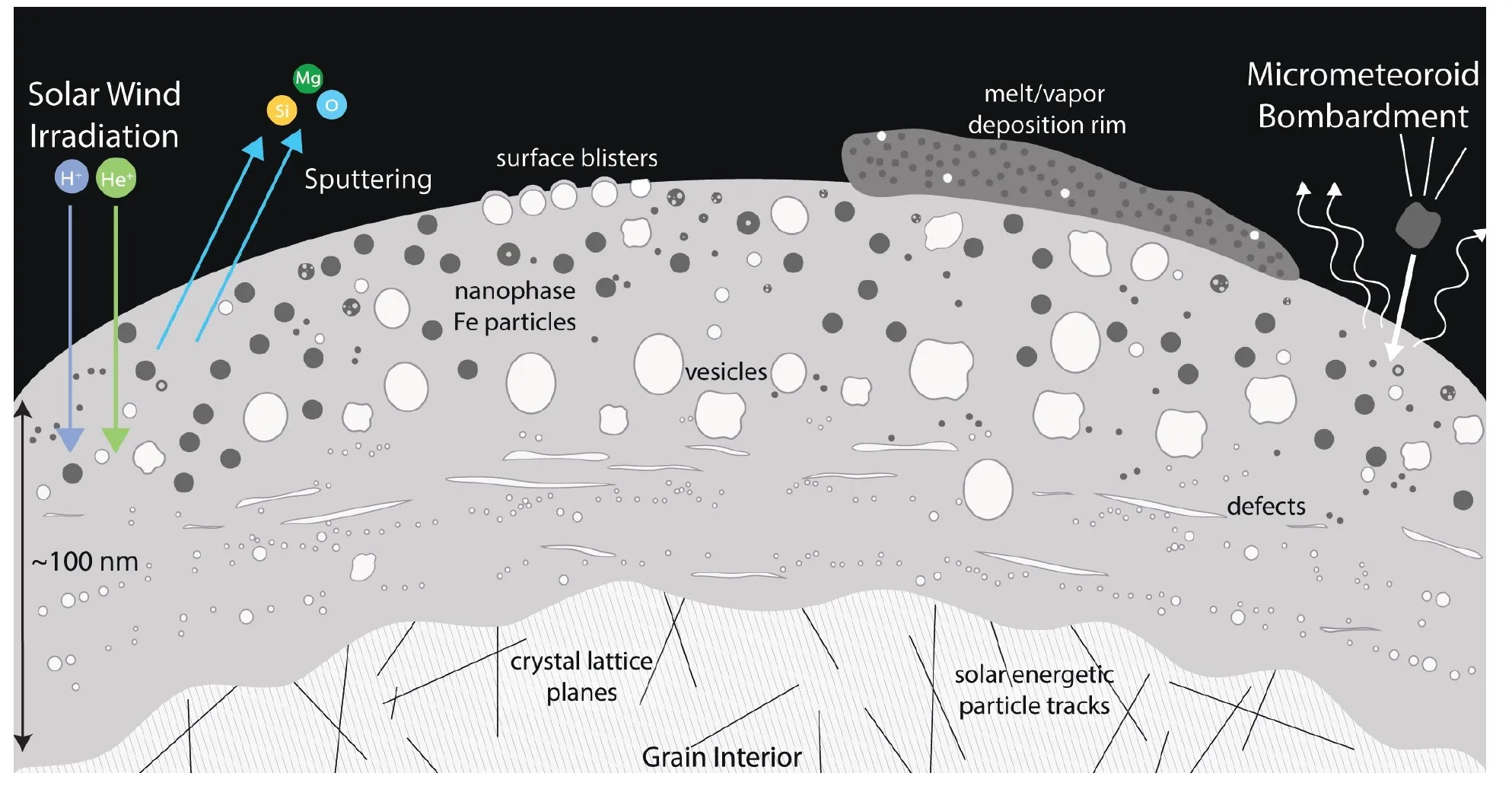
that serve as impactors in the near-Earth environment (Zolensky 2021). These impacts result in the production of discrete amorphous melt splashes, spherules, and deposits on grain surfaces. These impacts are often identifiable as a result of their compositional heterogeneity compared with their underlying ‘host’ grain (Keller and McKay 1997). Similarly, high-velocity particles impacting the surface with enough energy can vaporize material that is subsequently redeposited on adjacent grain surfaces. Where melt deposits are often up to microns in thickness and can produce glassy surface coatings, known as patinas, across long-exposed lunar rock surfaces, vapor deposits are usually thinner, typically on the order of tens of nanometers (Keller and McKay 1997). Micrometeoroid impacts also produce a specific grain type, ubiquitous in the lunar regolith, known as agglutinates (Heiken et al. 1991). Comprised of mineral fragments welded together by or embedded in impact glass, agglutinates are often optically dark and were the first phase attributed with the observed changes in spectral characteristics exemplified by the light versus dark rays of lunar regolith near craters. However, further examination with scanning and transmission electron microcopy (TEM) revealed the true culprit: nanophase metallic Fe particles (npFe).
These npFe particles are spherules composed predominantly of Fe0, ranging in size from a few to hundreds of nanometers in diameter (Keller and McKay 1997; Hapke 2001). They can occur both as surface-correlated products, which are typically smaller in size and embedded in melt and vapor deposits, and as a volume-correlated phase, which can be larger in size and distributed throughout agglutinitic glassy interiors. The abundance of these npFe has been quantified in returned lunar soils, relative to the bulk Fe content of the sample, in a parameter known as Is/FeO. This term indicates relative maturity of the soil samples, a proxy for surface exposure age on the Moon (e.g., Morris 1976). Subsequent laboratory experiments have demonstrated that npFe is responsible for driving the lunar-style spectral changes, with small (<40 nm) npFe reddening and large (>40 nm) npFe darkening the VNIR spectra (e.g., Noble et al. 2007). In addition, the characteristic absorption bands (e.g., the 1- and 2-µm bands associated with Fe2+ in silicate minerals) are attenuated as a result of this conversion to Fe0. There have been many proposed formation mechanisms for npFe. In impact events resulting in the vaporization of target materials, FeO molecules in the vapor cloud have a low relative binding energy, resulting in their preferential dissociation into independent Fe and O compared with e.g., SiO, MgO, etc. As a less volatile species (compared with O), Fe will condense in this reducing environment of the lunar surface as Fe0 in vapor deposits on grains surfaces (Hapke 2001). In contrast, the formation of npFe in agglutinates has been linked to products of other space weathering processes: solar wind irradiation (Hapke 2001).
The solar wind plasma that continually irradiates regolith on the lunar surface has been characterized by multiple spacecraft and is composed predominantly of H+ and He+ with the He+/H+ ratio ~0.04 (e.g., Reisenfeld et al. 2013). Solar wind irradiation results in the implantation of these ions into the upper ~100 nm of grain rims, resulting in the amorphization of crystal structure, the production of vesicles, and the steady sputtering of ions from the upper most surface of the regolith (Keller and McKay 1997). Typically, rims produced by solar wind irradiation have the same bulk chemistry as the underlying grain, enabling the discernment of layers produced by impacts from those produced via solar wind. Implanted H+ may play an important role in the formation of npFe, acting as either a reducing agent during micrometeoroid impacts, or serving to preferentially sputter O to create locally reducing conditions in the grain rims as a result of solar wind irradiation (Hapke 2001). Both mechanisms may drive the production of npFe0 in the lunar regolith. Solar wind irradiation also plays an important role in the production of water on the lunar surface, contributing to its volatile cycling and supply in the exosphere. The implantation of hydrogen into O-bearing minerals can lead to the production of water (OH and H2O), which is trapped in other microstructural products of space weathering, e.g., defects, vesicles, and the glassy matrix of agglutinates (Liu et al. 2012; Burgess et al. 2023).
Download high-resolution image
Beyond the solar wind, returned samples from the Moon also record evidence of exposure to solar energetic particles (SEP) originating from solar flares. Trails of ionization damage like bullet holes through the crystal structure of exposed grains are predominantly formed by Fe-group nuclei SEPs. Such nuclei travel with energies ranging from <1 MeV/nucleon up to ~100 MeV/nucleon, which can penetrate up to millimeters in depth into the lunar regolith (e.g., Keller et al. 2021). Measuring the density of these tracks enables us to determine a calibrated exposure timescale, revealing that grains can reside in the upper regolith on the lunar surface for millions of years, providing insight into gardening and comminution processes on the Moon (Keller et al. 2021). Finally, signatures of solar and galactic cosmic ray irradiation can be identified in returned samples through the measurement of cosmogenic nuclides.
The effects of space weathering processes on the Moon do not exist in isolation from one another. Individual grains exhibit complex histories that reveal evidence for co-exposure to solar wind irradiation and sometimes multiple generations of micrometeoroid bombardment (Keller and McKay 1997). Their microstructural and chemical products are intricately linked, and make it challenging to determine which, if either, process dominates the effects at the grain scale (Denevi et al. 2023). The Moon also still offers us a natural space weathering laboratory, where features like lunar swirls represent the next frontier in understanding the contributions of constituent space weathering processes across the lunar surface. Upcoming missions targeting these unique features will provide an improved understanding of their formation and persistence across Solar System timescales, even beyond the Moon. However, an opportunity to better understand the specific contributions of solar wind irradiation came with the return of our first sample collection from the Sun through the Genesis mission.
REVEALING THE SOLAR WIND THROUGH GENESIS
NASA’s Genesis Solar Wind Sample Return mission was flown to enable precise measurements of the composition of solar material in terrestrial laboratories. The Sun contains 99.8% of the material in the Solar System so, although mostly H+ and He+, solar wind reflects the composition of the Solar System itself. For nearly two years, Genesis exposed a diverse set of crystalline, metallic, and amorphous materials to the solar wind to collect these ions and return them to Earth (e.g., Russell 2003). Like space weathering, collector material surfaces captured solar wind ions by implantation, but the low dose radiation was not expected to significantly affect the collectors themselves. However, studies of the returned, irradiated collectors in terrestrial laboratories revealed that the collectors had started to space weather solely due to the impacting solar wind, providing an unexpected window into how the process of solar wind implantation contributes to space weathering on airless bodies.
But first, Genesis samples prompted a reevaluation of the role of solar wind in the alteration of lunar materials (Grimberg et al. 2006). The isotopic composition of solar wind Ne in the rims of lunar regolith grains returned by the Apollo missions was anomalous: the proportion of heavy Ne isotopes at depth was higher than expected from models of solar wind implantation. One hypothesis was that the Sun had streamed more high-energy, heavy Ne ions in the early Solar System, which were recorded by the lunar regolith. However, results from Grimberg et al. (2006) indicated that the unexpected shape of the solar wind Ne implantation profile in lunar grains was a result of simultaneous sputtering by and implantation of solar wind during eons of space weathering on the lunar surface. That is, the Ne signature of the lunar regolith is a product of the modern solar wind that we see today.
The later discovery of identifiable physical and chemical effects of space weathering in the collectors themselves was unexpected. The Array Collector instrument on Genesis allowed the comparison of space weathering in different collector materials subjected to the same solar wind composition, flux, and duration of exposure, as well as an evaluation of how those same collector types respond to different solar wind conditions. Because the solar wind velocities and implantation currents, composition, and times of exposure are all known, and the structure of the wafers before and after exposure can be observed, Genesis provided a controlled sample set with which to compare naturally space weathered samples. This enabled a more robust identification of microstructural fingerprints for solar wind irradiation in other returned samples.

Download high-resolution image
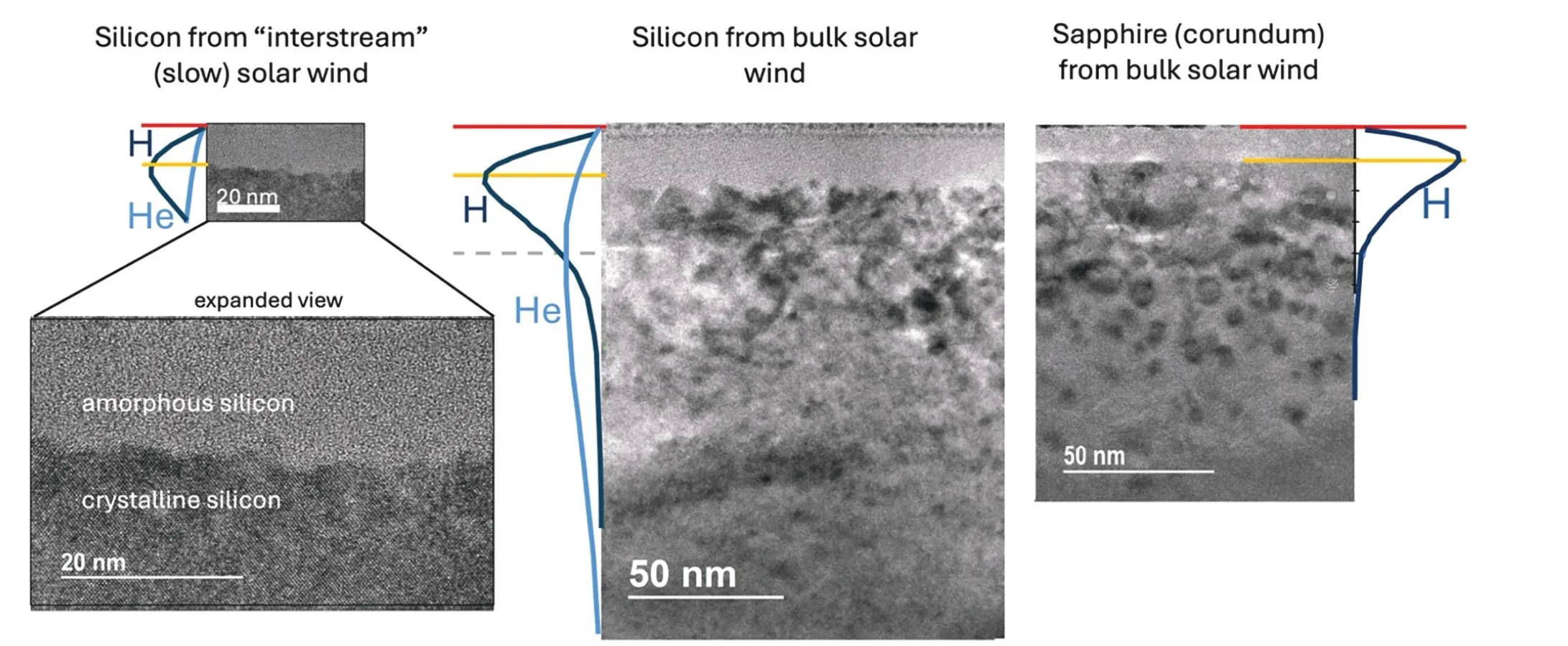
The microstructural and chemical effects of solar wind irradiation in Genesis samples were characterized using TEM. Microstructurally, the collectors have shown an amorphous or partially amorphous surface, and their thick- nesses correspond to the modelled implantation depths of solar wind H and He in various materials (e.g., silicon and corundum) by the Stopping and Range of Ions in Matter (SRIM) code (Fig. 2). Solar wind also affected chemistry in the radiation-damaged surfaces (e.g., Jurewicz et al. 2023). For example, the etching rate of silicon collectors was observed to be controlled by solar wind H present in the ideal depth profile, predicted by SRIM, despite the semiconductor literature predicting diffusion length scales for H that would exceed the collector thickness. In contrast, other solar wind elements had moved in situ, away from the SRIM-calculated profile, due to radiation-induced segrega- tion, despite seemingly following the solar wind H depth profile near the surface. Prior to the etching study, the role of implanted ion chemistry was not recognized, and it was assumed that defects generated by the implantation (not ions) would induce radiation-enhanced movement. Similar changes in the chemistry of surfaces have certainly occurred during space weathering on airless bodies, and models of elemental redistribution in grain rims as a result of space weathering should be further compared to the findings from Genesis.
These results demonstrate that data from Genesis could fill gaps in our understanding of how and why solar wind changes space-exposed surfaces. The contribution of processes such as micrometeorite impacts to space weath- ering are easily observable in lunar samples, as evidenced by the propensity of agglutinates readily identified using only optical microscopy. But the damage caused by irradia- tion by solar wind is a slow process, requiring advanced analytical techniques for characterization, and changes are cumulative, progressing over time and modifying (including erasing) earlier features. Moreover, although some excellent laboratory simulations have been used to study the role of solar wind in space weathering, the low currents and the spectrum of solar wind energies in the natural world (and Genesis samples) are challenging and, in practice, duplication in a laboratory is impossible. While the return of the Genesis mission provided insight and context for solar wind irradiation, our understanding of space weathering processes, however, took another important leap forward with the return of samples from near-Earth asteroid Itokawa.
SPACE WEATHERING AS AN AGENT OF CHANGE ON ASTEROIDS
The Hayabusa mission collected our first samples from an S-type asteroid, and with their return confirmed the long- hypothesized link between these asteroids and ordinary chondrites (Nakamura et al. 2011). Linking meteor- ites to their parent-body asteroids has historically been challenging because space weathering processes alter the spectral characteristics of asteroidal regoliths, making it difficult to match meteorites analyzed using laboratory spectroscopy to remote sensing and telescopic observations of asteroids. In particular, S-type asteroids like Itokawa are spectrally redder and exhibit attenuated absorption bands in the VNIR compared with meteorites in the laboratory. The relationship between ordinary chondrites (H, L, LL) and S-type asteroids was finally confirmed with the analysis of returned samples from the Hayabusa mission, and their spectral discrepancies attributed conclusively to space weathering.
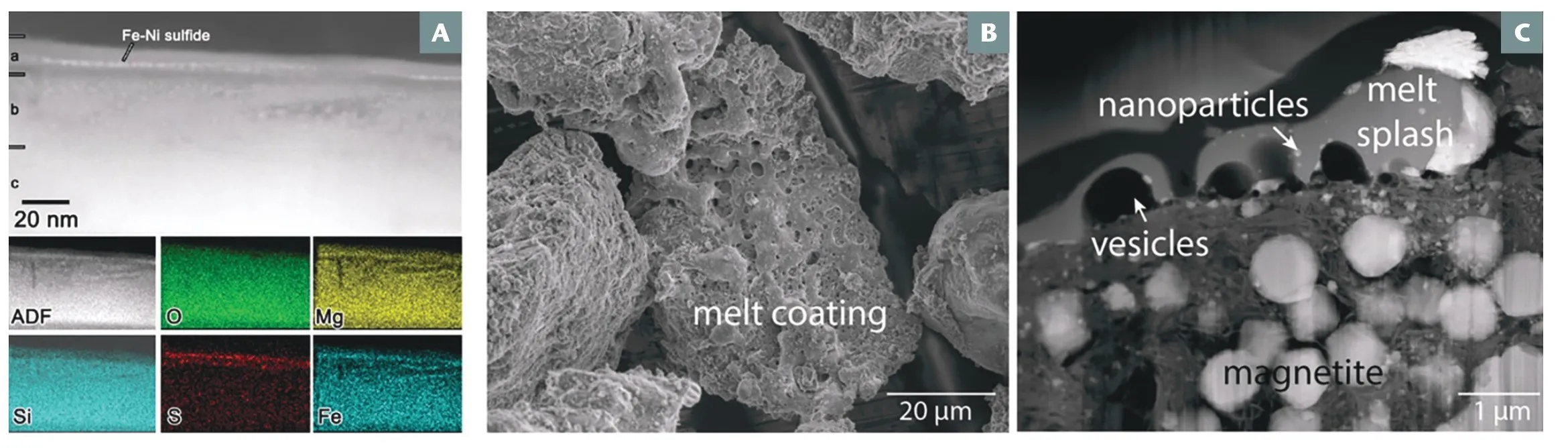
With the return of a new sample set came the opportu- nity to expand our model for space weathering beyond the Moon. Analyses of samples from Itokawa revealed both familiar and novel space weathering products. In addition to the canonical metallic npFe particles, we saw a diversity of compositions for the nanophase opaques, including FeS, MgS, and more (Fig. 3; e.g., Noguchi et al. 2014). These phases pointed towards the importance of S, sourced from constituent sulfide minerals, which make up 5–15 wt.% of chondritic asteroids, in the production of optically active phases on asteroids, representing a depar- ture from the predominance of only npFe on the Moon. Further analysis of the sulfide source minerals revealed the presence of metallic Fe whiskers protruding from sulfide mineral grain surfaces, new microstructural signatures of space weathering in mineral compositions not commonly found on the lunar surface (Matsumoto et al. 2020). Comparisons could also be made for the exposure timescale of grains on the surface of Itokawa from SEP track density, demonstrating that the surface of Itokawa was relatively fresh (104–105 years) compared with the Moon (Noguchi et al. 2014). While grains from Itokawa presented some variation on the archetypal space weathering products observed in lunar samples, the most significant differ- ence was the limited identification of impact products.
Unlike lunar regolith, where agglutinates and melt and vapor deposits are abundant, samples from Itokawa were dominated by the effects of solar wind, exemplified by the presence of amorphous and nanocrystalline grain rims. These observations provided a new hypothesis for space weathering processes and the timescales on which they operate, suggesting that solar wind irradiation may be driving regolith alteration on short timescales as the dominant mechanism of change on asteroids (Noguchi et al. 2014). The return of samples from asteroids Ryugu and Bennu, however, would put this hypothesis to the test.
Near-Earth asteroids Ryugu and Bennu are primitive, organic-rich, and hydrated bodies targeted by the Hayabusa2 and OSIRIS-REx missions, respectively. The recent return of these samples has opened a new regime in space weathering studies. These carbonaceous asteroids are more compo- sitionally complex than the Moon or S-type asteroids, including hydrated phyllosilicates, nominally anhydrous silicates, sulfides, oxides, phosphates, carbonates, organic molecules, and more (Kitazato et al. 2019; Lauretta et al. 2019). While we employed laboratory experiments and analogs in advance of sample return in an attempt to predict how space weathering processes might affect such mineralogically diverse bodies (e.g., Thompson et al. 2019; Laczniak et al. 2021), there is no replacement for the analysis of true returned samples. Further, these missions provided the first opportunity to compare space weathering signatures across materials from two independent aster- oids that belong to broadly the same group (carbonaceous asteroids). This comparative ability is enabling an exami- nation of how universal space weathering processes truly are, independent of mineralogy.
Samples from Ryugu broadened our library of microstruc- tural and chemical hallmarks of space weathering. There are the traditional amorphous and nanocrystalline rims associated with solar wind irradiation. However, rather than metallic npFe, nanoparticles in the abundant melt deposits (Fig. 3) in the Hayabusa2 samples are dominated by FeS and Fe–Ni–S compositions, further underscoring the emerging importance of S in space weathering on aster- oids at which the Hayabusa collection first hinted (Fig. 3; Noguchi et al. 2023). Further, for the first time, the role of organics in space weathering could be studied, with novel Fe-nitride deposits suggesting that these species actively contribute to the surface alteration of asteroidal regolith particles (Matsumoto et al. 2024). Our first results from the analysis of Bennu samples reveal similar features, melt layers with abundant nanoparticles with sulfide mineralo- gies distributed across grain surfaces (Fig. 3; Keller et al. 2025). One common characteristic between these space weathering products was their proposed formation mecha- nism: micrometeoroid impacts.
Contrary to the vision of space weathering on aster- oids supported by the analysis of samples from Itokawa, which were dominated by solar wind processing, Ryugu samples demonstrate that impacts do play a critical role in surface alteration. In situ spectroscopic observations by the Hayabusa2 spacecraft suggested that the once hydrous minerals in Ryugu were considerably dehydrated by internal heating in the parent body and by solar irradiation during its close orbit around the Sun. Surprisingly, however, most of the recovered samples contained large amounts of hydrous minerals (Yabuta et al. 2025 this issue). Melt splashes and deposits are commonly observed on Ryugu grain surfaces, compared with samples from Itokawa, exhibiting abundant nanoparticle phases and vesicles distributed throughout (Noguchi et al. 2021). Although the sample collection has not revealed true lunar-style aggluti- nates, melt layers on grain surfaces can reach micrometers in thickness. These impact deposits are thought to play a critical role in masking evidence for hydrated minerals on asteroidal surfaces. The presence of widespread anhydrous melts on grain surfaces may prevent the identification of some water-related absorption features in spectral obser- vations, which could have important implications for the detection of hydrated asteroids in remote sensing data and, more broadly, our understanding of the volatile inventory of the early Solar System (Noguchi et al. 2021).
The implications of space weathering on the spectral characteristics of carbonaceous asteroids goes beyond the hydrous/anhydrous divide. In the typical, lunar-style model for space weathering, VNIR spectra become reddened over time (Hapke 2001). However, freshly exposed surfaces on carbonaceous asteroids are redder than the surrounding, weathered surfaces, which are blue-sloped. Asteroids Ryugu and Bennu also exhibit different degrees of bluing (Yumoto et al. 2024), and the recent return of samples from asteroid Bennu will hopefully illuminate the reasons why. Are these differences the result of unique mineralogies, exposure timescales, or some combination? Together, the continued analysis of space weathering characteristics in returned sample collections from asteroids is leading to a new era, wherein lunar-style space weathering, once thought canon- ical and ubiquitous across the inner Solar System, is exactly that: relevant only to the Moon.
SPACE WEATHERING FORECAST: THE NEXT FRONTIER
Where lunar samples set the stage for our discovery and understanding of space weathering, Genesis samples provided critical context, and asteroidal sample return created a new paradigm. While laboratory experiments and remote observations of airless surfaces provide impor- tant insight into space weathering across the Solar System, sample return is what truly yields ground truth. Space weathering processes are among the most important and omnipresent in the Solar System. Thus, building a robust understanding of their effects has critical implications for remote sensing observations for all spacecraft missions to airless bodies, whether samples are returning to Earth or not. Recent analysis of returned sample collections has revealed that space weathering is not a uniform process, does not create the same microstructural and chemical products across all airless surfaces, and does not drive spectral properties in a linear and predictable fashion. Instead, it is multidimensional, at times influenced by mineralogy, heliocentric distance, exposure timescale, and more. It is clear now there is no singular style of space weathering, and that our model(s) for this process across the Solar System should be flexible, based on the theory of fundamental physical processes, and adaptable. Looking forward, with sample return from the martian moon Phobos by JAXA’s Martian Moons eXploration (MMX) mission on the horizon (Udry et al. 2025 this issue), we will be offered an opportunity to explore space weathering in a new environment, which will undoubtedly lead to an even better understanding of this important Solar System process.
ACKNOWLEDGMENTS
The authors wish to thank Drs. K. Welton and T. Glotch for their reviews, which greatly improved the manuscript. We thank A. Kling for contributing FigUre 1. Drs. J. J. Barnes and J. Davidson are acknowledged for editorial handling.
REFERENCES
Burgess KD, Cymes BA, Stroud RM (2023) Hydrogen-bearing vesicles in space weathered lunar calcium-phosphates. Communications Earth & Environment 4: 414, doi: 10.1038/s43247−023−01060−5
Denevi BW and 13 coauthors (2023) Space weathering at the Moon. Reviews in Mineralogy and Geochemistry 89: 611−650, doi: 10.1515/9781501519895−017
Glotch TD and 7 coauthors (2015) Formation of lunar swirls by magnetic field standoff of the solar wind. Nature Communications 6: 6189, doi: 10.1038/ncomms7189
Gold T (1955) The lunar surface. Monthly Notices of the Royal Astronomical Society 115: 585−604
Grimberg A and 8 coauthors (2006) Solar wind neon from Genesis: implications for the lunar noble gas record. Science 314: 1133−1135, doi: 10.1126/science.1133568
Hapke B (2001) Space weathering from Mercury to the asteroid belt. Journal of Geophysical Research: Planets 106: 10039−10073, doi: 10.1029/2000JE001338
Heiken G, Vaniman D, French BM (1991) Lunar Sourcebook: A User’s Guide to the Moon. Cambridge University Press, 796 pp
Jurewicz Amy JG and 6 coauthors (2023) Space weathering of Genesis mission solar-wind collectors with inferences for weathering on airless bodies. The Planetary Science Journal 4: 98, doi: 10.3847/PSJ/acd33c
Keller LP, McKay DS (1997) The nature and origin of rims on lunar soil grains. Geochimica et Cosmochimica Acta 61: 2331−2341, doi: 10.1016/S0016−7037(97)00085−9
Keller LP, Berger EL, Zhang S, Christoffersen R (2021) Solar energetic particle tracks in lunar samples: a transmission electron microscope calibration and implications for lunar space weathering. Meteoritics & Planetary Science 56: 1685−1707, doi: 10.1111/maps.13732
Keller LP and 21 coauthors (2025) Space weathering effects in Bennu asteroid samples. Nature Geoscience, doi: 10.1038/s41561−025−01745-w
Kitazato K and 65 coauthors (2019) The surface composition of asteroid 162173 Ryugu from Hayabusa2 near-infrared spectroscopy. Science 364: 272−275, doi: 10.1126/science.aav7432
Laczniak DL and 6 coauthors (2021) Characterizing the spectral, microstructural, and chemical effects of solar wind irradiation on the Murchison carbonaceous chondrite through coordinated analyses. Icarus 364: 114479, doi: 10.1016/j.icarus.2021.114479
Lauretta DS and 29 coauthors (2019) The unexpected surface of asteroid (101955) Bennu. Nature 568: 55−60, doi: 10.1038/s41586−019−1033−6
Liu Y and 5 coauthors (2012) Direct measurement of hydroxyl in the lunar regolith and the origin of lunar surface water. Nature Geoscience 5: 779−782, doi: 10.1038/ngeo1601
Matsumoto T, Harries D, Langenhorst F, Miyake A, Noguchi T (2020) Iron whiskers on asteroid Itokawa indicate sulfide destruction by space weathering. Nature Communications 11: 1117, doi: 10.1038/s41467−020−14758−3
Matsumoto T and 76 coauthors (2024) Influx of nitrogen-rich material from the outer Solar System indicated by iron nitride in Ryugu samples. Nature Astronomy 8: 207−215, doi: 10.1038/s41550−023−02137-z
Morris RV (1976) Surface exposure indices of lunar soils: a comparative FMR study. In: Proceedings of the Lunar Science Conference, Volume 7. Pergamon Press, New York, pp 315−335
Nakamura T and 21 coauthors (2011) Itokawa dust particles: a direct link between S-type asteroids and ordinary chondrites. Science 333: 1113−1116, doi: 10.1126/science.1207758
Noble SK, Pieters CM, Keller LP (2007) An experimental approach to understanding the optical effects of space weathering. Icarus 192: 629−642, doi: 10.1016/j.icarus.2007.07.021
Noguchi T and 23 coauthors (2014) Space weathered rims found on the surfaces of the Itokawa dust particles. Meteoritics & Planetary Science 49: 188−214, doi: 10.1111/maps.12111
Noguchi T and 138 coauthors (2023) A dehydrated space-weathered skin cloaking the hydrated interior of Ryugu. Nature Astronomy 7: 170−181, doi: 10.1038/s41550−022−01841−6
Pieters CM, Noble SK (2016) Space weathering on airless bodies. Journal of Geophysical Research: Planets 121: 1865−1884, doi: 10.1002/2016JE005128
Reisenfeld DB and 6 coauthors (2013) Solar wind conditions and composition during the Genesis mission as measured by in situ spacecraft. Space Science Reviews 175: 125−164, doi: 10.1007/s11214−013−9960−2
Russell CT (2003) The Genesis Mission. Springer, 178 pp
Thompson MS, Loeffler MJ, Morris RV, Keller LP, Christoffersen R (2019) Spectral and chemical effects of simulated space weathering of the Murchison CM2 carbonaceous chondrite. Icarus 319: 499−511, doi: 10.1016/j.icarus.2018.09.022
Udry A, Ostwald AM, Usui T (2025) Seeing red: retrieving rocks from Mars and Phobos. Elements 21: 333−339
Yabuta H, McCoy TJ, Alexander CMO’D (2025) One’s trash is another’s treasure: cosmic rubble piles. Elements 21: 340−345
Yumoto K and 26 coauthors (2024) Comparison of optical spectra between asteroids Ryugu and Bennu: II. High-precision analysis for space weathering trends. Icarus 420: 116204, doi: 10.1016/j.icarus.2024.116204
Zolensky M (2021) The long duration exposure facility—a forgotten bridge between Apollo and Stardust. Meteoritics & Planetary Science 56: 900−910, doi: 10.1111/maps.13656