

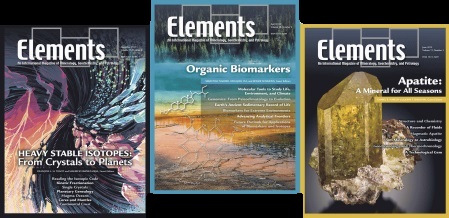
Tourmaline typically forms where crustal rocks interact with migrating hydrous fluids or silicate melts, and its isotopic composition provides a reliable record of the isotopic composition of the fluids and melts from which it crystallized. Minerals of the tourmaline supergroup are exceptional in their physical robustness and chemical variability, and they allow us to extract a uniquely broad range of isotopic information from a single mineral. The chemical variability of tourmaline confronts us with the difficulty of deciphering an extremely complex mineral system, but it also presents us with a geochemical recorder of half the periodic table, a breadth of representation that is unparalleled among minerals. Plate tectonic–scale geochemical cycles, local and regional fluid–rock interactions, magmatic–hydrothermal systems, ore-forming processes, and ages of tourmaline formation have all been reconstructed using this unique isotopic broadband recorder.
This content is for Registered members only. To subscribe, please
join one of our participating societies or contact the Editorial Team.