Elements Magazine Past Issues

YEAR  2026 | 2025  |  2024 | 2023 | 2022 | 2021 | 2020 | 2019 | 2018 | 2017 | 2016 | 2015 | 2014 | 2013 | 2012 | 2011 | 2010 | 2009 | 2008 | 2007 | 2006 | 2005

VOLUME  22
 |  21 | 20 | 19 | 18 | 17 | 16 | 15 | 14 | 13 | 12 | 11 | 10 | 9 | 8 | 7 | 6 | 5 | 4 | 3 | 2 | 1

Issues Published in 2009 -- Volume 5

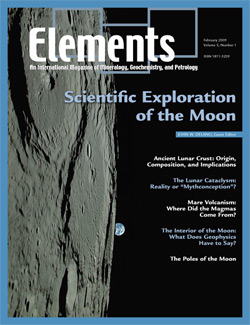
February 2009 – Volume 5 Number 1 

Scientific Exploration of the Moon

GUEST EDITOR
John W. Delano

PRINCIPAL EDITOR
E. Bruce Waston

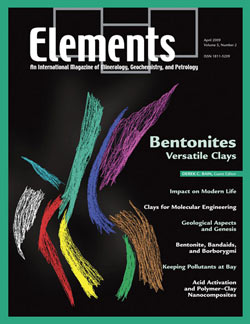
April 2009 – Volume 5 Number 2 

Bentonites - Versatile Clays

GUEST EDITOR
Derek C. Bain

PRINCIPAL EDITOR
Susan L.S. Stipp

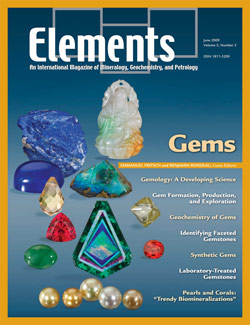
June 2009 – Volume 5 Number 3

Gems

GUEST EDITORS
Emmanuel Fritsch and Benjamin Rondeau

PRINCIPAL EDITOR
David J. Vaughan

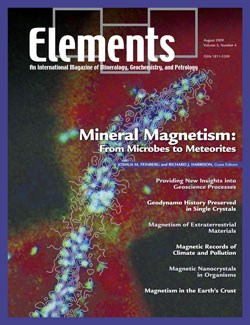
August 2009 – Volume 5 Number 4

Mineral Magnetism: From Microbes to Meteorites

GUEST EDITORS
Joshua M. Feinberg and Richard J. Harrison

PRINCIPAL EDITOR
David J. Vaughan

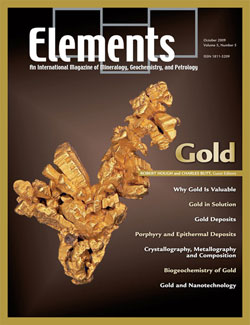
October 2009 – Volume 5 Number 5 

Gold

GUEST EDITORS
Robert M. Hough and Charles R. M. Butt

PRINCIPAL EDITOR
Harry Y. (Hap) McSween

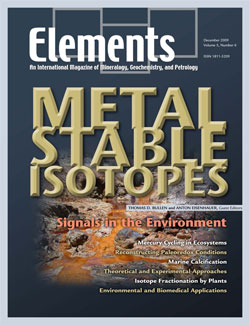
December 2009 – Volume 5 Number 6 

Metal Stable Isotopes: Signals in the Environment

GUEST EDITOR
Thomas D. Bullen and Anton Eisenhauer

PRINCIPAL EDITOR
Susan S.L. Stipp

Scroll to Top

December 2025 --The Variscan Orogeny in Europe – Understanding Supercontinent Formation

The Variscan orogen formed between 380 and 300 million years ago through several accretionary and collisional cycles, culminating with the construction of the Pangea supercontinent. This process occurred via sequential opening and closure of oceanic basins, synchronous detachment of Gondwana derived continental ribbons, and their outboard amalgamation onto the Laurussia margin. The Variscan orogen is rather unique compared with other orogenic belts on Earth: its overthickened and dominantly magmatic crust in the central belt, surprisingly minor mantle involvement in the magmatic and geodynamic processes, coherent and pulsed magmatism along the collision suture, and its complex accretionary history. Because its final product, Pangea, is the youngest and best-understood supercontinent on Earth, the Variscan orogeny offers clues for understanding the mechanisms of supercontinent formation.