


Elements Toolkit
KEY CONCEPTS
August 2026
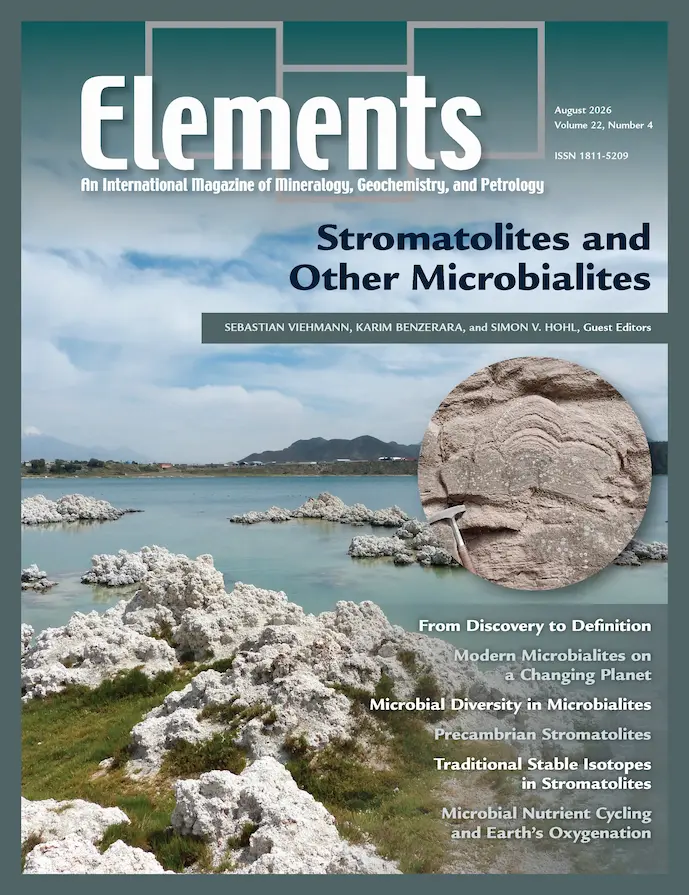
Extracellular polymeric substances (EPS): mixtures of polymers of high molecular weight, comprising carbohydrates, proteins, and nucleic acids, that are produced by a diversity of microorganisms. They can form a sticky matrix that holds microbial cells together in a biofilm or a mat.
More than Math: How Tensors Help Describe Mineral Properties
By Patrick Cordier and Jennifer M. Jackson | February 2026
The scope of tensors, however, extends far beyond this presentation. They are widely used in theoretical physics, engineering, image processing, artificial intelligence, and many other scientific fields. They are used to represent and manipulate physical quantities, force fields, images, structured data, and more.
WHAT ARE CARBON CYCLE MODELS?
By Sandra Kirtland Turner and Pam Vervoort | February 2026
In spring 2025, the Scripps CO2 program first measured a seasonal peak in CO2 concentrations exceeding 430 ppm. As atmospheric concentrations continue to rise, paleo-CO2 reconstructions are extending the limits of past carbon cycle knowledge—including CO2 measurements from million-year-old ice cores, as well as refinements and intercomparisons of both marine and terrestrial CO2-proxies that cover tens to hundreds of millions of years. Interpreting this wealth of data has motivated the development of numerical models of Earth’s global carbon cycle.
KEY TERMS OF THE VARISCAN OROGENY AND SUPERCONTINENT FORMATION
December 2025
This glossary provides short explanations of structural, tectonic, and geochemical terms that frequently appear in studies of the Variscan orogeny and related continental assembly processes. It is designed as a quick reference for readers navigating the complex vocabulary of orogenic dynamics, isotope geochemistry, and plate tectonics— concepts central to understanding how supercontinents form, evolve, and disperse through Earth’s history.
DEFINITIONS, CONCEPTS, AND UNDERSTANDING THE BASICS OF RE-OS ISOTOPE GEOCHEMISTRY
By Holly Stein, Laurie Reisberg, Judith Hannah, Vineet Goswami, and Aaron Zimmerman | August 2025
Re and Os are naturally occurring elements. Like most elements, Re and Os each have several isotopes. The word “isotope” refers to forms of the same element with different atomic masses. The various isotopes of a given element have different numbers of neutrons, but all have the same number of protons, that is, the same atomic number. Re has two isotopes. Os has seven isotopes.
ARCHEAN CRATONS: TERMS, CONCEPTS, AND ANALYTICAL APPROACHES
The articles in this Elements issue highlight various aspects of the formation and evolution of the Earth’s earliest crust. This Toolkit includes a glossary of terms, concepts, and analytical approaches important to the study of Archean cratons to provide context for the methodologies discussed in these articles. Geologic timescales are rarely presented without compressing the Precambrian portion of Earth history. For this reason, it is easy to overlook the fact that the time between Earth formation and the end of the Archean at 2.5 Ga (billion years ago)—the time period covered by the articles in this issue—represents fully 45% of Earth history.
INNOVATING AND NETWORKING GLOBAL GEOCHEMICAL DATA RESOURCES THROUGH ONEGEOCHEMISTRY
By Alexander M. Prent, Dominik C. Hezel, Marthe Klöcking, Lesley Wyborn, Rebecca Farrington, Kirsten Elger, Lucia Profeta, Angus L. Nixon, and Kerstin Lehnert | June, 2023
A vision of the not-too-distant future: Imagine yourself as a researcher who is making plans for fieldwork in the Andes Mountains. You are behind your computer and load a three-dimensional visualisation of the Earth and its geology to investigate the research already done in the southern Patagonian regions. You zoom in to the mountain range of interest and select various data layers to show samples, their chemical and isotopic compositions, as well as rock ages for further reference. One area shows particularly young ages and a single click brings up an image showing the thermal and chemical evolution of the rocks, bringing to life the events experienced by that part of the Earth.
ALKALINITY IN THEORY AND PRACTICE
By Nicholas J. Tosca and Benjamin M. Tutolo | February, 2023
The articles in this issue highlight interdisciplinary approaches to the science of alkaline lakes, but one important concept links all of them together: alkalinity. Here, we discuss what alkalinity is, why it is important, and how it is typically measured. We review two different but complementary definitions of alkalinity that offer an intuitive starting point for understanding how this critical parameter responds to biogeochemical processes.
Measuring Noble Gases for Thermochronology
By Peter K. Zeitler and Marissa M. Tremblay | October, 2020
The articles in this issue show how applications of noble gas thermochronology can help answer fundamental questions about Earth and planetary processes. Here, we discuss how noble gas measurements are actually made. We review the different methods used to extract and isolate noble gases from natural materials and to measure those gas concentrations and isotopic compositions using mass spectrometry.