Thematic Articles

Tourmaline the Indicator Mineral: From Atomic Arrangement to Viking Navigation

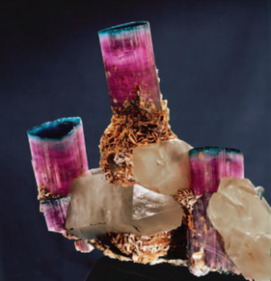
Tourmaline sensulato has been known for at least two thousand years, and its unique combination of physical properties has ensured its importance to human society, from technical devices (such as a possible Viking navigational aid and early piezoelectric gauges in the 20th century) to attractive and popular gemstones. The chemical diversity and accommodating nature of its structure combine to make tourmaline a petrogenetic indicator for the wide range of rocks in which it occurs. Recent advances in understanding the structure, site assignments, and substitution mechanisms have led to a new nomenclature for the tourmaline supergroup minerals. Eighteen species have been described to encapsulate the chemical variety found in this intriguing structure.

This content is for Registered members only. To subscribe, please
join one of our participating societies or contact the Editorial Team.

Login
Already a member? Log in here

Tourmaline the Indicator Mineral: From Atomic Arrangement to Viking Navigation Read More »
Tourmaline: A Geologic DVD

Tourmaline is an eye-catching mineral, but even more importantly, it has played a significant role in the evolution of scientific thought and, more recently, has been recognized as a medium for recording geologic information, not unlike a DVD. With its plethora of chemical constituents, its wide range of stability from conditions near the Earth’s surface to the pressures and temperatures of the upper mantle, and its extremely low rates of volume diffusion, tourmaline can acquire a chemical signature from the rock in which it develops and can retain that signature through geologic time. As a source as well as a sink for boron, tourmaline is nature’s boron recorder. Tourmaline can be used as a geothermometer, provenance indicator, fluid-composition recorder, and geochronometer. Although long prized as a gemstone, tourmaline is clearly more than meets the eye.

This content is for Registered members only. To subscribe, please
join one of our participating societies or contact the Editorial Team.

Login
Already a member? Log in here

Tourmaline: A Geologic DVD Read More »

Organizing Melt Flow through the Crust

Melt that crystallizes as granite at shallow crustal levels in orogenic belts originates from migmatite and residual granulite in the deep crust; this is the most important mass-transfer process affecting the continents. Initially melt collects in grain boundaries before migrating along structural fabrics and through discordant fractures initiated during synanatectic deformation. As this permeable porosity develops, melt flows down gradients in pressure generated by the imposed tectonic stress, moving from grain boundaries through outcrop-scale vein networks to ascent conduits. Gravity then drives melt ascent through the crust, either in dikes that fi ll ductile-to-brittle–elastic fractures or by pervasive flow in planar and linear channels in belts of steep structural fabrics. Melt may be arrested in its ascent at the ductile-to-brittle transition zone or it may be trapped en route by a developing tectonic structure.

This content is for Registered members only. To subscribe, please
join one of our participating societies or contact the Editorial Team.

Login
Already a member? Log in here

Organizing Melt Flow through the Crust Read More »

Crustal Melting and the Flow of Mountains

As the continental crust thickens during mountain building, it can become hot enough to start melting, leading to a profound reduction in its strength. Melt-weakened crust can flow outward or upward in response to the pressure gradients associated with mountain building, and may be transported hundreds of kilometres laterally as mid-crustal channels. In the Himalayan–Tibetan system, melting began about 30 million years ago, and widespread granite intrusion began at 20–23 Ma. Geophysical data indicate that melt is present beneath the Tibetan plateau today, and deeply eroded mountain belts preserve evidence for melt-enhanced ductile flow in the past. Flow of partially molten crust may limit the thickness and elevation of mountain belts and has influenced the deep structure of continents.

This content is for Registered members only. To subscribe, please
join one of our participating societies or contact the Editorial Team.

Login
Already a member? Log in here

Crustal Melting and the Flow of Mountains Read More »

Melted Rocks under the Microscope: Microstructures and Their Interpretation

Recognising the former presence of melt in rocks which have undergone cooling and exhumation over millions of years following regional metamorphism commonly relies on the correct interpretation of grain-scale structures visible only under the microscope. The evolution of these structures during prograde melting and, later, retrograde cooling can be understood using concepts derived from experimental simulation and materials science.

This content is for Registered members only. To subscribe, please
join one of our participating societies or contact the Editorial Team.

Login
Already a member? Log in here

Melted Rocks under the Microscope: Microstructures and Their Interpretation Read More »

Is the Crucible Reproducible? Reconciling Melting Experiments with Thermodynamic Calculations

Experimental studies and thermodynamic modelling have advanced our understanding of partial melting in the crust and have provided a framework for the interpretation of migmatites, residual granulites and granites. Each approach has advantages and pitfalls, and each is more appropriate than the other for investigating particular aspects of the melting process. A comparison of these two approaches may be useful because, together, they potentially give more information. A comparison of a small number of experiments with model calculations using equivalent bulk compositions shows important consistencies between the results, especially regarding the overall topologies of key melting equilibria. Despite this, several significant differences between the two approaches remain, though the sources of these differences are difficult to determine.

This content is for Registered members only. To subscribe, please
join one of our participating societies or contact the Editorial Team.

Login
Already a member? Log in here

Is the Crucible Reproducible? Reconciling Melting Experiments with Thermodynamic Calculations Read More »

How Does the Continental Crust Get Really Hot?

There is widespread evidence that ultrahigh temperatures of 900–1000 °C have been generated in the Earth’s crust repeatedly in time and space. These temperatures were associated with thickened crust in collisional mountain belts and the production of large volumes of magma. Numerical modelling indicates that a long-lived mountain plateau with high internal concentrations of heat-producing elements and low erosion rates is the most likely setting for such extreme conditions. Preferential thickening of alreadyhot back-arc basins and mechanical heating by deformation in ductile shear zones might also contribute to elevated temperatures.

This content is for Registered members only. To subscribe, please
join one of our participating societies or contact the Editorial Team.

Login
Already a member? Log in here

How Does the Continental Crust Get Really Hot? Read More »

When the Continental Crust Melts

Partial melting of the continental crust has long been of interest to petrologists as a small-scale phenomenon. Mineral assemblages in the cores of old, eroded mountain chains that formed where continents collided show that the continental crust was buried deeply enough to have melted extensively. Geochemical, experimental, petrological and geodynamic modelling now show that when the continental crust melts the consequences are crustal-scale. The combination of melting and regional deformation is critical: the presence of melt on grain boundaries weakens rocks, and weak rocks deform faster, infl uencing the way mountain belts grow and how rifts propagate. Tectonic forces also drive the movement of melt out of the lower continental crust, resulting in an irreversible chemical differentiation of the crust.

This content is for Registered members only. To subscribe, please
join one of our participating societies or contact the Editorial Team.

Login
Already a member? Log in here

When the Continental Crust Melts Read More »

Iron Ore Deposits Associated with Precambrian Iron Formations

Most large deposits of iron ore are associated with iron formations for the simple reason that they have the highest iron concentrations of any “normal” rock type. Iron formations are found in all Precambrian shields. Iron was preconcentrated in iron formations by surface processes in Precambrian marginal-marine environments, as outlined elsewhere in this issue.

This content is for Registered members only. To subscribe, please
join one of our participating societies or contact the Editorial Team.

Login
Already a member? Log in here

Iron Ore Deposits Associated with Precambrian Iron Formations Read More »

Iron Minerals in Marine Sediments Record Chemical Environments

Post-depositional chemical reactions involving iron are important in shallow-marine sediments. They play a significant role in governing the types of minerals that precipitate in such settings. The level of iron supply to marine sediments creates contrasting chemical pathways, each producing distinctive mineral assemblages. An understanding of these processes not only offers insights into past sedimentary environments on Earth but also a greater appreciation of the nature of mineral–water–bacteria interactions throughout the shallow-marine realm.

This content is for Registered members only. To subscribe, please
join one of our participating societies or contact the Editorial Team.

Login
Already a member? Log in here

Iron Minerals in Marine Sediments Record Chemical Environments Read More »

Scroll to Top

December 2025 --The Variscan Orogeny in Europe – Understanding Supercontinent Formation

The Variscan orogen formed between 380 and 300 million years ago through several accretionary and collisional cycles, culminating with the construction of the Pangea supercontinent. This process occurred via sequential opening and closure of oceanic basins, synchronous detachment of Gondwana derived continental ribbons, and their outboard amalgamation onto the Laurussia margin. The Variscan orogen is rather unique compared with other orogenic belts on Earth: its overthickened and dominantly magmatic crust in the central belt, surprisingly minor mantle involvement in the magmatic and geodynamic processes, coherent and pulsed magmatism along the collision suture, and its complex accretionary history. Because its final product, Pangea, is the youngest and best-understood supercontinent on Earth, the Variscan orogeny offers clues for understanding the mechanisms of supercontinent formation.