
Thematic Articles

Oceanic Dispersion Simulations of 137Cs Released from the Fukushima Daiichi Nuclear Power Plant

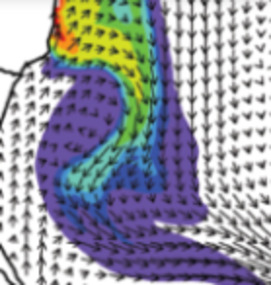
Five models have been used to estimate the oceanic dispersion of 137Cs from the Fukushima Daiichi nuclear power plant during March and April 2011, following the accident on March 11, 2011. The total discharged activity of 137Cs is estimated to be 2 to 15 petabequerels. A weak southward current along the Fukushima coast was responsible for the initial transport direction, while mesoscale eddy-like structures and surface-current systems contributed to dispersion in areas beyond the continental shelf. Most of the discrepancies among the models in April are caused by differences in how the mesoscale current structures off the Ibaraki coast are represented.

This content is for Registered members only. To subscribe, please
join one of our participating societies or contact the Editorial Team.

Login
Already a member? Log in here

Oceanic Dispersion Simulations of 137Cs Released from the Fukushima Daiichi Nuclear Power Plant Read More »

Land-Surface Contamination by Radionuclides from the Fukushima Daiichi Nuclear Power Plant Accident

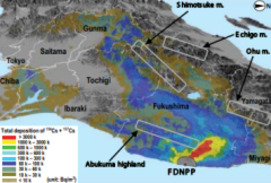
Radionuclides, such as 134Cs, 137Cs, and 131I, were released during the Fukushima Daiichi nuclear power plant accident in March 2011. Their distribution was monitored by airborne surveys and soil sampling. The most highly contaminated areas are to the northwest of the plant and in the Naka-dori region of Fukushima Prefecture; this contamination was mainly the result of wet deposition on March 15. Radionuclides were also released on March 21, and they were dispersed up to 200 km south of the plant. The Cs/I ratios are different for these two events, probably because of differences in the initial ratios in the airborne plumes and the amount of wet deposition. Numerical simulations of the dispersion process and vertical profiles of radionuclides in soils are used to describe the contamination of soils.

This content is for Registered members only. To subscribe, please
join one of our participating societies or contact the Editorial Team.

Login
Already a member? Log in here

Land-Surface Contamination by Radionuclides from the Fukushima Daiichi Nuclear Power Plant Accident Read More »

Atmospheric Dispersion and Deposition of Radionuclides from the Fukushima Daiichi Nuclear Power Plant Accident

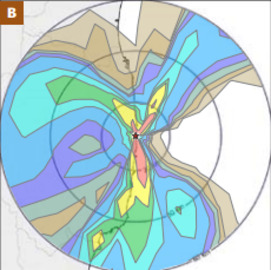
On March 11, 2011, an earthquake and tsunami hit the northeast coast of Japan and damaged the Fukushima Daiichi nuclear power plant, leading to the release of radioactive material into the atmosphere. We trace the evolution of radioactivity release to the atmosphere and subsequent dispersion as simulated by models, and we compare these to actual measurements. Four main release periods are highlighted. The first event had limited consequences to the north of the power plant along the coast; the second had no impact on Japanese territory because the plumes travelled toward the Pacific Ocean; the third was responsible for significant and longterm impact, especially northwest of the plant; and the last had consequences of lesser impact on the Tokyo area.

This content is for Registered members only. To subscribe, please
join one of our participating societies or contact the Editorial Team.

Login
Already a member? Log in here

Atmospheric Dispersion and Deposition of Radionuclides from the Fukushima Daiichi Nuclear Power Plant Accident Read More »

Examining the Nuclear Accident at Fukushima Daiichi

The major nuclear accident at the Fukushima Daiichi nuclear power plant more than one year ago was the result of a combination of four interrelated factors: site selection, external hazard assessment and site preparation, the utility’s approach to risk management, and fundamental reactor design. The reactor accident was initiated by a magnitude 9 earthquake, followed by an even more damaging tsunami. An insufficient tsunami defense-in-depth strategy led to significant core damage in three units and radioactive release to the environment. This paper provides a summary of the sequence of events that led to the accident and current efforts to contain and manage the released radioactivity.

This content is for Registered members only. To subscribe, please
join one of our participating societies or contact the Editorial Team.

Login
Already a member? Log in here

Examining the Nuclear Accident at Fukushima Daiichi Read More »

The 2011 Tohoku Earthquake

Rapid seismological analyses, carried out within minutes of the March 11, 2011, Tohoku earthquake, were crucial in providing an earthquake ground shaking and tsunami early warning and in hastening the evacuation of the population along Japan’s northeastern coast. By 20 to 30 minutes after fault rupture began, these analyses had established that the event had a moment magnitude of Mw = 9 and involved shallow thrust faulting on the plate boundary megathrust. Preparation for future large earthquakes on megathrusts in Japan and elsewhere should include onshore and offshore geodetic monitoring of strain accumulation, implementation of rapid earthquake and tsunami warning systems, and public training and education for shaking and tsunami response.

This content is for Registered members only. To subscribe, please
join one of our participating societies or contact the Editorial Team.

Login
Already a member? Log in here

The 2011 Tohoku Earthquake Read More »

Water Conservation, Efficiency, and Reuse

Global water scarcity is intensifying. Economizing on water use will be an important aspect of any effective response. Water recycling and reuse technologies offer possibilities for more extensive use of water, depending on cost. Institutional responses, such as the use of rational pricing and the creation of water markets or exchanges, promise to improve wateruse efficiency. Consumer education is a simple and inexpensive means of economizing on water in the urban and agricultural sectors. Rationing is effective in managing short-term interruptions such as drought. Point-of-use technology will also offer opportunities for economizing on many water uses.

This content is for Registered members only. To subscribe, please
join one of our participating societies or contact the Editorial Team.

Login
Already a member? Log in here

Water Conservation, Efficiency, and Reuse Read More »

Water Management Challenges Associated with the Production of Shale Gas by Hydraulic Fracturing

Development of unconventional, onshore natural gas resources in deep shales is rapidly expanding to meet global energy needs. Water management has emerged as a critical issue in the development of these inland gas reservoirs, where hydraulic fracturing is used to liberate the gas. Following hydraulic fracturing, large volumes of water containing very high concentrations of total dissolved solids (TDS) return to the surface. The TDS concentration in this wastewater, also known as “flowback,” can reach 5 times that of sea water. Wastewaters that contain high TDS levels are challenging and costly to treat. Economical production of shale gas resources will require creative management of flowback to ensure protection of groundwater and surface water resources. Currently, deep-well injection is the primary means of management. However, in many areas where shale gas production will be abundant, deep-well injection sites are not available. With global concerns over the quality and quantity of fresh water, novel water management strategies and treatment technologies that will enable environmentally sustainable and economically feasible natural gas extraction will be critical for the development of this vast energy source.

This content is for Registered members only. To subscribe, please
join one of our participating societies or contact the Editorial Team.

Login
Already a member? Log in here

Water Management Challenges Associated with the Production of Shale Gas by Hydraulic Fracturing Read More »

Groundwater: A Resource in Decline

Around the world, groundwater sources are in decline due to overpumping and pollution. History informs us that as water supplies are lost so are civilizations. Such was the case with the Garamantian civilization, which thrived in the western Libya desert from 500 BCE to 400 CE, then disappeared when the groundwater ran out. Present-day mining of groundwater from large aquifers in the United States, North Africa, and China illustrates this problem. In less than a century, pressures from food production and population growth are leading to declines in supplies that appeared to many as inexhaustible. In many countries, there can be no replacement for declining water resources. Food scarcity and health epidemics, leading to societal decline, are likely outcomes as people chase dwindling water supplies.

This content is for Registered members only. To subscribe, please
join one of our participating societies or contact the Editorial Team.

Login
Already a member? Log in here

Groundwater: A Resource in Decline Read More »

Hydrogeochemical Processes and Controls on Water Quality and Water Management

The chemical constituents in water determine its potability, usability for agriculture and recreation, and interactions with biological systems. Anthropogenic processes have significantly influenced the geochemistry of water in many regions. Physical, chemical, and biological processes control the chemistry and chemical evolution of water in natural and contaminated systems. Advances in our ability to quantify these processes will improve our ability to manage our water resources, help us identify potential sources of contamination, and illuminate potential solutions to water-quality problems. Particularly impressive are the applications of chemical and isotopic tracers, which can track water movement and quantify water fluxes on the surface and in the subsurface. To better address societal needs, future advances will require a holistic approach to interpreting geochemical data.

This content is for Registered members only. To subscribe, please
join one of our participating societies or contact the Editorial Team.

Login
Already a member? Log in here

Hydrogeochemical Processes and Controls on Water Quality and Water Management Read More »

Scroll to Top

December 2025 --The Variscan Orogeny in Europe – Understanding Supercontinent Formation

The Variscan orogen formed between 380 and 300 million years ago through several accretionary and collisional cycles, culminating with the construction of the Pangea supercontinent. This process occurred via sequential opening and closure of oceanic basins, synchronous detachment of Gondwana derived continental ribbons, and their outboard amalgamation onto the Laurussia margin. The Variscan orogen is rather unique compared with other orogenic belts on Earth: its overthickened and dominantly magmatic crust in the central belt, surprisingly minor mantle involvement in the magmatic and geodynamic processes, coherent and pulsed magmatism along the collision suture, and its complex accretionary history. Because its final product, Pangea, is the youngest and best-understood supercontinent on Earth, the Variscan orogeny offers clues for understanding the mechanisms of supercontinent formation.