Thematic Articles

The Crystallography, Metallography and Composition of Gold

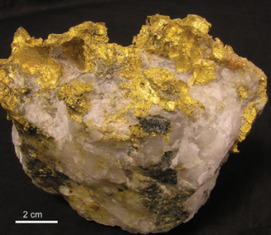
Gold is an element, a metal and a mineral. In nature, gold most commonly occurs as an alloy with silver and, more rarely, with palladium, mercury and copper, and ranges in size from nanoparticles to nuggets weighing 70 kg. Crystallography, metallography and composition control the colour of the alloy, how it will deform, how it will behave at high temperature and how it reacts. These properties offer insights into how gold deposits have formed and been altered, whether under hydrothermal or Earth-surface conditions.

This content is for Registered members only. To subscribe, please
join one of our participating societies or contact the Editorial Team.

Login
Already a member? Log in here

The Crystallography, Metallography and Composition of Gold Read More »
From Source to Sinks in Auriferous Magmatic-Hydrothermal Porphyry and Epithermal Deposits

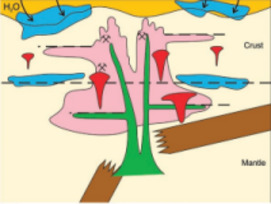
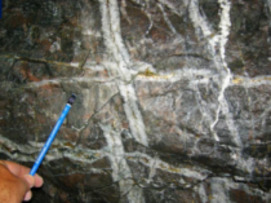
Auriferous porphyry Cu deposits are restricted to convergent plate settings, whereas epithermal precious metal deposits form at extending convergent plate settings and in rifts. Both deposit types are linked to magma carrying metals and ligands that rises to form an upper-crustal magma chamber. Magma convection and fractionation lead to volatile exsolution and collection in the apical parts of the chamber, from which exsolved hydrothermal fluid ascends to form either a porphyry Cu–Au deposit associated with stocks and dykes generally at 2–5 km depth, or an epithermal deposit associated with coeval volcanic rocks at depths of

This content is for Registered members only. To subscribe, please
join one of our participating societies or contact the Editorial Team.

Login
Already a member? Log in here

From Source to Sinks in Auriferous Magmatic-Hydrothermal Porphyry and Epithermal Deposits Read More »

Gold Deposits: Where, When and Why

Gold concentrations in mineable deposits range from ~1 to 100 parts per million (ppm), or higher in bonanza deposits, in comparison to an average crustal abundance of ~1.3 ppb. A diverse range of elements may be associated with Au (La, Ce, U, V, Cr, Mo, W, Fe, Co, Ni, Pd, Pt, Cu, Ag, Zn, Hg, B, Tl, C, Si, Pb, As, Sb, Bi, S, Se, Te). A common mineralogical association is gold and quartz, but gold accumulations are also found with carbonates, carbon, feldspars, Fe sulfides and oxides, base metal sulfides, Fe ± Co ± Ni arsenides, and Fe ± Mg ± Ca ± V ± Cr silicates.

This content is for Registered members only. To subscribe, please
join one of our participating societies or contact the Editorial Team.

Login
Already a member? Log in here

Gold Deposits: Where, When and Why Read More »

Gold in Solution

Although gold is a noble metal and is effectively insoluble even in strong acids, we have known for nearly 500 years that it can be concentrated to mineable levels by being transported as dissolved species in crustal fluids (indeed, most economic gold deposits owe their origin to this mode of transport). From alchemy and later experimental chemistry and geochemistry, we have developed an understanding of the solubility and speciation of gold in aqueous liquids and other crustal fluids. This knowledge informs us about the processes that promote the transport of gold in the Earth’s crust, result in exploitable gold deposits and lead to the remobilization of gold in the surficial environment.

This content is for Registered members only. To subscribe, please
join one of our participating societies or contact the Editorial Team.

Login
Already a member? Log in here

Gold in Solution Read More »

Why Gold is Valuable

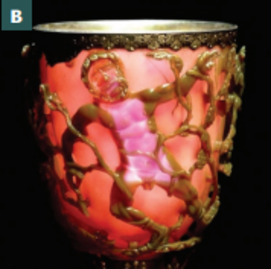
Gold has fascinated people of most cultures since earliest times because of its colour, seeming immutability and ease of fabrication into exquisite objects. Due to gold’s rarity, its principal functions have been as currency and a store of wealth. Most of the gold ever mined has been hoarded, and rich discoveries over the past 160 years have increased the notional global amount per capita two to five fold. This rate of inflation is minor in comparison to that of currency, so gold still performs its historical financial role. Research is directed at discovering new deposits to support this role, and at finding practical applications commensurate with its monetary cost.

This content is for Registered members only. To subscribe, please
join one of our participating societies or contact the Editorial Team.

Login
Already a member? Log in here

Why Gold is Valuable Read More »

Hydrothermal Zircon

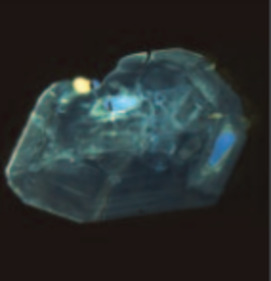
Numerous cases have been reported where zircon may have precipitated from a hydrothermal fluid or a fluid-saturated residual melt. Temperatures for hydrothermal zircon formation range from 600°C in late-magmatic systems at the magmatic-to-hydrothermal transition down to 300°C in mesothermal ore-forming systems. Late-magmatic to hydrothermal zircon may precipitate from fluid-saturated magma and possibly from the fluids exsolved from mineralized granites and pegmatites. For example, in the Sn–Wmineralized Mole Granite, New South Wales, Australia, zircon occurs in growth zones in hydrothermal quartz, along with monazite, xenotime and thorite

This content is for Registered members only. To subscribe, please
join one of our participating societies or contact the Editorial Team.

Login
Already a member? Log in here

Hydrothermal Zircon Read More »

Re-equilibration of Zircon in Aqueous Fluids and Melts

Natural zircon crystals often show complex secondary textures that cut across primary growth zones. In zircon showing structural damage caused by self-irradiation, such textures are the result of a diffusion– reaction process in which a hydrous species diffuses inwards and “catalyzes” structural recovery. Nanoscale pores develop, solvent elements such as Ca, Al and Fe are gained, and radiogenic Pb is lost. In both aqueous fluids and melts, replacement of zircon with undamaged structure by a coupled dissolution– reprecipitation process can produce similar textures. The reacted domains usually have lower trace element contents and may contain micrometer-sized pores and inclusions of uranium, thorium and/or yttrium phases, originally in solid solution. Both processes have considerable implications for zircon geochronology.

This content is for Registered members only. To subscribe, please
join one of our participating societies or contact the Editorial Team.

Login
Already a member? Log in here

Re-equilibration of Zircon in Aqueous Fluids and Melts Read More »

Rare Earth Element Behavior in Zircon–Melt Systems

Natural zircon crystals incorporate rare earth elements (REE) into their structure at concentrations determined by the pressure, temperature, and composition of their growth environment. In principle, REE concentrations in magmatic zircon crystals can be used to infer their conditions of growth and the composition of the melt from which they grew—provided accurate information is available about the distribution of REE between zircon and melt. Currently available zircon–melt partitioning data show a range in values covering several orders of magnitude for some REE. Further experimental work and studies using carefully selected natural samples are required to fully understand REE incorporation in zircon.

This content is for Registered members only. To subscribe, please
join one of our participating societies or contact the Editorial Team.

Login
Already a member? Log in here

Rare Earth Element Behavior in Zircon–Melt Systems Read More »

Zircon Behaviour in Deeply Subducted Rocks

Zircon is of fundamental importance in the investigation of deeply subducted crustal rocks in which it is a trace constituent. Tiny mineral inclusions within zircon may be the only indicators that rocks were subducted to a depth of up to 150 km. Because zircon is resistant to physical and chemical changes, it preserves stages of the subduction and exhumation history within submillimetre-size grains. Advanced in situ techniques allow us to date zircon domains and to determine their trace element composition. We can thus acquire a detailed knowledge of the temperature–pressure–time paths that these extraordinary rocks have experienced. Zircon studies provide evidence that subduction and exhumation act at plate tectonic speeds of 1–3 cm/year.

This content is for Registered members only. To subscribe, please
join one of our participating societies or contact the Editorial Team.

Login
Already a member? Log in here

Zircon Behaviour in Deeply Subducted Rocks Read More »

Zircon Behaviour and the Thermal Histories of Mountain Chains

Using the U–Pb geochronology of zircon we can understand the growth and collapse of mountain chains, both recent and ancient. In the hightemperature metamorphic rocks that underlie mountain ranges, zircon may survive from precursor rocks, recrystallize, or grow anew. All these possibilities must be considered in the interpretation of zircon ages. Microtextural characterisation and microanalysis, coupled with considerations of mineral equilibria and trace element distributions between zircon and neighbouring silicate minerals, provide insights into the factors controlling zircon modification and growth. Zircon ages do not usually correspond to the peak of metamorphism but instead provide information on the history of cooling from high temperatures, including the timing and rates of exhumation of the deep roots of mountain chains.

This content is for Registered members only. To subscribe, please
join one of our participating societies or contact the Editorial Team.

Login
Already a member? Log in here

Zircon Behaviour and the Thermal Histories of Mountain Chains Read More »

Scroll to Top

December 2025 --The Variscan Orogeny in Europe – Understanding Supercontinent Formation

The Variscan orogen formed between 380 and 300 million years ago through several accretionary and collisional cycles, culminating with the construction of the Pangea supercontinent. This process occurred via sequential opening and closure of oceanic basins, synchronous detachment of Gondwana derived continental ribbons, and their outboard amalgamation onto the Laurussia margin. The Variscan orogen is rather unique compared with other orogenic belts on Earth: its overthickened and dominantly magmatic crust in the central belt, surprisingly minor mantle involvement in the magmatic and geodynamic processes, coherent and pulsed magmatism along the collision suture, and its complex accretionary history. Because its final product, Pangea, is the youngest and best-understood supercontinent on Earth, the Variscan orogeny offers clues for understanding the mechanisms of supercontinent formation.