Thematic Articles

The Earth’s Lower Mantle and Core

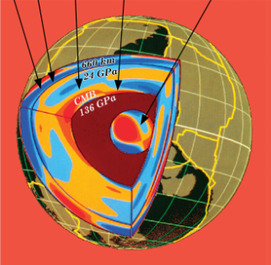
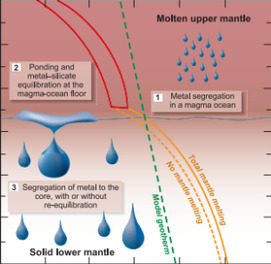
More than 90 percent of the Earth’s mass is composed of iron, oxygen, silicon and magnesium, distributed among a metal-rich core, a silicate-rich mantle and more highly fractionated crustal rocks (less than 1% of the total). Mantle and core compositions can be approximated quite easily provided the bulk-Earth composition is assumed to be the same as that of appropriate meteorites. Critical mineral-physics data, some of which are reviewed in this article, are then needed to develop viable compositional and thermal Earth models, thus leading to a better knowledge of the deepest rocks in the Earth.

This content is for Registered members only. To subscribe, please
join one of our participating societies or contact the Editorial Team.

Login
Already a member? Log in here

The Earth’s Lower Mantle and Core Read More »
The Upper Mantle and Transition Zone

The upper mantle is the source of almost all magmas. It contains major transitions in rheological and thermal behaviour that control the character of plate tectonics and the style of mantle dynamics. Essential parameters in any model to describe these phenomena are the mantle’s compositional and thermal structure. Most samples of the mantle come from the lithosphere. Although the composition of the underlying asthenospheric mantle can be estimated, this is made difficult by the fact that this part of the mantle partially melts and differentiates before samples ever reach the surface. The composition and conditions in the mantle at depths significantly below the lithosphere must be interpreted from geophysical observations combined with experimental data on mineral and rock properties. Fortunately, the transition zone, which extends from approximately 410 to 660 km, has a number of characteristic globally observed seismic properties that should ultimately place essential constraints on the compositional and thermal state of the mantle.

This content is for Registered members only. To subscribe, please
join one of our participating societies or contact the Editorial Team.

Login
Already a member? Log in here

The Upper Mantle and Transition Zone Read More »

Elastic Properties of Minerals: A Key for Understanding the Composition and Temperature of Earth’s Interior

Seismological studies give us a high-definition 3-D picture of the Earth’s interior in terms of seismic velocity and density. Near the surface, observations of these properties can be compared with rock samples. As we go deeper into the Earth, interpretation of seismic data is more difficult. Laboratory measurements of velocities and other elastic properties of minerals are the key to understanding this seismic information, allowing us to translate it into quantities such as chemical composition, mineralogy, temperature, and preferred orientation of minerals. Here we present a description of modern techniques for measuring elastic properties at high pressures and temperatures, emphasizing those most relevant to understanding the interior of the Earth and other planets.

This content is for Registered members only. To subscribe, please
join one of our participating societies or contact the Editorial Team.

Login
Already a member? Log in here

Elastic Properties of Minerals: A Key for Understanding the Composition and Temperature of Earth’s Interior Read More »

Deep Earth and Recent Developments in Mineral Physics

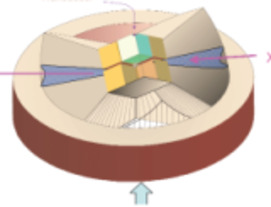
Very few rocks on the Earth’s surface come from below the crust. In fact, most of Earth’s interior is unsampled, at least in the sense that we do not have rock samples from it. So how do we know what is down there? Part of the answer comes from laboratory and computer experiments that try to recreate the enormous pressure–temperature conditions in the deep Earth and to measure the properties of minerals under these conditions. This is the realm of high-pressure mineral physics and chemistry. By comparing mineral properties at high pressures and temperatures with geophysical observations of seismic velocities and density at depth, we get insight into the mineralogy, composition, temperature, and deformation within Earth’s interior, from the top of the mantle to the center of the planet.

This content is for Registered members only. To subscribe, please
join one of our participating societies or contact the Editorial Team.

Login
Already a member? Log in here

Deep Earth and Recent Developments in Mineral Physics Read More »

Water on Mars and the Prospect of Martian Life

Evidence of water on Mars dates back to the first observations of channeled landscapes made by Mariner 9 and Viking. More recent images from Mars Global Surveyor and Mars Express strikingly confirm that fluids have sculpted the Martian surface at least episodically through its history. The Mars Exploration Rovers Opportunity and Spirit have added evidence for extensive rock–water chemical interactions in the regions where these remote geologists landed, while OMEGA and THEMIS have shown that similar processes took place in many parts of the planet. Because of the close relationship between water and biological activity on Earth, such observations have been taken as hopeful signs that Mars, as well, might once have supported life and, indeed, might still do so in subterranean oases. There is, however, much more to consider. Water appears to be neces- sary for life, at least as it exists on Earth and can be contemplated on Mars, but it does not, by itself, insure habitability. In this paper, we review the broader requirements for biological activity as they relate to water and use these to constrain astrobiological inferences about Mars.

This content is for Registered members only. To subscribe, please
join one of our participating societies or contact the Editorial Team.

Login
Already a member? Log in here

Water on Mars and the Prospect of Martian Life Read More »

Evidence for Water at Meridiani

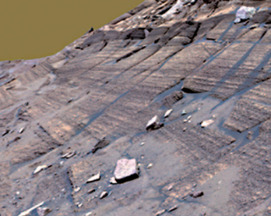
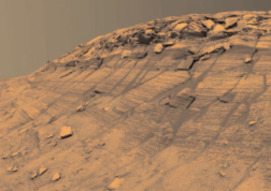
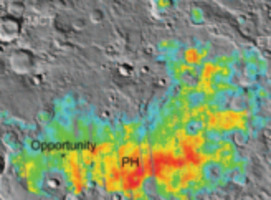
The Mars Exploration Rover Opportunity has examined sedimentary structures in the Burns formation at Meridiani Planum. The materials in this formation reflect, in part, subaqueous deposition of reworked, sulfate-rich, clastic sediments that likely formed in a playa–interdune setting. The chemistry and mineralogy of the sedimentary rocks record an origin by evaporation of sulfate- and chloride-rich brines mixed with a fine, altered, basaltic mud or dust component, prior to reworking. Cementation and postde- positional reactions to form hematite-rich concretions and crystal-mold porosity reflect diagenesis in a groundwater-saturated subsurface. More recent dehy- dration events are evidenced by polygonal textures in rocks within craters and exposed on the plains. The timing of formation of fracture fillings that cut across bedding is not well constrained and may be early postdiagenetic or later. The fracture fillings may have formed by solutions remobilized along zones of weakness. Alteration rinds may reflect more recent interactions between rock and atmospheric water vapor.

This content is for Registered members only. To subscribe, please
join one of our participating societies or contact the Editorial Team.

Login
Already a member? Log in here

Evidence for Water at Meridiani Read More »

Aqueous Processes Recorded by Martian Meteorites Analyzing Martian Water on Earth

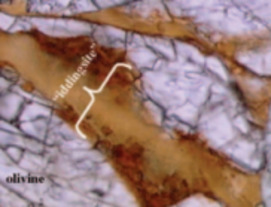
Martian meteorites have delivered to Earth water molecules and minerals produced by aqueous processes on Mars. The study of these samples, using powerful analytical instrumentation, provides a basis for understanding aqueous activity on Mars. Although most analyses are at the scale of microns, the conclusions reached have important implications for large-scale aqueous processes. Secondary minerals, such as clays, salts, and carbonates, are present at some level in all Martian meteorite subtypes and are especially important in the nakhlites and ALH84001. Light element stable isotope analyses show evidence for mixing between atmosphere and magmatic fluids into a crustal reservoir, and that this crustal water was not in equilib- rium with the host rocks. The mineralogical and isotopic data present a fairly consistent picture of the aqueous history of Mars: low levels of aqueous alteration are generally present but extensive aqueous processes are probably limited in space and time.

This content is for Registered members only. To subscribe, please
join one of our participating societies or contact the Editorial Team.

Login
Already a member? Log in here

Aqueous Processes Recorded by Martian Meteorites Analyzing Martian Water on Earth Read More »

Water at the Poles and in Permafrost Regions of Mars

The poles and mid-latitudes of Mars contain abundant water in ice caps, thick sequences of ice-rich layers, and mantles of snow. The volume of the known reservoir is ≥≥5 x 10⁶ km3, corresponding to a layer ~35 m thick over the planet. Hydrogen in subsurface H2O ice has been detected at latitudes poleward of 50°. Morphological features show downslope flow of ice-rich sediment, and recent gullies have been produced from subsurface aquifers or melting snowpacks. Variations in Mars’ orbit on timescales of 50,000 to 2,000,000 years produce significant changes in climate, which result in the transport of water from the poles, where it currently resides, to the lower latitudes, where it may play a critical role in surface geology, mineralogy, and geochemistry.

This content is for Registered members only. To subscribe, please
join one of our participating societies or contact the Editorial Team.

Login
Already a member? Log in here

Water at the Poles and in Permafrost Regions of Mars Read More »

The Orbital Search for Altered Materials on Mars

The Martian surface is dominated by primary igneous minerals common in basaltic rocks. Limited chemical alteration exists in fine-grained dust, and is likely in sands and rocks at high latitudes and in the northern lowland plains where materials have interacted with ice and snow. Evidence for extensive production of secondary phases is revealed at higher spatial resolutions, where alteration effects of unique, and perhaps time-limited, aqueous environments are observed. The distribution of ice on Mars thus appears to have a global influence on the production of alteration materials, whereas the effects of water are discovered in unique and locally diverse geological settings.

This content is for Registered members only. To subscribe, please
join one of our participating societies or contact the Editorial Team.

Login
Already a member? Log in here

The Orbital Search for Altered Materials on Mars Read More »

Geomorphological Evidence for Water on Mars

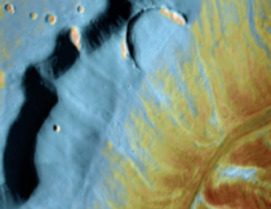
Martian landscapes and landforms indicate episodic activity by water and ice, extending from the planet’s earliest history up to the present day. Most of the relevant fluvial, glacial, volcano–ice, periglacial, lacustrine (even “marine”), and related landforms have direct counterparts on Earth. Moreover, they exist in causally related, holistic associations of space and time that confirm their relationship to a long-term history of water-related activity. Although strong geomorphological evidence for many of these relation- ships has been apparent for 30 years, its scientific importance has only been recently appreciated because of direct geochemical measurements of water and ice features by surface robotic and orbital instruments.

This content is for Registered members only. To subscribe, please
join one of our participating societies or contact the Editorial Team.

Login
Already a member? Log in here

Geomorphological Evidence for Water on Mars Read More »

Scroll to Top

December 2025 --The Variscan Orogeny in Europe – Understanding Supercontinent Formation

The Variscan orogen formed between 380 and 300 million years ago through several accretionary and collisional cycles, culminating with the construction of the Pangea supercontinent. This process occurred via sequential opening and closure of oceanic basins, synchronous detachment of Gondwana derived continental ribbons, and their outboard amalgamation onto the Laurussia margin. The Variscan orogen is rather unique compared with other orogenic belts on Earth: its overthickened and dominantly magmatic crust in the central belt, surprisingly minor mantle involvement in the magmatic and geodynamic processes, coherent and pulsed magmatism along the collision suture, and its complex accretionary history. Because its final product, Pangea, is the youngest and best-understood supercontinent on Earth, the Variscan orogeny offers clues for understanding the mechanisms of supercontinent formation.