Author name: Christophe Thomazo

Exploring the Stable Isotope Record of Stromatolites

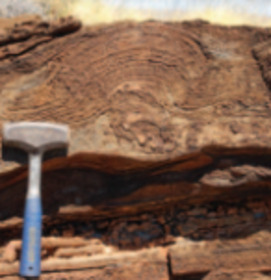
Stromatolites rank among the most productive ecosystems on Earth, with extremely high rates of element cycling, especially carbon, oxygen, nitrogen, iron, and sulfur. Their study provides critical insights into early microbial life evolution, environmental conditions, and associated biogeochemical cycling. Specifically, carbon, nitrogen, and sulfur isotopes can be used to assess metabolic activities of microbial communities, including those that may regulate the formation and preservation of modern and ancient stromatolites, such as photosynthesis, nitrogen fixation, and sulfate reduction. Moreover, while Precambrian stromatolites’ isotopic signals can record microbial communities that both influence and adapt to changing major redox conditions such as the Great Oxidation Event, local and secondary processes can open a window onto microbial evolution such as the early evolution of bacterial sulfate reduction.

This content is for Registered members only. To subscribe, please
join one of our participating societies or contact the Editorial Team.

Login
Already a member? Log in here

Exploring the Stable Isotope Record of Stromatolites Read More »

Biogeochemical Cycling of Nitrogen on the Early Earth

Variations in the nitrogen isotope composition of ancient organic matter and associated sediments provide clues for the early evolution of Earth’s atmosphere–ocean–biosphere system. In particular, large isotopic variations have been linked to the protracted oxygenation of Earth’s atmosphere during the Precambrian. Important problems being investigated include the nature of the variations observed at specifi c times in Earth’s history and the degree of preservation of ancient nitrogen biogeochemical signatures during diagenesis and metamorphism. Interpreting these records in Archean sedimentary environments and their possible implications for the evolution of Earth’s early atmosphere, ocean, and life is challenging.

This content is for Registered members only. To subscribe, please
join one of our participating societies or contact the Editorial Team.

Login
Already a member? Log in here

Biogeochemical Cycling of Nitrogen on the Early Earth Read More »

Scroll to Top

December 2025 --The Variscan Orogeny in Europe – Understanding Supercontinent Formation

The Variscan orogen formed between 380 and 300 million years ago through several accretionary and collisional cycles, culminating with the construction of the Pangea supercontinent. This process occurred via sequential opening and closure of oceanic basins, synchronous detachment of Gondwana derived continental ribbons, and their outboard amalgamation onto the Laurussia margin. The Variscan orogen is rather unique compared with other orogenic belts on Earth: its overthickened and dominantly magmatic crust in the central belt, surprisingly minor mantle involvement in the magmatic and geodynamic processes, coherent and pulsed magmatism along the collision suture, and its complex accretionary history. Because its final product, Pangea, is the youngest and best-understood supercontinent on Earth, the Variscan orogeny offers clues for understanding the mechanisms of supercontinent formation.