Thematic Articles

The Rosetta Mission and the Chemistry of Organic Species in Comet 67P/Churyumov-Gerasimenko

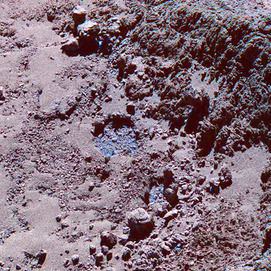
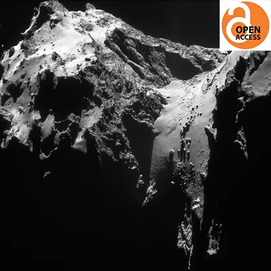
Comets are regarded as probably the most primitive of solar system objects, preserving a record of the materials from which the solar system aggregated. Key amongst their components are organic compounds – molecules that may trace their heritage to the interstellar medium from which the protosolar nebula eventually emerged. The most recent cometary space mission, Rosetta, carried instruments designed to characterize, in unprecedented detail, the organic species in comet 67P/Churyumov–Gerasimenko (67P). Rosetta was the first mission to match orbits with a comet and follow its evolution over time, and also the first mission to land scientific instruments on a comet surface. Results from the mission revealed a greater variety of molecules than previously identified and indicated that 67P contained both primitive and processed organic entities.

This content is for Registered members only. To subscribe, please
join one of our participating societies or contact the Editorial Team.

Login
Already a member? Log in here

The Rosetta Mission and the Chemistry of Organic Species in Comet 67P/Churyumov-Gerasimenko Read More »

Flyby Missions to Comets and Return Sample Analysis

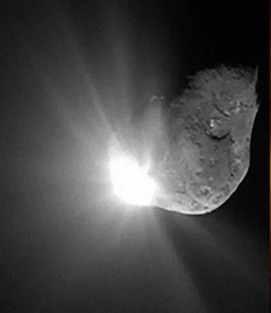
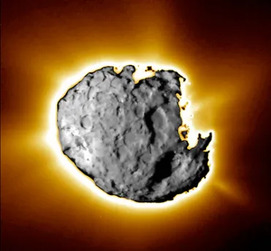
Images from flyby missions show comets to be geomorphically diverse bodies that spew jets of gas, dust, and rocks into space. Comet surfaces differ from other small bodies because of their ejection of mass into space. Comet solids >2 µm are similar to primitive meteorite ingredients and include the highest temperature materials made in the early solar system. The presence of these materials in ice-rich comets is strong evidence for large-scale migration of solid grains in the early solar system. Cometary silicates appear to have formed in numerous hot solar system regions. Preserved interstellar grains are rare, unless they have eluded identification by having solar isotopic compositions

This content is for Registered members only. To subscribe, please
join one of our participating societies or contact the Editorial Team.

Login
Already a member? Log in here

Flyby Missions to Comets and Return Sample Analysis Read More »

Comets: Where We Are, How We Got Here, and Where We Want To Go Next

We introduce the principal mysteries surrounding comets; discuss the proposed importance of comets to the origin of water and organic compounds in the inner solar system; and summarize the history of cometary observation, study, and exploration over the past 22 centuries.

This content is for Registered members only. To subscribe, please
join one of our participating societies or contact the Editorial Team.

Login
Already a member? Log in here

Comets: Where We Are, How We Got Here, and Where We Want To Go Next Read More »

Seeing Snails in a New Light

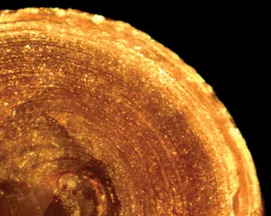
Luminescence is exhibited by many common minerals, some of which have been exploited for dating. Calcite has the potential to date events that occurred over millions of years, but a series of challenges has hindered its use in dating limestone building stones, speleothems, and mollusk shells. Now, however, promising results from calcite luminescence dating have been achieved from an unexpected source: the opercula grown by certain species of snail. Coupled with innovations in luminescence imaging systems, snail opercula offer an exciting new approach that may finally unlock calcite’s potential for dating.

This content is for Registered members only. To subscribe, please
join one of our participating societies or contact the Editorial Team.

Login
Already a member? Log in here

Seeing Snails in a New Light Read More »

Luminescence Thermochronometry: Investigating the Link between Mountain Erosion, Tectonics and Climate

Luminescence thermochronometry is a recently developed method that can constrain erosion histories at sub-Quaternary timescales. Luminescence thermochronometry determines the timing and rate at which electrons are trapped and thermally released in minerals, in response to in situ radiation and rock cooling. Erosion histories can be inferred by translating rock cooling rates into an erosion rate using knowledge of the Earth’s thermal field. In this article, we use examples of luminescence thermochronometry applied to the Himalaya mountains, the New Zealand Alps and the Japanese Alps to infer (and link together) wider aspects of regional erosion, climate and tectonic activity.

This content is for Registered members only. To subscribe, please
join one of our participating societies or contact the Editorial Team.

Login
Already a member? Log in here

Luminescence Thermochronometry: Investigating the Link between Mountain Erosion, Tectonics and Climate Read More »

Timelines for Human Evolution and Dispersals

Luminescence dating has been instrumental in constraining the age of archaeological and human skeletal remains. Thermoluminescence dating was applied originally to heated pottery and burnt flint, and optical dating was developed subsequently to estimate the depositional age of sun-bleached sediments associated with artefacts and fossils. These methods have helped establish numerical timelines for human evolution and dispersals over the last half million years, including the earliest evidence for modern humans in Africa, Asia and Australia, and the comings and goings of archaic humans in Eurasia and Indonesia. Here, we recount the major role that luminescence dating has played recently in enriching our understanding of global human history.

This content is for Registered members only. To subscribe, please
join one of our participating societies or contact the Editorial Team.

Login
Already a member? Log in here

Timelines for Human Evolution and Dispersals Read More »

Dates and Rates of Earth-Surface Processes Revealed using Luminescence Dating

Understanding rates and variability of Earth-surface processes is vital to assessing natural hazards, landscape response to climate change and addressing concerns related to food security and water supply. Surface processes affect the critical zone, where life interacts with the land surface, and are archived in sediment records. Luminescence dating provides an age estimate for sediment deposition and can provide dates to calculate rates and recurrence intervals of natural hazards and Earth-surface processes. This method has produced robust age estimates from a wide range of terrestrial, marine, tectonic, and archaeological settings. Importantly, luminescence dating covers an age range that spans the last several decades to the last several hundred thousand years, providing critical rates and dates for evaluating processes that are important to society.

This content is for Registered members only. To subscribe, please
join one of our participating societies or contact the Editorial Team.

Login
Already a member? Log in here

Dates and Rates of Earth-Surface Processes Revealed using Luminescence Dating Read More »

Innovative Dose Rate Determinations for Luminescence Dating

Luminescence dating relies on the fact that mineral grains (crystals) are exposed to sources of natural radiation, which causes charge to be stored in electron traps within the crystal lattice. The radiation dose rate from the grain’s local environment, which ideally should be homogeneous, is what is routinely measured for luminescence dating. However, there are often local, sub-millimetre, sources of radiation heterogeneity that adversely affect a desired luminescence age. For the past 15 years, researchers have been developing Monte Carlo simulations and computer software that can correct for these heterogeneities. These new computer modelling techniques, and concomitant advances in statistics, allow more accurate luminescence dates to be obtained and also allow researchers access to a wider range of samples for an even greater number of dating applications.

This content is for Registered members only. To subscribe, please
join one of our participating societies or contact the Editorial Team.

Login
Already a member? Log in here

Innovative Dose Rate Determinations for Luminescence Dating Read More »

Telling the Time with Dust, Sand and Rocks

Luminescence dating plays a major role in reconstructing environments of Earth’s recent geological history. Since its proposal in 1953, luminescence dating has developed into a versatile geochronological technique that can be applied to material up to 2 million years old. Luminescence dating has many novel applications because it can utilize the most ubiquitous minerals in the Earth’s crust (quartz and feldspar) to determine the timing of sediment burial or exposure. The technique can be applied to grain sizes from silt to boulder, and to sediments that occur in a wide range of settings, e.g. deserts, rivers, lakes, glaciers, caves. This issue discusses the latest technical developments of luminescence dating and the key scientific discoveries that it has facilitated over the last few decades.

This content is for Registered members only. To subscribe, please
join one of our participating societies or contact the Editorial Team.

Login
Already a member? Log in here

Telling the Time with Dust, Sand and Rocks Read More »

Layered Mafic–Ultramafic Intrusions of Fennoscandia: Europe’s Treasure Chest of Magmatic Metal Deposits

Northeastern Fennoscandia hosts a rich diversity of mafic–ultramafic intrusions of variable shape and size, emplaced in different tectonic regimes over a period spanning ~600 million years (between 1.88 Ga and 2.5 Ga). Several of the bodies contain world-class ore deposits, notably the Kemi chromium deposit and the Pechenga nickel deposits. Other deposits include nickel and copper at Kevitsa, Kotalahti and Sakatti; vanadium at Koillismaa; and platinum-group elements at Portimo and Penikat. These deposits constitute important resources that could shield Europe from potential future supply shortages of these key industrial metals.

This content is for Registered members only. To subscribe, please
join one of our participating societies or contact the Editorial Team.

Login
Already a member? Log in here

Layered Mafic–Ultramafic Intrusions of Fennoscandia: Europe’s Treasure Chest of Magmatic Metal Deposits Read More »

Scroll to Top

December 2025 --The Variscan Orogeny in Europe – Understanding Supercontinent Formation

The Variscan orogen formed between 380 and 300 million years ago through several accretionary and collisional cycles, culminating with the construction of the Pangea supercontinent. This process occurred via sequential opening and closure of oceanic basins, synchronous detachment of Gondwana derived continental ribbons, and their outboard amalgamation onto the Laurussia margin. The Variscan orogen is rather unique compared with other orogenic belts on Earth: its overthickened and dominantly magmatic crust in the central belt, surprisingly minor mantle involvement in the magmatic and geodynamic processes, coherent and pulsed magmatism along the collision suture, and its complex accretionary history. Because its final product, Pangea, is the youngest and best-understood supercontinent on Earth, the Variscan orogeny offers clues for understanding the mechanisms of supercontinent formation.