
Thematic Articles

High-Volume Magmatic Events in Subduction Systems

The world’s biggest Phanerozoic magmatic arcs formed above subduction zones and comprise the products of continuous magma emplacement into the crust over periods of up to 500 My. However, the intensity of magmatic activity can vary significantly. Punctuated magmatic events lasting from 5 to 20 My can dwarf the volume of magmas generated through the remainder of an arc’s history: these high-volume events are called “fl areups” and can completely rebuild an arc’s crust. In arcs formed on continental lithosphere, fl are-ups typically correlate with regional structural events that shorten and/or thicken the crust. Geochemical and isotopic signatures show that these high magmatic addition rate events involve ~50% recycled upperplate crust and mantle lithosphere; the remaining ~50% comes from the mantle wedge.

This content is for Registered members only. To subscribe, please
join one of our participating societies or contact the Editorial Team.

Login
Already a member? Log in here

High-Volume Magmatic Events in Subduction Systems Read More »
Arc Magmatic Tempos: Gathering the Evidence

In this issue of Elements we explore the characteristics, potential causes, and implications of episodic magmatism in arcs. A comparison of U–Pb bedrock and detrital zircon ages in arcs with independent calculations of volumetric magma addition rates (MARs) indicates that the former nicely track the episodic temporal histories of arc magmatism but not MARs. MAR estimates indicate that 100–1000 times more magmatism is added to continental arcs during fl are-ups than during lulls and result in plutonic/volcanic ratios of >30/1. Episodic arc magmatism may result from external forcing on arc systems caused by events outside the arc and/or from internal cyclic processes driven by feedback between linked tectonic and magmatic processes within the arc. Along and across arc strike, changes and asymmetries in magmatic, tectonic, and geochemical histories provide important constraints for evaluating these poorly understood driving mechanisms.

This content is for Registered members only. To subscribe, please
join one of our participating societies or contact the Editorial Team.

Login
Already a member? Log in here

Arc Magmatic Tempos: Gathering the Evidence Read More »

Volatile and Isotopic Imprints of Ancient Mars

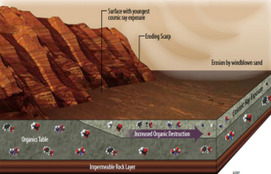
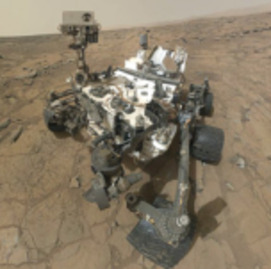
The science investigations enabled by Curiosity rover’s instruments focus on identifying and exploring the habitability of the Martian environment. Measurements of noble gases, organic and inorganic compounds, and the isotopes of light elements permit the study of the physical and chemical processes that have transformed Mars throughout its history. Samples of the atmosphere, volatiles released from soils, and rocks from the floor of Gale Crater have provided a wealth of new data and a window into conditions on ancient Mars.

This content is for Registered members only. To subscribe, please
join one of our participating societies or contact the Editorial Team.

Login
Already a member? Log in here

Volatile and Isotopic Imprints of Ancient Mars Read More »

Determining Mineralogy on Mars with the CheMin X-Ray Diffractometer

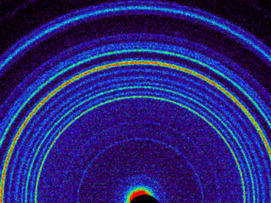
The rover Curiosity is conducting X-ray diffraction experiments on the surface of Mars using the CheMin instrument. The analyses enable identification of the major and minor minerals, providing insight into the conditions under which the samples were formed or altered and, in turn, into past habitable environments on Mars. The CheMin instrument was developed over a twenty-year period, mainly through the efforts of scientists and engineers from NASA and DOE. Results from the first four experiments, at the Rocknest, John Klein, Cumberland, and Windjana sites, have been received and interpreted. The observed mineral assemblages are consistent with an environment hospitable to Earth-like life, if it existed on Mars.

This content is for Registered members only. To subscribe, please
join one of our participating societies or contact the Editorial Team.

Login
Already a member? Log in here

Determining Mineralogy on Mars with the CheMin X-Ray Diffractometer Read More »

In Situ Compositional Measurements of Rocks and Soils with the Alpha Particle X-ray Spectrometer on NASA’s Mars Rovers

The Alpha Particle X-ray Spectrometer (APXS) is a soda can–sized, arm-mounted instrument that measures the chemical composition of rocks and soils using X-ray spectroscopy. It has been part of the science payload of the four rovers that NASA has landed on Mars. It uses 244Cm sources for a combination of PIXE and XRF to quantify 16 elements. So far, about 700 Martian samples from about 50 km of combined traverses at the four landing sites have been documented. The compositions encountered range from unaltered basaltic rocks and extensive salty sandstones to nearly pure hydrated ferric sulfates and silica-rich subsurface soils. The APXS is used for geochemical reconnaissance, identification of rock and soil types, and sample triage. It provides crucial constraints for use with the mineralogical instruments. The APXS data set allows the four landing sites to be compared with each other and with Martian meteorites, and it provides ground truth measurements for comparison with orbital observations.

This content is for Registered members only. To subscribe, please
join one of our participating societies or contact the Editorial Team.

Login
Already a member? Log in here

In Situ Compositional Measurements of Rocks and Soils with the Alpha Particle X-ray Spectrometer on NASA’s Mars Rovers Read More »

ChemCam: Chemostratigraphy by the First Mars Microprobe

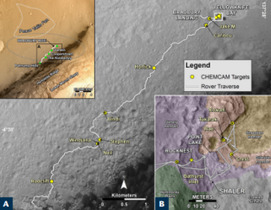
The ChemCam laser-induced breakdown spectrometer on the rover Curiosity has provided more than 200,000 spectra from over 5000 different locations on Mars. This instrument is the first chemical microprobe on Mars and has an analytical footprint 0.3–0.6 mm in diameter. ChemCam has observed a measure of hydration in all the sedimentary materials encountered along the rover traverse in Gale Crater, indicating the ubiquity of phyllosilicates as a constituent of the analyzed sandstones, mudstones, and conglomerates. Diagenetic features, including calcium sulfate veins, millimeter-thick magnesium-rich diagenetic ridges, and manganese-rich rock surfaces, provide clues to water–rock interactions. Float clasts of coarsegrained igneous rocks are rich in alkali feldspars and some are enriched in fluorine, indicating greater magmatic evolution than expected on Mars. The identification of individual soil components has contributed to our understanding of the evolution of Martian soil. These observations have broadened our understanding of Mars as an active and once habitable planet.

This content is for Registered members only. To subscribe, please
join one of our participating societies or contact the Editorial Team.

Login
Already a member? Log in here

ChemCam: Chemostratigraphy by the First Mars Microprobe Read More »

Images from Curiosity: A New Look at Mars

The surface of Mars has been sculpted by flowing water and shaped by wind. During the first two years of its exploration of Gale Crater, the Mars Science Laboratory mission’s Curiosity rover has recorded abundant geologic evidence that water once existed on Mars both within the subsurface and, as least episodically, flowed on the land surface. And now, as Curiosity presses onward toward Mount Sharp, the complexity of the Martian surface is becoming increasingly apparent. In this paper, we review the nature of the surface materials and their stories, as seen through the eyes of Curiosity.

This content is for Registered members only. To subscribe, please
join one of our participating societies or contact the Editorial Team.

Login
Already a member? Log in here

Images from Curiosity: A New Look at Mars Read More »

Curiosity’s Mission of Exploration at Gale Crater, Mars

Landed missions to the surface of Mars have long sought to determine the material properties of rocks and soils encountered during the course of surface exploration. Increasingly, emphasis is placed on the study of materials formed or altered in the presence of liquid water. Placed in the context of their geological environment, these materials are then used to help evaluate ancient habitability. The Mars Science Laboratory mission—with its Curiosity rover—seeks to establish the availability of elements that may have fueled microbial metabolism, including carbon, hydrogen, sulfur, nitrogen, phosphorus, and a host of others at the trace element level. These measurements are most valuable when placed in a geological framework of ancient environments as interpreted from mapping, combined with an understanding of the petrogenesis of the igneous rocks and derived sedimentary materials. In turn, the analysis of solid materials and the reconstruction of ancient environments provide the basis to assess past habitability.

This content is for Registered members only. To subscribe, please
join one of our participating societies or contact the Editorial Team.

Login
Already a member? Log in here

Curiosity’s Mission of Exploration at Gale Crater, Mars Read More »

Carbon-Based Nanoscience

Fullerenes, carbon nanotubes, and graphene are nanometer-sized forms of carbon with the properties of almost ideal low-dimensional systems. These systems have been at the center of exceptionally intense scientific interest. They have been considered not only as objects of fundamental research but also as components in a wide range of possible applications. In popular science, their names are synonymous with nanotechnology.

This content is for Registered members only. To subscribe, please
join one of our participating societies or contact the Editorial Team.

Login
Already a member? Log in here

Carbon-Based Nanoscience Read More »

Presolar Graphitic Carbon Spherules: Rocks from Stars

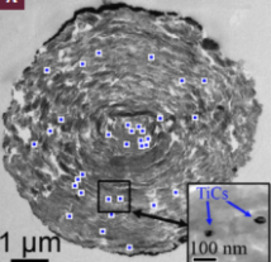
Graphitic carbon spherules found in primitive meteorites have large carbon isotope anomalies, indicating that they are carbonaceous stardust (also known as presolar grains) expelled from dying stars prior to the formation of the Sun. Presolar spherules show varying degrees of graphitization, ranging from poorly graphitic, turbostratic layers in low-density spherules to well-crystallized graphitic outer shells in high-density ones, and some spherules also contain a polycrystalline phase in their core. Within the spherules, grains of other refractory phases (including carbides and metals) are common, and these assemblages can be studied as one would study a rock. The isotopic and microstructural information available from these presolar graphitic assemblages gives insights into nucleosynthesis and grain condensation in late-stage carbon-rich stars.

This content is for Registered members only. To subscribe, please
join one of our participating societies or contact the Editorial Team.

Login
Already a member? Log in here

Presolar Graphitic Carbon Spherules: Rocks from Stars Read More »

Scroll to Top

December 2025 --The Variscan Orogeny in Europe – Understanding Supercontinent Formation

The Variscan orogen formed between 380 and 300 million years ago through several accretionary and collisional cycles, culminating with the construction of the Pangea supercontinent. This process occurred via sequential opening and closure of oceanic basins, synchronous detachment of Gondwana derived continental ribbons, and their outboard amalgamation onto the Laurussia margin. The Variscan orogen is rather unique compared with other orogenic belts on Earth: its overthickened and dominantly magmatic crust in the central belt, surprisingly minor mantle involvement in the magmatic and geodynamic processes, coherent and pulsed magmatism along the collision suture, and its complex accretionary history. Because its final product, Pangea, is the youngest and best-understood supercontinent on Earth, the Variscan orogeny offers clues for understanding the mechanisms of supercontinent formation.