Thematic Articles

Interactions of Kaolin Minerals in the Environment

The interactions of ions, organics, and microorganisms at the aqueous interface with kaolin-group minerals control many important geochemical processes in the environment. Kaolinite has both hydrophilic and relatively hydrophobic external surfaces that exhibit different adsorption phenomena. Our understanding of kaolin minerals in the environment is advancing as a result of molecular simulation and field studies. Molecular dynamics simulations reveal the structure and behavior of adsorbed ions and water molecules at the interface. The presence of microorganisms affects the formation and surfaces of kaolinite and halloysite. Mechanisms by which kaolin-group minerals complex, adsorb, and desorb radioactive pollutants in the subsurface can be understood by combining theory with observation.

This content is for Registered members only. To subscribe, please
join one of our participating societies or contact the Editorial Team.

Login
Already a member? Log in here

Interactions of Kaolin Minerals in the Environment Read More »
Mining and Processing Kaolin

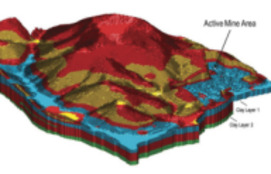
Kaolin is used in many consumer products and as a functional additive and process enabler in manufacturing. It is typically extracted from open-pit mines that range from small to very large scale (tens to hundreds of thousands of dry metric tons produced per year). Ore processing consists of removing impurities, engineering particle size and shape, and enhancing certain properties through thermal and chemical treatment. In addition to the technical aspects of mining and processing, the social, environmental, and economic impacts of kaolin production are managed at each stage of the mining life cycle. Discussed herein are aspects of the history of kaolin mining, the classification of kaolin mines, the processing of kaolin, and the life cycle of mining.

This content is for Registered members only. To subscribe, please
join one of our participating societies or contact the Editorial Team.

Login
Already a member? Log in here

Mining and Processing Kaolin Read More »

Kaolin-Group Minerals: From Hydrogen-Bonded Layers to Environmental Recorders

Kaolin-group minerals typically form as a result of hydrothermal alteration and/or weathering processes. They occur in environments as diverse as tropical soils, continental sedimentary deposits, and altered crustal rocks. They have also been detected on the surface of Mars. Given their prevalence, they have attracted the attention of researchers in materials chemistry, environmental geochemistry, and high-pressure mineral physics. Their structure and related properties have been studied for about a century, and these studies reflect advances in experimental techniques, modeling approaches, and concepts in mineralogy. Among key features of their structure are the predominance of 2-D stacking defects and the peculiar role of H-bonding in the control of their polytypism.

This content is for Registered members only. To subscribe, please
join one of our participating societies or contact the Editorial Team.

Login
Already a member? Log in here

Kaolin-Group Minerals: From Hydrogen-Bonded Layers to Environmental Recorders Read More »

Kaolin: From Ancient Porcelains to Nanocomposites

Kaolin has played a prominent role in both Earth and human cultural history, and will continue to do so into the foreseeable future. Its abundance in the rock record has varied according to the waxing and waning of life faunal radiations, crustal differentiation, and climatic conditions. Kaolin-group minerals play an important environmental role in soils of tropical and temperate regions. They also occur in hydrothermal zones, where they form at the expense of felsic rocks through acid hydrolysis, and commonly in episodic geologic events. Kaolin deposits form the basis of many modern materials, but the first sophisticated human use was in porcelains from Jingdezhen, China. From the initial discovery of kaolin and its sculptural use 2000 years ago to today’s modern applications in nanocomposites, kaolin has been important throughout cultural history. Art and science are intertwined by the properties and uses of this amazingly small clay mineral.

This content is for Registered members only. To subscribe, please
join one of our participating societies or contact the Editorial Team.

Login
Already a member? Log in here

Kaolin: From Ancient Porcelains to Nanocomposites Read More »

Diamonds in Ophiolites

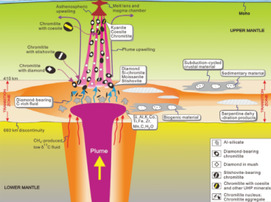
Ophiolites are a newly documented host of diamonds on Earth. Abundant diamonds have indeed been separated from peridotites and chromitites of ophiolites in China, Myanmar, and Russia. In addition, diamond grains have recently been discovered in chromite from the Cretaceous Luobusa ophiolite (Tibet) and the early Paleozoic Ray-Iz ophiolite (polar Urals, Russia). These diamonds are accompanied by a wide range of highly reduced minerals, such as Ni–Mn–Co alloys, Fe–Si and Fe–C phases, and moissanite (SiC); these have been found as either mineral separates or inclusions in diamonds and indicate growth under superreducing conditions. The diamond-bearing chromite grains likely formed near the mantle transition zone and were then brought to shallow levels in the upper mantle to form podiform chromitites in oceanic lithosphere. Because these diamond grains occur widely in peridotites and chromitites of many ophiolites, we refer to them as ophiolite-hosted diamonds. It is possible that such diamonds may be common in the upper oceanic mantle.

This content is for Registered members only. To subscribe, please
join one of our participating societies or contact the Editorial Team.

Login
Already a member? Log in here

Diamonds in Ophiolites Read More »

Deep Biosphere Record of In Situ Oceanic Lithosphere and Ophiolites

Volcanic glass from pillow lavas and hyaloclastites displays distinctive alteration textures that suggest the activity of boring microbes. Analogous textures are common in volcanic sections of the seafloor, in ophiolites, and in greenstone belts up to 3.5 Ga in age. While the origin of such trace fossils remains poorly understood, they offer much potential for investigating processes in the present-day, deep-ocean, crustal biosphere and their role in biogeochemical cycles.

This content is for Registered members only. To subscribe, please
join one of our participating societies or contact the Editorial Team.

Login
Already a member? Log in here

Deep Biosphere Record of In Situ Oceanic Lithosphere and Ophiolites Read More »

Izu-Bonin-Mariana Forearc Crust as a Modern Ophiolite Analogue

Recent geological and geophysical surveys in the Izu-Bonin-Mariana forearc have revealed the occurrence on the seafl oor of oceanic crust generated in the initial stages of subduction and the earliest stage of island arc formation. The earliest magmatism after subduction initiation generated forearc basalts, and subsequently, boninitic and tholeiitic to calc-alkaline lavas were produced. Collectively, these rocks make up the extrusive sequence of the Izu-Bonin-Mariana forearc oceanic crust. This volcanic stratigraphy and its time-progressive development are analogous to those documented from many suprasubduction zone ophiolites. Most suprasubduction zone ophiolites may be on-land fragments of forearc oceanic crust, produced during the initiation of subduction and the early stages of island arc development.

This content is for Registered members only. To subscribe, please
join one of our participating societies or contact the Editorial Team.

Login
Already a member? Log in here

Izu-Bonin-Mariana Forearc Crust as a Modern Ophiolite Analogue Read More »

Records of Ocean Growth and Destruction in the Oman–UAE Ophiolite

The Oman–UAE ophiolite is the largest piece of oceanic crust exposed on land, yet debate continues about its origin. It has been variously considered as an ideal analogue for a fast-spreading mid-ocean ridge and as a typical suprasubduction zone ophiolite. A resolution to this conundrum comes from the recognition of at least two different phases of magmatism, with the second phase being most voluminous in the northern blocks of the ophiolite. The first phase was formed at an oceanic spreading centre; petrological and geochemical evidence clearly shows that the second phase was formed above a subduction zone.

This content is for Registered members only. To subscribe, please
join one of our participating societies or contact the Editorial Team.

Login
Already a member? Log in here

Records of Ocean Growth and Destruction in the Oman–UAE Ophiolite Read More »

Immobile Element Fingerprinting of Ophiolites

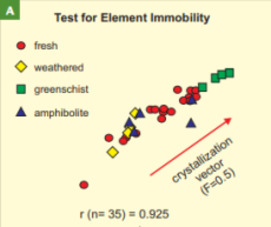
Much of our understanding of ocean ridges has come from the collection and analysis of glasses recovered from ridge axes. However, applying the resulting methodologies to ophiolite complexes is not straightforward because ophiolites typically experience intense alteration during their passage from ridge to subduction zone to mountain belt. Instead, immobile element proxies for fractionation indices, alkalinity, mantle temperature, mantle flow and subduction addition may be used to classify ophiolite lavas and fingerprint the precise setting of the ridge at which an ophiolite formed. The results can help us recognise and interpret past spreading centres and so make plate tectonic reconstructions.

This content is for Registered members only. To subscribe, please
join one of our participating societies or contact the Editorial Team.

Login
Already a member? Log in here

Immobile Element Fingerprinting of Ophiolites Read More »

Ophiolites and Their Origins

Ophiolites are suites of temporally and spatially associated ultramafic, mafic, and felsic rocks that are interpreted to be remnants of ancient oceanic crust and upper mantle. Ophiolites show significant variations in their internal structure, geochemical fingerprints, and emplacement mechanisms. These differences are controlled by (1) the proximity, when formed at the magmatic stage, to a plume or trench; (2) the rate, geometry, and nature of ocean-ridge spreading; (3) mantle composition, temperature, and fertility; and (4) the availability of fluids. The oceanic crust preserved in ophiolites may form in any tectonic setting during the evolution of ocean basins, from the rift–drift and seafloor spreading stages to subduction initiation and terminal closure. An ophiolite is emplaced either from downgoing oceanic lithosphere via subduction-accretion or from the upper plate in a subduction zone through trench–continent collision. Subduction zone tectonics is thus the most important factor in the igneous evolution of ophiolites and their emplacement into continental margins.

This content is for Registered members only. To subscribe, please
join one of our participating societies or contact the Editorial Team.

Login
Already a member? Log in here

Ophiolites and Their Origins Read More »

Scroll to Top

December 2025 --The Variscan Orogeny in Europe – Understanding Supercontinent Formation

The Variscan orogen formed between 380 and 300 million years ago through several accretionary and collisional cycles, culminating with the construction of the Pangea supercontinent. This process occurred via sequential opening and closure of oceanic basins, synchronous detachment of Gondwana derived continental ribbons, and their outboard amalgamation onto the Laurussia margin. The Variscan orogen is rather unique compared with other orogenic belts on Earth: its overthickened and dominantly magmatic crust in the central belt, surprisingly minor mantle involvement in the magmatic and geodynamic processes, coherent and pulsed magmatism along the collision suture, and its complex accretionary history. Because its final product, Pangea, is the youngest and best-understood supercontinent on Earth, the Variscan orogeny offers clues for understanding the mechanisms of supercontinent formation.